
Crypto DAO: Building a Financial System That Cannot Do Evil Through On-Chain Governance


Crypto DAO: Building a “Financial System That Cannot Do Evil” Through On-Chain Governance.
Crypto DAO Secures DeFi Future
As decentralized finance (DeFi) evolves, the industry enters a new phase—one focused not just on rapid experimentation, but also on governance, security, and long-term sustainability. In this context, Crypto DAO emerges as a next-generation decentralized financial system, tackling some of DeFi’s most persistent structural challenges.

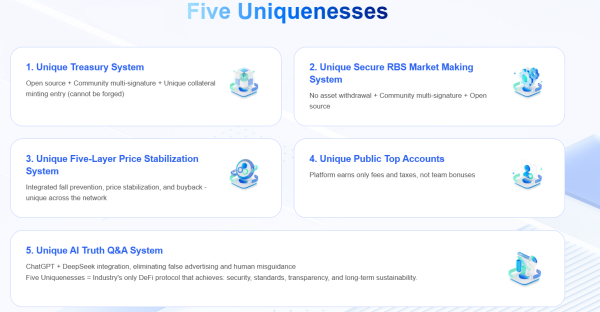
Built as an open-source, community-driven, fully on-chain protocol, Crypto DAO revolves around three core principles: Security, Stability, and Sustainability. Unlike many existing systems that rely on human-led governance, opaque decision-making, or centralized control, Crypto DAO rejects these approaches. Its long-term goal is to create a “financial system that cannot do evil,” where rules and behavior are permanently encoded on the blockchain.
Rethinking Governance in DeFi
Governance remains one of DeFi’s most debated topics. While decentralization is often a core principle, many protocols still depend on core teams, privileged administrators, or informal off-chain coordination. These structures, though flexible, often fall prey to conflicts of interest, manipulation, and unexpected intervention.
Crypto DAO takes a different approach. It minimizes human discretion in critical decision-making. Governance logic sits directly in immutable smart contracts. Once deployed, these contracts execute predefined rules that no one can alter arbitrarily.
This approach reflects a growing belief that carefully designed, transparently audited code-based governance can outperform traditional structures in fairness, predictability, and resistance to corruption.
Open Source as a Structural Requirement
Crypto DAO fully commits to open-source development. All core components, governance logic, and security mechanisms are publicly available for review and contribution.
This openness allows developers and security researchers to audit the system, reducing the risk of hidden vulnerabilities. It ensures no single entity controls the protocol. Open-source development also aligns with the ethos of decentralized systems, where trust comes from transparency, not authority.
By making its framework public, Crypto DAO positions itself as evolving public infrastructure for decentralized finance.
Community Multi-Signature Architecture
While Crypto DAO eliminates daily human governance, it addresses security and risk management during early development and system upgrades.
The protocol uses a community-based multi-signature system. Unlike traditional wallets controlled by a few insiders, Crypto DAO distributes multi-signature authority across many verified community participants.
Participants follow transparent criteria and are bound by on-chain rules. Their authority is limited to emergencies or protocol migrations. Actions require collective approval and on-chain verification. This design balances decentralization with operational safety.
On-Chain Mechanisms Over Off-Chain Promises
DeFi often struggles with gaps between promises and actual enforcement. Many projects rely on off-chain agreements or social consensus that are hard to verify.
Crypto DAO enforces all critical mechanisms on-chain. Asset management, incentive distribution, and risk controls run automatically through smart contracts. By removing off-chain reliance, Crypto DAO ensures outcomes depend on code, not interpretation. This supports “trust minimization,” a core blockchain principle.
Security as a Core Principle
Many DeFi projects treat security as an afterthought. Crypto DAO makes security central to its architecture.
The protocol keeps designs simple to reduce vulnerabilities. Smart contracts are modular, so components can be independently tested and reviewed. Formal verification and continuous audits form part of development.
Crypto DAO avoids centralized oracles and opaque dependencies, which often introduce systemic risk. Where external data is needed, the protocol uses decentralized verification. This proactive security builds long-term trust in the system.
Stability Beyond Short-Term Incentives
DeFi protocols often face volatility in assets and behavior. Many rely on short-term incentives that attract liquidity temporarily but leave systems fragile.
Crypto DAO prioritizes stability over fast growth. Its economic mechanisms discourage speculative actions. Instead of aggressive token emissions or complex yields, it emphasizes predictable, rule-based interactions. Stability here does not mean stagnation—it ensures sustainable, disciplined growth.
Sustainability as a Systemic Goal
Crypto DAO views sustainability broadly. It aims to operate autonomously over long periods without constant intervention. By reducing human dependency, it lowers governance fatigue and avoids governance capture. Automated mechanisms allow the system to function as participants come and go.
This long-term approach sets Crypto DAO apart from projects chasing rapid adoption metrics over durability.
Rejecting Centralization and Black Boxes
Crypto DAO explicitly rejects centralized control and opaque systems. Users no longer have to trust intermediaries with hidden processes.
Every rule, transaction, and governance action is on-chain and public. No privileged interfaces, hidden algorithms, or secret decisions exist. This transparency empowers participants to verify the system independently.
Toward an Anti-Manipulation Financial System
Market manipulation remains a significant concern in both traditional and decentralized finance. While no system can eliminate manipulation entirely, Crypto DAO is designed to be structurally resistant to common forms of abuse.
By limiting discretionary control, enforcing rules through code, and distributing authority across a broad network of participants, the protocol reduces the effectiveness of coordinated attacks. On-chain monitoring and automated responses further enhance resilience.
The result is not a system that claims perfection, but one that acknowledges risk and addresses it at the architectural level rather than through reactive measures.
A New Direction for DeFi Infrastructure
Crypto DAO does not position itself as a replacement for existing financial systems overnight. Instead, it represents a directional shift in how decentralized financial infrastructure can be designed.
Its emphasis on immutability, transparency, and automation reflects a growing recognition that the future of DeFi may depend less on charismatic leadership or rapid innovation cycles, and more on institutional-grade reliability encoded directly into protocols.
As regulators, developers, and users alike seek greater clarity and accountability in decentralized systems, models like Crypto DAO offer a potential blueprint for the next stage of industry maturation.
Crypto DAO Promotes Sustainable DeFi
In an ecosystem often defined by rapid change and experimentation, Crypto DAO stands out for its deliberate, principle-driven approach. By centering its design on Security, Stability, and Sustainability—and by rejecting human governance, centralized control, and opaque mechanisms—the project articulates a clear vision of what decentralized finance could become.
Whether Crypto DAO ultimately achieves its ambition of creating a “financial system that cannot do evil” remains to be seen. However, its architecture and philosophy contribute meaningfully to ongoing discussions about trust, governance, and responsibility in blockchain-based systems.
As DeFi continues to evolve, initiatives like Crypto DAO highlight an important truth: the most transformative innovations may not be those that move fastest, but those that are built to last.
Company Details
Organization: Crypto DAO
Contact Person: Sam kirs
Website: https://cryptodao.it.com
Email: Send Email
Country: United States
Release Id: 17122539159