
AI Product Designer Rita Ling Recognized for Leading AI-Native Product Redesign


As artificial intelligence becomes increasingly integrated into everyday software, product designers face a new challenge: translating complex machine learning systems into intuitive and trustworthy user experiences. Unlike traditional applications, AI-driven products must support dynamic workflows, uncertain outputs, and evolving model capabilities—making the design of these systems significantly more complex.
Within this emerging area of AI-native product design, designers who can bridge the gap between advanced AI infrastructure and real-world usability are becoming increasingly valuable.
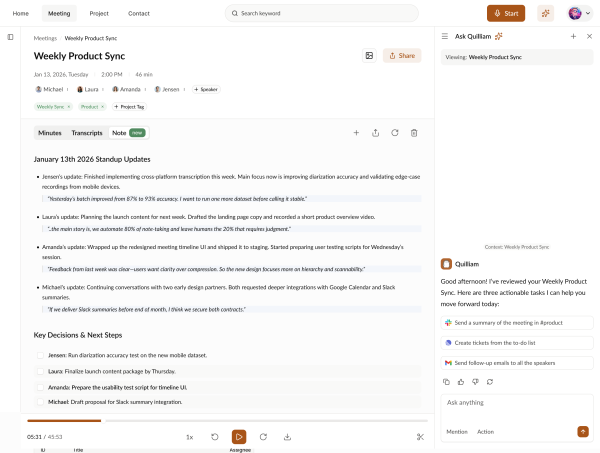
One example of this work can be seen in the redesign of Quill Meetings, an AI productivity platform developed by Quill Notes, Inc. The redesign effort was led by product designer Rita (Ziyuan) Ling, whose work focused on rethinking how users interact with AI-powered tools while building the design infrastructure needed for the product’s long-term scalability.
Leading the Redesign of an AI-Native Platform
Quill Meetings was initially launched as an AI-powered meeting and note-taking tool. As the company expanded its vision toward building a broader “AI Chief of Staff” platform designed to automate knowledge workflows, the existing product experience required a significant transformation.
Product designer Rita Ling played a central role in this transformation, leading the effort to rethink how users interact with AI-powered productivity tools. Upon joining the company, Ling conducted a comprehensive audit of the platform’s existing interface and interaction models, identifying limitations that would hinder the product’s ability to scale as AI capabilities evolved.
Based on this analysis, Ling directed a full redesign of the desktop application. Her work included redefining the product’s visual identity, restructuring the interface architecture, and introducing a more cohesive design language aligned with the company’s privacy-first AI strategy.
Industry observers note that redesigning AI-native software presents unique challenges compared with conventional applications. AI systems must accommodate uncertain outputs, adaptive workflows, and human-AI collaboration patterns that traditional design frameworks were never built to support. Ling’s work addressed these challenges directly by creating a product experience that made advanced AI capabilities understandable and approachable for users.
Building the Design Infrastructure for AI Systems
One of Ling’s most influential contributions to the Quill Meetings platform was the creation of the company’s first comprehensive design system and component library.
In AI-driven applications, rapid iteration is common as new model capabilities and product features are introduced. Without a scalable design framework, maintaining consistency across the product becomes increasingly difficult.
To address this challenge, Ling developed a comprehensive design system that standardized interface components, visual styles, and interaction behaviors across the platform. This infrastructure allowed engineers and designers to collaborate more efficiently and accelerated the development of new product features.
Industry observers increasingly recognize the importance of such infrastructure in AI-native software, where scalable design systems play a critical role in enabling teams to rapidly translate evolving AI capabilities into stable user-facing products.
Defining Human–AI Interaction Patterns
Another key achievement of Ling’s work involved defining how users interact with intelligent systems.
Traditional software relies on predictable workflows, but AI-powered tools require interfaces that allow users to delegate tasks, review generated outputs, and collaborate with automated agents.
Ling played a key role in designing these interaction models within Quill Meetings. Her work focused on structuring how users initiate AI tasks, interpret AI-generated information, and integrate AI assistance into everyday productivity workflows.
By developing clear interaction flows for AI-assisted note-taking, task automation, and knowledge management, she helped translate complex machine learning capabilities into a user-friendly product experience.
Integrating AI Tools into the Product Design Process
The redesign process also reflected a broader shift in how AI products are built.
Ling also contributed to the evolution of the product design process itself. During the redesign, she introduced new workflows that integrated AI-assisted prototyping tools into the design and development cycle.
Using these tools, the design team was able to simulate AI interaction patterns, test edge-case scenarios, and rapidly iterate on product concepts before committing to full engineering implementation.
This approach allowed designers and engineers to iterate more quickly on AI interaction models before committing to full engineering implementation.
As AI-native product development continues to evolve, many technology teams are beginning to explore similar approaches that combine design systems, AI-assisted prototyping, and cross-disciplinary collaboration.
Scaling the Platform Across Devices
Following the redesign of the desktop application, Ling’s work also contributed to the expansion of the Quill Meetings platform to mobile and enterprise environments. Her design frameworks helped ensure that AI interaction patterns remain consistent across different product surfaces.
Today, Quill Meetings is available through both the Apple App Store and the Microsoft Store, with a growing global user base of tens of thousands of users spanning all seven continents. These milestones reflect the platform’s increasing adoption among professionals seeking AI-powered productivity tools capable of managing conversations, meetings, and knowledge workflows.
A Growing Field: AI-Native Product Design
As artificial intelligence becomes embedded in more consumer and enterprise software, the role of designers in shaping how humans interact with AI systems is rapidly expanding.
Industry leaders increasingly emphasize that successful AI products require not only strong machine learning capabilities but also thoughtful interface design that makes those capabilities accessible and trustworthy for users.
Through her work on the redesign of Quill Meetings, Rita Ling has emerged as a designer contributing to this evolving field, demonstrating how scalable design systems, human-AI interaction models, and strategic product design can bring advanced AI technologies into everyday professional tools.
Her work on the Quill Meetings platform illustrates the growing importance of designers who can bridge the gap between sophisticated artificial intelligence infrastructure and real-world usability—an area that is becoming increasingly critical as AI applications expand across industries.
Company Details
Organization: Quill Notes, Inc
Contact Person: Michael Daugherty
Website: https://www.quillmeetings.com/
Email: Send Email
Country: United States
Release Id: 26032642958