
Common App Launch Press Release Mistakes That Stop Media Coverage

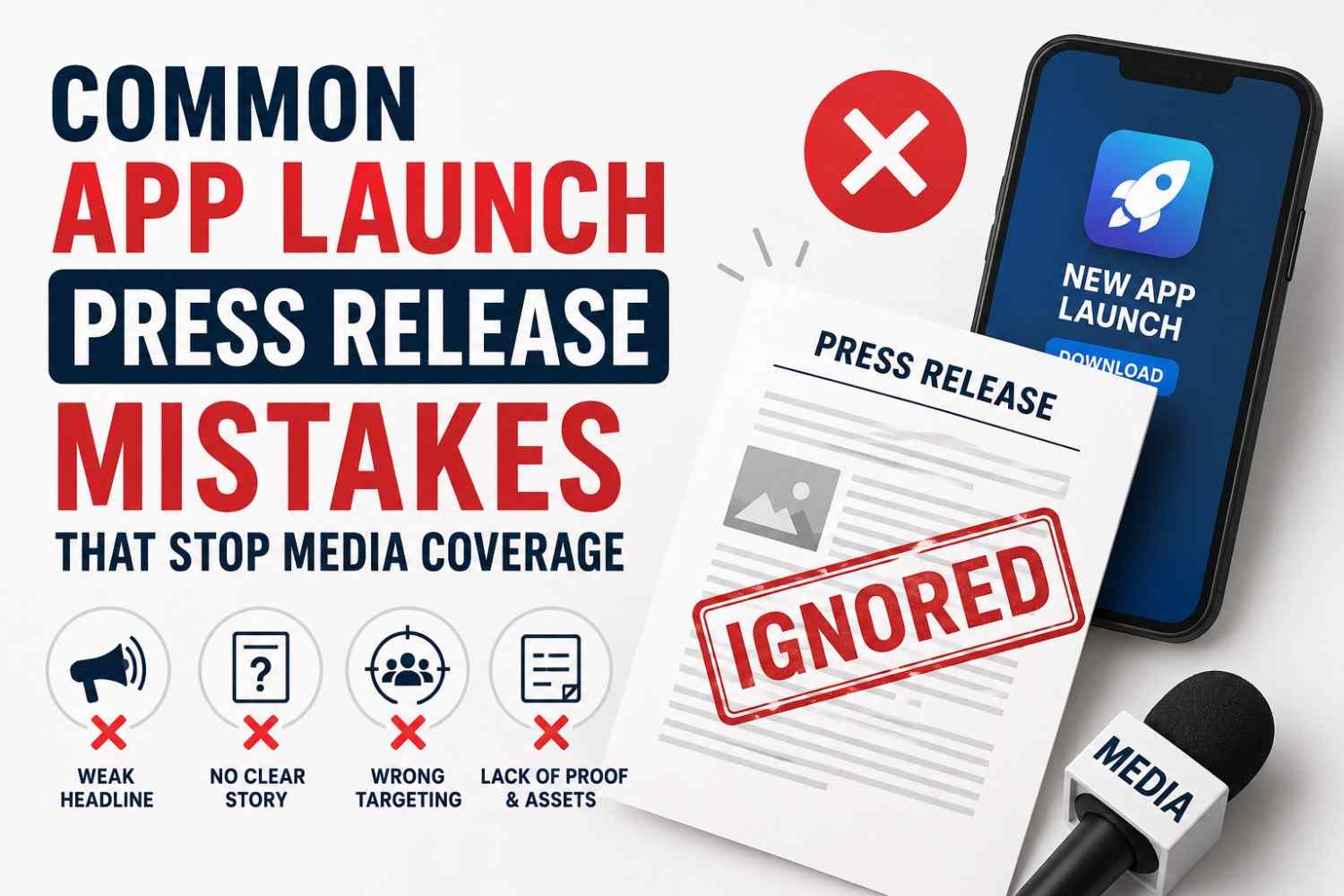
Common App Launch Press Release Mistakes That Stop Media Coverage
Author: King Newswire Editorial Team
Expertise: App Launch PR, Press Release Writing, Media Distribution, and Digital Visibility
Experience: 10+ Years | 5,000+ Brands Served Globally
Published: June 2026
Last Updated: June 2026
Reviewed By: King Newswire Senior PR Editor | Fact-checked for accuracy and completeness
Most startups write an app launch press release and hope to get immediate media attention. Nonetheless, journalists do not report on all the app announcements they receive. It does not necessarily have to be the app. It is often the issue of poor writing, lack of evidence, untimely or incorrect media list.
These errors in press releases when launching an app could prevent coverage before a journalist has even read the entire release. In 2026, this is even more important as the app market is saturated. Sensor Tower announced that downloads of iOS and Google Play were almost 150 billion in 2025. That is why a press release for an app should be clear, useful and reliable at the very first line.
Why App Launch Press Release Mistakes Stop Media Coverage
Journalists work fast. They get lots of pitches, and they scan them all. Should there be a weak headline, an unclear story, or a release that is not backed up, they can pass. A report published by Muck Rack in 2026 on the State of Journalism revealed that 86 per cent of journalists say that at least some of their stories were pitched to them by PR.
However, 88% disregard pitches that miss their beat. This demonstrates a definite point. Even a press release may be of use, but only when it is pertinent, full, and user-friendly. Thus, media coverage of app launches relies on the app story and how the release is packaged.
Mistake 1: Writing a Weak App Launch Headline
One of the major mistakes in writing a press release is a weak headline. A lot of startups will write a headline such as Company X Launches New App. This does not demonstrate the type of app, user utility or news. Before drafting your headline, reviewing proven app launch press release writing tips can help you craft a headline that captures journalist attention instantly.
The improved title would be: Company X Introduces AI Budgeting App to enable Freelancers to monitor daily expenses.
This version is more powerful as it describes the type of app, audience, and value. It also provides an incentive to read more. Then, it is always prudent to ensure that the headline is clear, specific and helpful. Use the app launch press release checklist to validate your headline before submission.
Mistake 2: Not Explaining Why the App Matters Now
The journalists must have a motive for reporting the story today. When the launch of the app fails to relate to a user issue, market trend, or need that is timely, it does not seem as newsworthy.
As a case in point, the release of a health application can be more significant when it comes to increasing demand for remote wellness solutions. An application in finance can be important when it assists users in handling everyday expenses in the challenging economy.
And do not say that your app is live only. Indicate why the launch is so essential at this time and why readers need to be interested.
Mistake 3: Focusing on Features Instead of User Benefits
Most of the errors in announcing the app occur due to startups enumerating features rather than benefits. Features explain what the app has. Advantages justify the necessity for the users.
As an example, AI reminders are just an option. A more advantageous feature is, “can help users not miss work and schedule tasks quicker.
Journalists give consideration to the user story. Readers are concerned with results. Thus, each of the features in the release needs to be tied to a tangible user value. This simplifies the app and simplifies its coverage. Study best app launch press release examples to see how top brands translate features into compelling user benefits.
Mistake 4: Missing Proof Points and Trust Signals
Unsubstantiated claims sound feeble. This is among the largest press release mistakes. The proof points to include in the strong app launch release are beta feedback, early sign-ups, user results, screenshots, app rating, founder quotes, expert comments, or app store links. Such facts make journalists have confidence in the story.
Google also encourages creators to consider Who, How and Why when creating content. This justifies E-E-A-T in that readers are able to know who the information was made by, the means by which the information was made, and the reason it exists. Consequently, release proofs render the release more believable and less promotional. If you are building your overall launch strategy, this guide on mobile app PR strategy for startup app launch covers how to structure proof points within your broader PR plan.
Mistake 5: Sending the Press Release Without a Media Kit
It is not always sufficient to use a press release. App assets are also required by journalists. When you release without a media kit, you complicate their work.
The app logo, app icon, screenshots, demo video, App Store link, Google Play link, founder bio, company boilerplate, product fact sheet, media contact, and privacy information should be included in your media kit.
This is among the most prevalent errors in launching an app’s publicity. A comprehensive media kit is time-saving. It also assists journalists in comprehending and reporting on the app more quickly. Follow the complete app launch media kit guide to understand exactly what journalists need before covering your app.
Mistake 6: Targeting the Wrong Journalists
Among the most severe errors in PR of mobile apps is poor targeting. Random lifestyle reporters should not be targeted by a fintech app. Business editors should not be the only ones who receive a gaming app. Health, wellness, or tech writers should be the target audience of an app.
Muck Rack also reported that nearly half of journalists seldom receive pitches that match their coverage area. It implies that most PR departments continue to send the wrong story to the wrong individual.
Therefore, create a targeted media list. Look over what each journalist reports. Then distribute the app story to interested parties. Using a professional app launch press release service ensures your release reaches journalists who actively cover your app’s category.
Mistake 7: Using Too Much Hype and Not Enough Facts
Advertisements are not desired by journalists. They desire a definite tale. There should not be such words as the best, amazing or revolutionary unless you can prove them.
Instead, use facts. Describe the user issue, application advantage, release date, platform, cost and evidence points. A cool, objective voice creates greater credibility than passion.
For example, do not say, “This app will change the world.” Say, the app assists small business owners in creating invoices, monitoring payments and managing client records all in a single dashboard.
Mistake 8: Forgetting App Store and Google Play Links
The links in the app stores are elementary, yet most of the teams overlook them. This is a source of tension for journalists and users.
Journalists should have links to check the app. It requires links to be downloaded by the users. Therefore, include the App Store link, Google Play link, website link, and demo access (where applicable).
Talk about the planned launch date if the app is not live yet. You may provide early access or embargoed access to individual journalists. This renders the release more practical. Knowing the best time to publish an app launch press release can significantly improve pickup rates and journalist response.
2026 SEO Sin: Creating Content that Pushes Buttons, Not News.
Stuffing with keywords is an error. Google argues that people should be the ones who create helpful content, rather than manipulating search rankings. In its 2026 guide on AI search, Google also notes that SEO fundamentals remain relevant to generative AI search.
Write to journalists and readers, then. Use keywords intuitively, including app launch press release mistakes, press release writing mistakes, and app launch media coverage. Include coherent brand context, too.
Do not write: Company X launches new app, write: Company X, a mobile productivity startup, launches an Android and iOS planning app for remote teams. This assists the reader, Google, and AI tools in comprehending the brand more quickly. An optimized app launch press release that is structured for both journalists and AI search tools gives your app the best chance of organic discovery in 2026.
How King Newswire Helps Avoid App Launch Press Release Mistakes
King Newswire assists startups in writing press releases detailing the launch of the app in a clear structure, with helpful information, and ready to be published by the media. The headline, app story, founder quote, proof points, and flow of the press release can be enhanced by the team.
The App Launches Press Release Service of King Newswire also assists in the distribution of app launch PR to related media outlets. This will assist startups in avoiding poor app announcement errors and introduce the launch more professionally.
King Newswire assists in eliminating frequent PR pitfalls by making its message clear and publication reporting transparent.
FAQs
1. Why do journalists ignore app launch press releases?
Journalists look through weak releases when the headline is ambiguous, there is no evidence in the story, the pitch is pointless, or there is no media kit.
2. What are the most common app launch press release mistakes?
The most prevalent are poor headlines, lack of an angle, lack of app links, lack of proof points, excessive hype, and improper targeting of the journalist.
3. How do I avoid mobile app PR mistakes before launch?
Write a succinct narrative, compile a media kit, add links to apps, develop a target list of journalists, include a founder quote, and verify all links before outreach.
4. Should I send screenshots and demo videos with an app press release?
Yes. Demo videos and screenshots will assist the journalists in getting to know the app more quickly. They also make the story easier to publish.
5. How can I improve app launch media coverage?
Include a catchy headline, robust user benefit, proof points, media kit, focused outreach and friendly follow-up. And, have the release easy to scan.
Final Thoughts
The majority of errors in launching press releases of apps occur due to the lack of clarity in the story, the lack of strength of proofs, or insufficient helpful information provided by the journalist. An effective app launch press release must consist of an accurate headline, user benefit, type of app, proof points, store links, a quote by the founder, a media kit and targeted outreach.
It should not be hyped, stuffed with keywords and irrelevant pitching also. The press releases should assist media coverage as well as AI search understanding in 2026. When startups require professional assistance, King Newswire may assist in writing, optimising, and publishing app launch press releases with concise messages, formatted for media readiness, and transparent reporting.