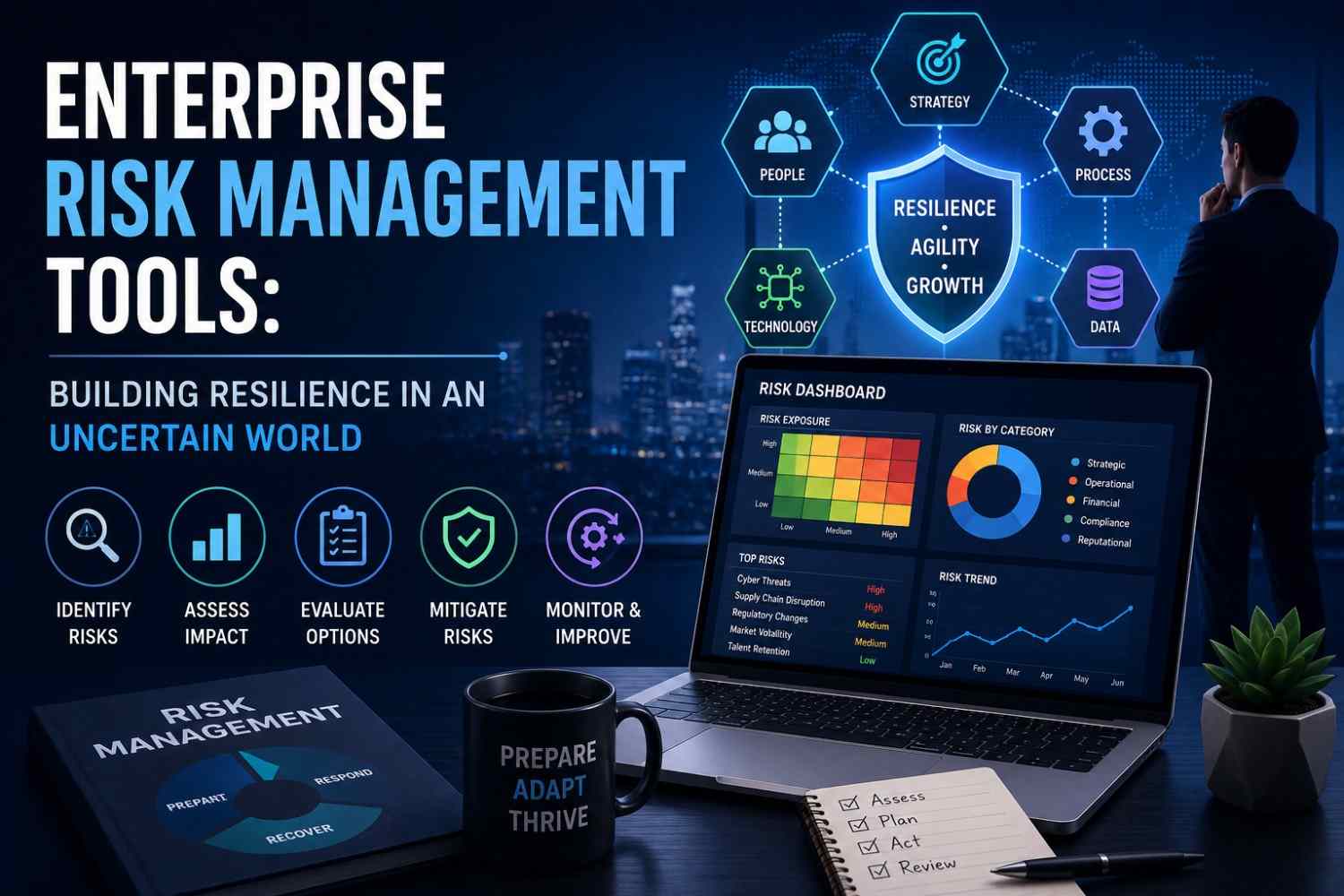
Enterprise Risk Management Tools: Building Resilience in an Uncertain World

Written by Sarah Whitfield | Last Reviewed: September 1, 2026
Quick Answer: Enterprise risk management tools assist businesses in identifying and addressing risks. They combine risk information into a single system. Teams are able to evaluate risks and monitor controls and changes. Reporting and risk mitigation are also supported in modern ERM software.
There are numerous threats to businesses. Cyberattacks, supply-chain issues, financial pressure, and regulatory changes can disrupt operations. These risks might impact various departments simultaneously. When these disruptions become public, many companies rely on a press release distribution platform to keep stakeholders and the market clearly informed.
Businesses can handle these risks using enterprise risk management tools. Teams are also able to spot risks, determine their effects, assign owners and monitor mitigation. ERM software also assists leaders in tracking change and making wise decisions.
However, choosing the right tool is not only about features. Businesses ought to address their risk needs, objectives, current systems, budget and future expansion. This guide will describe what a typical enterprise risk management software consists of and how one can select an appropriate ERM platform.
Key Takeaways
- ERM tools assist companies in handling risks centrally.
- ERM software facilitates risk evaluation and tracking.
- It has the ability to enhance reporting and risk visibility.
- The appropriate tool must suit your business requirements.
- Risk analysis and monitoring can be assisted by AI.
What Are Enterprise Risk Management Tools and How Do They Work?
Enterprise risk management tools help businesses manage risks across the organisation. They offer a single location to document, evaluate, and track risks. These tools can substitute for far-flung spreadsheets and manual procedures.
An enterprise risk management system links risks and owners, controls and mitigation plans. Teams can assign risk scores and set priorities. Leaders can then view important risks through dashboards and reports. When a company appoints a leader to own this function, a new executive leadership press release can formally announce the change to investors and media.
The basic process is simple. Teams discover a risk and determine its probability and consequences. They then assign an owner and strategise a response. The ERM platform continues to monitor the risk and reports important changes.
Essential Features of Modern ERM Software
Risk Identification and Assessment
The current ERM software assists staff in defining risks in business activities. The risks can be entered by users into a central risk register. The likelihood and impact can also be rated by them.
Risk Dashboards and Heat Maps
Dashboards provide leaders with an overview of significant risks. High-priority areas are displayed in heat maps. This simplifies the reviewing and comparing of risk information.
Key Risk Indicators and Monitoring
Key Risk Indicators (KRIs) help teams track changes in risk levels. Businesses are able to establish targets and warning signs. This will enable teams to take action before a risk is a significant problem.
Controls and Mitigation
ERM tools are able to link the risks to controls and mitigation plans. Teams are able to allocate owners and monitor activities. This establishes greater responsibility within the organisation.
Workflow and Reporting
Automation of workflow may decrease manual follow-ups. The system is able to make reminders and track tasks. Managers and boards can also have dashboards generated via reporting tools. Boards that want to publicize governance improvements can also turn to a press release distribution service to reach investors and the wider market.
Third-Party Risk Management
A variety of businesses rely on suppliers, vendors, and service providers. ERM software can help assess and monitor third-party risks. This provides more visibility into external dependencies for teams. When a new vendor relationship becomes strategically important, businesses can formalize it with a partnership announcement press release to keep stakeholders informed.
ERM Tools vs. GRC Software: The Difference?
ERM tools primarily centre on risk identification and management within an organisation. GRC software covers a broader area. It is able to relate governance, risk, compliance controls and audit.
| Area | ERM Tools | GRC Software |
| Main focus | Enterprise risk | Governance, risk, and compliance |
| Risk assessment | Core function | Common function |
| Risk monitoring | Core function | Common function |
| Compliance | Often included | Core function |
| Controls | Common | Core function |
| Audit | Often supported | Often integrated |
| Best fit | Enterprise risk programs | Broader GRC programs |
The two categories can overlap. Some enterprise risk management platforms also provide full GRC capabilities.
Choosing the Appropriate Enterprise Risk Management Tool
Define Your Risk Needs
Begin by identifying your risk issues of primary concern. Consider existing processes, gaps in reporting, and manual processes. This assists in establishing what the tool needs to address.
Check Core Capabilities
Review risk assessment, dashboards, KRIs, workflows, controls, and reporting. Select capabilities that suit your risk program. Do not choose software only based on the number of features.
Review Integrations
Your risk management platform should work with existing systems. Check integrations with ERP, HR, security, compliance, and audit tools. Data sharing can also be enhanced by API support.
Consider Scalability and Usability
The platform ought to support future expansion. Risk owners should also find it easy to use. A complex system can decrease uptake throughout the business. Companies scaling their risk program alongside broader growth often pair the rollout with a business expansion press release to signal the change to investors and partners.
Evaluate Cost and Support
Look beyond the software license. Take into account implementation, training, integration, customisation, and support. Look at the implementation support and model of service used by the vendor before deciding.
How AI Is Changing Enterprise Risk Management Tools
Modern enterprise risk management software is also incorporating new features with AI. It is able to analyze a large data on risks. It can also determine patterns and indicate abnormal changes. Companies rolling out these AI-driven capabilities often pair the upgrade with professional press release distribution to keep the market informed of the change.
AI can support emerging-risk detection, automated summaries, anomaly detection, and predictive analysis. Some systems may assist teams in analysing documents and drawing risk reports.
Nevertheless, AI must assist human decision-making. Risk teams still need to review important findings. There is also the need to pay special attention to data quality, privacy, explainability, and AI governance. Businesses investing in new AI-driven risk capabilities can share these developments through a research and development press release to build credibility with stakeholders.
How ERM Tools Support Different Business Risks
Enterprise risk management tools aid in the management of various business risks. They relate risk information, owners, controls and actions. This provides leaders with a better perspective of business risks.
Strategic & Operational Risk
ERM software assists teams in monitoring risks associated with business objectives. It also covers process failures and service disruptions. The COSO framework connects ERM with strategy and performance.
Cyber & Technology Risk
Cyber risks can change quickly. ERM tools assist teams in monitoring cyber risks and controls. They also relate matters to owners and actions.
Financial & Compliance Risk
Financial risks can affect cash flow and performance. Compliance risks can come from changing laws. A risk management platform assists teams in tracking the two aspects. Left unmanaged, these failures can escalate quickly — a crisis management press release helps businesses communicate a clear, controlled response when that happens.
Third-Party & Supply-Chain Risk
Suppliers and vendors can create business risks. ERM tools monitor vendor measures and activities. This assists teams in spotting issues earlier.
Emerging & AI Risks
New technologies can create new risks. Gartner reported in August 2026 that AI-enabled discovery of cyber vulnerabilities ranked as the top emerging risk in its latest survey. The survey involved 316 top managers and risk managers.
Businesses should therefore monitor AI, data, and third-party risks. Considering frequent reviews can also enable teams to react to evolving threats. Businesses that get emerging-risk management right can also use that strength as a story — for example, through an awards and industry recognition press release when their risk program earns outside recognition.
Frequently Asked Questions
Are ERM Tools Better Than Spreadsheets?
Spreadsheets may apply to simple risk programs. They, however, get harder to control with increased risks and users. Specialised tools have superior workflows, ownership, and reporting.
Do You Need a Dedicated ERM Tool?
Not always. Begin by defining your risks, controls and reporting requirements. Next, determine whether risk management software can be value-added.
Features or Ease of Use?
Both matter. However, risk owners must use the system regularly. A complicated platform can decrease adoption throughout the business.
Can One ERM Tool Manage Every Risk?
Some platforms address numerous risk areas. Nevertheless, businesses might still require cyber, compliance, or third-party risk tools.
What Should You Test Before Buying?
Check actual workflows rather than using demos. Check reporting, integrations, permissions, alerts, and mitigation tracking. Also involve actual risk owners during testing.
Conclusion
Enterprise risk management tools provide businesses with a linked picture of risk. They assist teams to determine risks, allocate owners, observe changes and trace responses.
However, software alone does not create resilience. Companies require proper procedures, effective data and effective leaders. The right ERM software should support these practices. As risk practices mature, communicating that progress matters too, which is where a guaranteed press release distribution service adds value.
Risks also continue to change. New challenges include AI, cyber threats, supply-chain problems, and regulations. An appropriate enterprise risk management platform can enable teams to react with more precision.
For businesses announcing risk, technology, or governance developments, a press release distribution network can help convey significant milestones to the right audiences.
Author Expertise
This article covers enterprise risk management, ERM software, and risk management platforms. It concentrates on major features and convenient selection criteria. It also takes into account GRC practices and contemporaneous risk-management requirements.