
Schema Markup for Press Releases: A Practical Guide

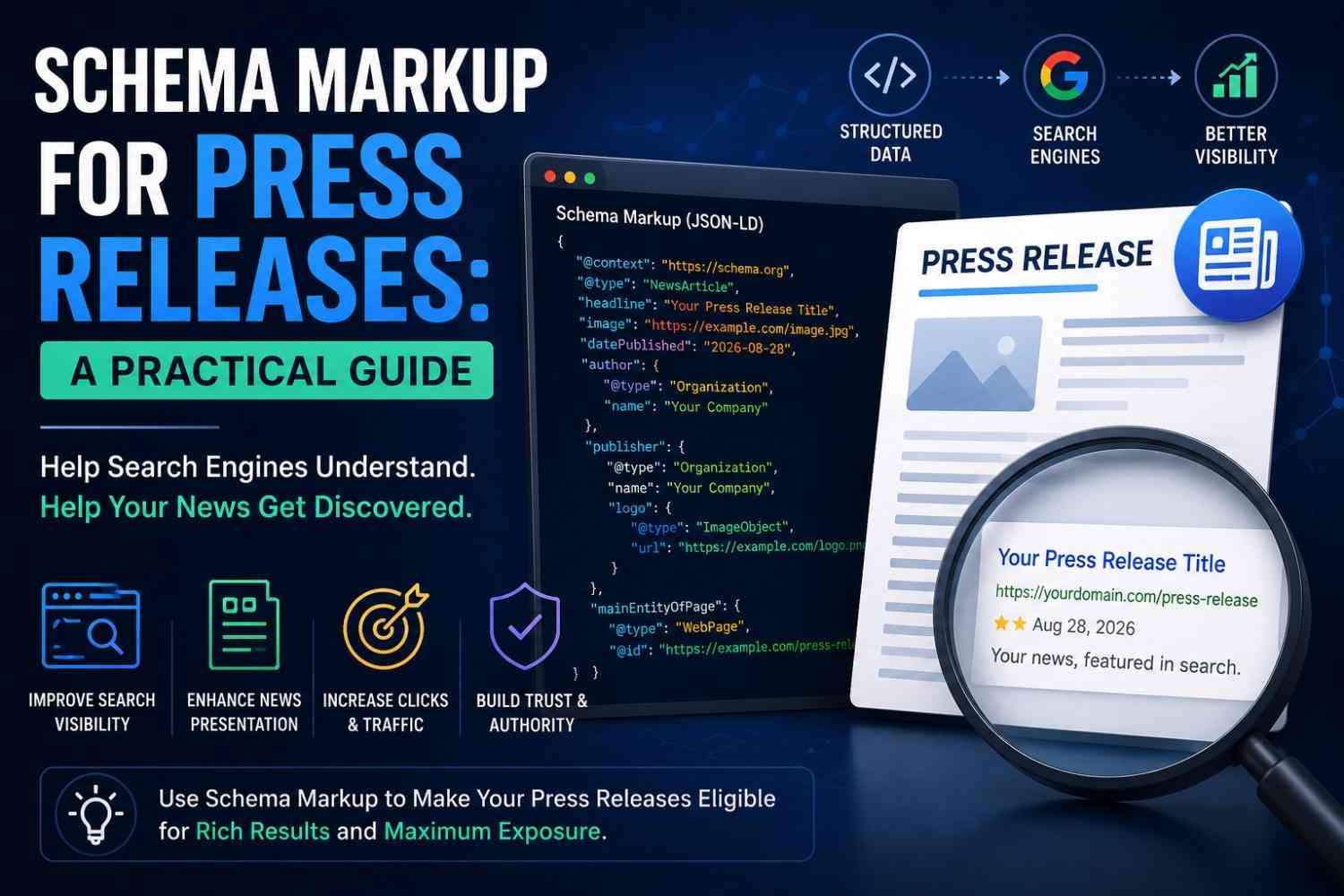
Quick Answer: Schema markup is structured code added to a press release page that tells search engines and AI systems exactly what the content is about — the headline, publisher, date, organisation, and key entities. Done correctly, it strengthens SEO, GEO, and AEO, and it can decide whether an announcement gets cited by AI Overviews and answer engines, or gets skipped entirely.
Press releases can no longer be discovered based on traditional search results. AI-powered search tools are also used today by people seeking to acquire information. Google AI Overviews, ChatGPT, Gemini, Perplexity, and Microsoft Copilot are transforming the process of content discovery.
Schema markup enables search engines to interpret a press release. It brings out crucial information about the business, the title, the date of publication, the writer, products and services. This simplifies content to be read and categorised by search systems.
In the case of businesses, this can assist with press release SEO, entity recognition and online presence. It can also assist in producing material that the modern search and AI systems find easier to comprehend.
Brands that skip structured data are increasingly invisible to AI Overviews, ChatGPT, and Perplexity, while press releases with clean schema get pulled into answers, summaries, and citations more consistently. For businesses relying on press releases for visibility, that difference can decide whether an announcement reaches its audience at all. This is one reason more businesses are turning to a press release distribution service that builds schema and AI-readiness into every release from the start.
Key Takeaways
- Schema markup aids search engines in decoding press releases.
- NewsArticle and Organization schema are the two most commonly used types for press releases.
- JSON-LD is the preferred format for structured data.
- Schema markup facilitates SEO, GEO, and AEO activities.
- Entity-based schema assists in linking brands, people, products and services.
- Schema validation is used to avoid errors and enhance accuracy.
How Schema Markup Helps Press Release SEO, GEO, and AEO
In the case of SEO, schema markup gives more information on a press release and its entities. This will allow the search engines to gain a clearer picture of what the content entails and its connection with the entity that is the origin of the content.
For GEO (Generative Engine Optimisation), structured data makes content more machine-readable. Search engines that use AI follow explicit signals to recognise topics, brands, people, products, and events. Schema markup assists in putting this information in an organised format.
For AEO (Answer Engine Optimisation), schema helps identify important information that may be useful when answer engines summarise or interpret content. Structured press releases are simpler to deal with, classify and relate to other entities.
For a closer look at how these two disciplines are defined and applied to press release content, see how GEO and AEO are reshaping press release writing.
Best Schema Types for Press Releases
Not all schema types apply to a press release. The most effective approach is to use a schema that accurately describes the content and its entities, drawing on the shared vocabulary maintained by Schema.org and adopted by major search engines.
NewsArticle Schema
The NewsArticle schema is often applied to press releases since it places the page as an article related to news. It may contain information about the title, author, date of publication, image, and publisher.
Organization Schema
Organization schema identifies the company behind the announcement. It can include the company name, logo, official webpage, and other business details, which helps connect the press release to the correct brand entity.
FAQPage Schema
When a press release contains a specific section of frequently asked questions, FAQPage schema can be used to structure questions and answers.
WebPage Schema
WebPage schema gives extra information regarding the page in general, and it may reinforce the overall structured data strategy.
Product or Event Schema
Certain press releases cover products, services, conferences, and events. Product or Event schema can be used to elaborate where it is pertinent to the announcement.
How to Add Schema Markup to a Press Release
Adding schema markup is not necessarily an intricate task. The accuracy and consistency may be facilitated by a systematic procedure.
Gather Key Information
Begin by gathering key information in the press release, including:
- Headline
- Publisher
- Author
- Publication date
- Featured image
- Organization name
- Page URL
Create JSON-LD Markup
JSON-LD is the preferred format for implementing structured data. Google recommends JSON-LD because it is easier to manage and maintain than other markup formats.
For example, a basic NewsArticle schema for a press release might look like this:
{
“@context”: “https://schema.org”,
“@type”: “NewsArticle”,
“headline”: “Your Press Release Headline”,
“datePublished”: “2026-09-01”,
“author”: { “@type”: “Organization”, “name”: “Your Company Name” },
“publisher”: {
“@type”: “Organization”,
“name”: “Your Company Name”,
“logo”: { “@type”: “ImageObject”, “url”: “https://example.com/logo.png” }
}
}
Replace the placeholder values with the press release’s actual headline, publication date, and organisation details before adding it to the page. Businesses that prefer to have this handled for them can use King Newswire’s press release writing and editorial review service, where schema-ready formatting is built into every release.
Add the Markup to the Page
Place the schema markup on the press release page it describes. The structured data must present the visible contents on the page properly.
This matters most on pages distributed through a trusted press release distribution network, where consistent, well-tagged pages are more likely to be picked up and reused by media outlets and AI systems alike.
Validate the Markup
Test the schema before publishing to find errors or warnings. Validation assists in making sure that search engines correctly read the structured data.
Monitor and Update
Look through organised data on a regular basis, particularly when revising press releases or modifying crucial page content.
Schema Markup and Entity SEO for Press Releases
Organization Entities
Each press release is related to an organisation. Organization schema is used to make search engines recognise which company announced something and match related information with this company.
Person Entities
Company executives, founders, or representatives usually provide quotes in a press release. Person entities assist in specifying the individuals and their relationship to the organisation.
This entity-first approach matters most at moments like product launches, where AI systems and journalists rely on clearly tagged names and roles to trust the announcement. See how GEO and AEO are changing product launch visibility for a closer look.
Product and Service Entities
Entity-based markup can be used with product launches and service announcements. Structured data assists in understanding what is announced and its relevance to the business.
For a full walkthrough of preparing announcements for 2026 search and AI standards, see King Newswire’s 2026 SEO and AI-readiness checklist for press releases, or work directly with a professional press release writing service to have it done for you.
Why Entity Relationships Matter
Current search engines and AI technologies are based mainly on entities and relations, not on keywords. In cases where schema markup explicitly links organisations, individuals, goods, services, and subjects, search engines get a better idea of what a press release is all about. This aids better content comprehension, discoverability, and fit with SEO, GEO, and AEO approaches.
Press Release Schema Markup Checklist
Before publishing a press release, review the following checklist:
- Select the appropriate type of schema.
- Add NewsArticle schema where necessary.
- Add Organization schema for the publishing company.
- Add the headline and publication date.
- Include the author or publisher information.
- Add a featured image when available.
- Use JSON-LD format for implementation.
- Ensure schema matches the visible page content.
- Validate the markup before publishing.
- Check for errors and warnings.
- Update schema on important page changes.
- Monitor performance through Search Console and structured data reports.
For related best practices on strengthening trust signals in press release content, see King Newswire’s guide to building E-E-A-T signals into press release content, and review the full range of press release distribution packages before your next announcement.
Conclusion
Schema markup assists search engines in comprehending press releases better. It structures key information concerning the company, announcement, individuals, products and services.
The appropriate schema might facilitate SEO, GEO and AEO. It should also be noted that the markup should be equivalent to the page content and to check validation.
With AI search steadily increasing, businesses can use clear and well-organised content to make their press releases simpler to read and uncover.
If you are preparing a press release and want it structured correctly from the start, King Newswire’s press release writing service combines professional writing with schema-ready formatting, so your announcement is easier for both journalists and AI systems to pick up. Explore King Newswire’s press release distribution plans to get your next announcement in front of the right audience, or visit the press release distribution platform to see how the full process works end to end.
Frequently Asked Questions
Does schema markup guarantee better rankings for press releases?
No. Schema markup does not directly enhance rankings. Nevertheless, it assists search engines in more precise content discovery, which may contribute to overall SEO.
Should every press release use NewsArticle schema?
Not always. NewsArticle schema is often suitable for press releases, but the best schema type depends on the content and purpose of the announcement.
Can I use multiple schema types on a press release page?
Yes. Depending on the content, any press release can have several schema types, including NewsArticle, Organization, FAQPage, Product, or Event schema.
Does schema markup help AI platforms understand press releases?
Schema markup offers organised data that may simplify the interpretation, categorisation, and linking of content by search engines and AI systems.
This is increasingly important for businesses distributing announcements through an AI-ready press release distribution service built for how modern search and AI systems actually read content.
What is the most common schema markup mistake?
The most frequent error concerns the use of schema which does not correspond to the content on the visible page. Common issues also include missing required fields and validation errors.
Is Organization schema important for press releases?
Yes. Organization schema assists search engines in recognising the company behind the announcement and linking the press release to the brand entity.
Businesses that want this set up correctly on every release can rely on a press release distribution and writing service that builds Organization and NewsArticle schema into the process by default.
Author Expertise & Editorial Disclosure
Written by Sarah Whitfield, Senior SEO & Structured Data Strategist at King Newswire, with 9+ years of experience in technical SEO, schema implementation, and AI-search optimisation. Reviewed by the King Newswire Editorial Team, which specialises in press release distribution, SEO, GEO, and AEO.Last updated: August 2026, to reflect current schema.org and AI-search guidance. This guide is for general educational purposes; validate any implementation against the latest Schema.org documentation before publishing.