
How to Write a Press Release: Format, Template & Expert Tips

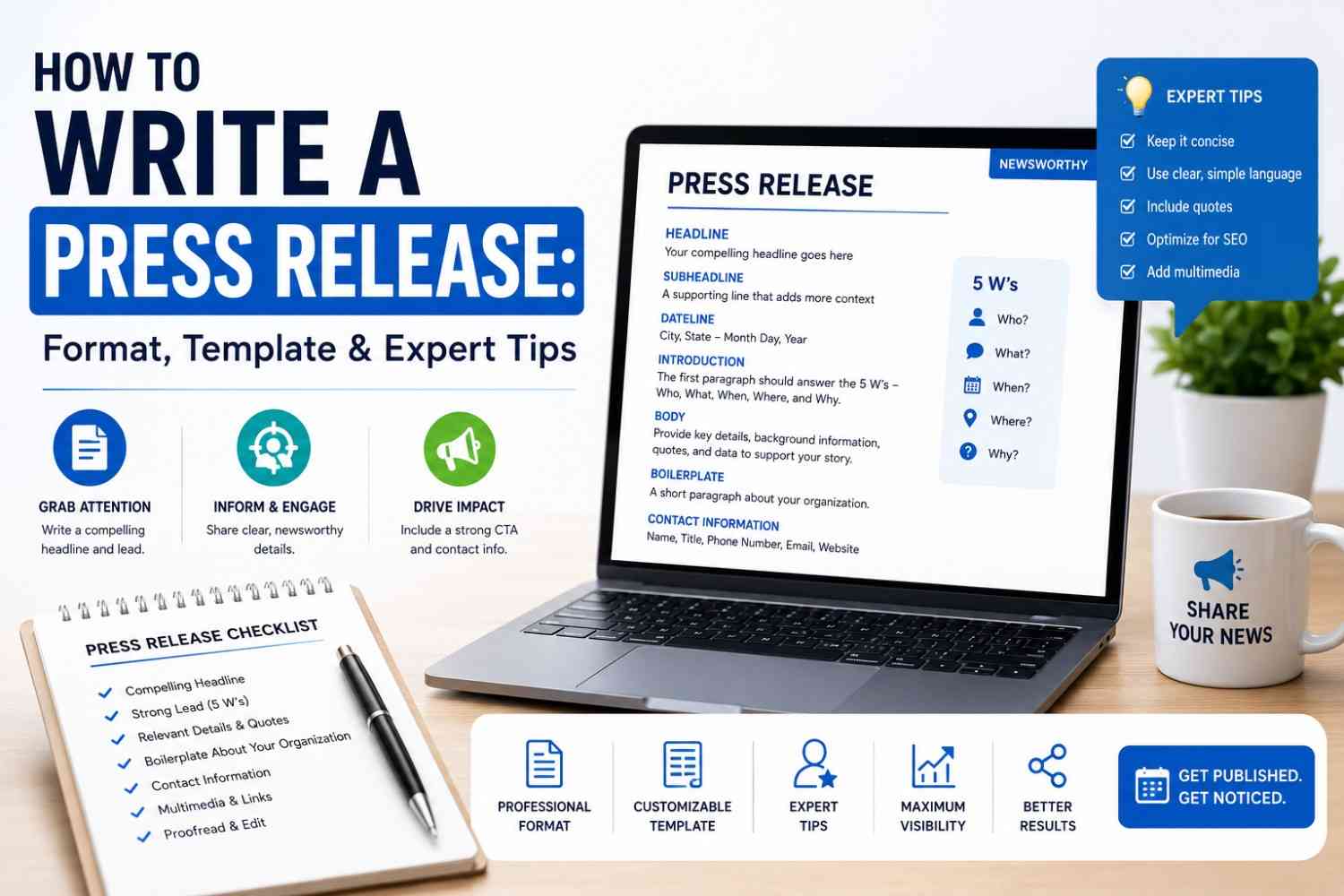
How to Write a Press Release
Learning how to write a press release is one of the most valuable skills for any business owner, PR professional, marketer, or journalist. A well-crafted press release can land your news story in major publications, generate media coverage, and build credibility for your brand. Whether you are announcing a product launch, a company milestone, or an event, understanding the correct press release format and structure is essential for getting results.
This guide walks you through every aspect of how to make a press release, from the opening line to the boilerplate. You will also find a ready-to-use press release template and a real-world sample press release to guide your writing. When you are ready to distribute, use a trusted press release distribution service to reach thousands of journalists simultaneously.
What Is a Press Release?
A press release is the formal written communication which is sent to the media and to the journalists announcing anything newsworthy related to a company, product, event or individual. It follows a specific press release format designed to make it easy for journalists to quickly understand the story and decide whether to cover it.
In the various industries, the following are some of the common uses of press releases:
- Hosting sessions on new products or services.
- Business associations or combinations.
- Reward successes and achievements.
- Changes of leadership or role.
- Communications are typically delivered at events, conferences or fundraisers.
- New studies or new data.
When written correctly, a press release gives journalists everything they need to write a story without needing to reach out for clarification. That is why following the right press release layout matters so much. If you need professional help structuring your announcement, explore our press release writing and distribution service.
Why Knowing How to Write a Press Release Matters
Media coverage built on a strong press release delivers significant benefits. For businesses using a professional press release distribution platform, a professionally written press release can reach thousands of journalists and news outlets simultaneously.
Here is why press release writing skills matter in today’s digital landscape:
- Earned media is more trusted than paid advertising by most consumers
- Press releases distributed via professional newswire distribution services generate backlinks and improve SEO authority
- A well-structured release signals professionalism and credibility to journalists
- Proper format increases the likelihood of your story being picked up
- Press releases create a permanent, indexed digital record of your announcement
Understanding the structure behind a professional press release example or sample press release is what separates companies that get coverage from those that do not. You can also study real press release examples to see how top brands structure their announcements.
Is Your News Worth Media Attention?
Many press releases fail because the announcement is not newsworthy outside the company. Before you write, test your story against a few questions:
- Does it have a clear impact on customers, the industry, or the wider market?
- Does it solve a real problem or offer something new?
- Is the timing relevant, or does it connect to a larger trend?
Internal updates, routine staff changes, or small operational improvements rarely qualify on their own. Once you know your angle, decide who you are writing for. Research your target audience and the journalists who cover your industry, then tailor the message to what they need: timely, accurate, and relevant information.
The Standard Press Release Format
All good press releases adhere to a press release format. Here are the elements that you need to include in the correct order.
1. Headline
The most important aspect of your press release is the headline. It needs to contain a good amount of keywords and be compelling, clear and easy to understand. Try to use 60 to 80 characters. Your headline should tell people right up front the news value.
2. Dateline
The date of release and the city of origin are included at the beginning of the first paragraph.
3. Lead Paragraph (The Most Important Paragraph)
The opening paragraph should include the 5 Ws (Who, What, When, Where and Why). Thousands of releases are read weekly by journalists. If your lead doesn’t get them in the first two sentences, they leave. Don’t overstuff this paragraph, but make it count, as it should be under 50 words. For example, a partnership lead might read: “[Company] has partnered with [Partner] to bring [new service] to [customers] in [market], starting [date].” If you are announcing a raise, our funding announcement press release guide includes a template and example.
4. Body Paragraphs
The body of your press release provides additional context, data, quotes and supporting detail to the lead paragraph. Apply the inverted pyramid structure: include the most significant information first followed by less significant information. The paragraphs should build upon the previous one(s) in a logical manner.
5. Quote from a Spokesperson
Use a minimum of one quote from an appropriate executive, founder or spokesperson. This makes the release more human, and provides a quote for journalists to place in their article in the press. Do not use slang in your writing. Make the quote sound natural and newsworthy.
6. Boilerplate
Boilerplate is a brief paragraph of the press release that provides a description of your company. It usually starts with ‘About [Company Name]’ and shares a concise description of who you are, what you do and where you work. This section remains the same throughout all of your press releases. Learn more about how to write a boilerplate in a press release. You can also browse our company boilerplate examples and templates.
7. Contact Information
Always put media contact information at the end: Full name, title, email address, phone number, and your company’s website. Otherwise, journalists will not be able to conduct further interviews and clarifications.
Optional: A Clear Call to Action
A press release should inform first, but it can also guide readers to a next step. Close the body with a short, neutral call to action, such as “Visit [website] to learn more about [product or service],” so interested readers and journalists know where to go.
Press Release Template
Use the following press release template as a starting point for any announcement. Fill in the bracketed sections with your own information. For a downloadable version, see our press release template in Word format. If you are formatting it yourself, see our picks for fonts that make a press release stand out.
FOR IMMEDIATE RELEASE
[COMPELLING HEADLINE ABOUT YOUR NEWS]
[Supporting Subheadline That Adds Context]
- [CITY, Country], [Date] — [Lead paragraph answering Who, What, When, Where, Why in 40-50 words]
- [Body paragraph 1: Expand on the news with key details, data, or context.]
- [Body paragraph 2: Add further supporting details, statistics, or background.]
- “[Spokesperson quote that humanizes the announcement],” said [Name], [Title] of [Company].
- [Body paragraph 3: Additional supporting information, availability, pricing, or next steps.]
About [Company Name]
[2-3 sentence boilerplate describing who you are, what you do, and where you operate.]
Media Contact:
[Full Name] | [Title] | [Email] | [Phone] | [Website]
10 Expert Tips for Writing a Press Release That Gets Picked Up
Even with the right press release layout in place, these professional tips will significantly increase your chances of media coverage.
- Write for journalists, not customers. Your release should sound like news, not marketing copy.
- Lead with the most newsworthy element. Do not build up to your news; lead with it.
- Keep it concise. Aim for 400 to 600 words. Journalists have no time for lengthy releases.
- Use a strong, specific headline. Avoid vague language like ‘exciting’ or ‘revolutionary.’
- Include one data point or statistic in your lead paragraph. Numbers make your news tangible.
- Use only one or two quotes. More than that makes the release feel scripted.
- Send your release in the body of an email, not as an attachment. Most journalists skip attachments.
- Time your release strategically. Mid-morning on Tuesday, Wednesday, or Thursday sees the highest open rates.
- Use a professional press release distribution platform to reach thousands of journalists simultaneously.
- Always proofread twice. A typo in a press release damages credibility instantly.
Beyond the day of the week, consider your industry’s calendar. Releasing news around relevant industry cycles, events, or launches can make it more timely for journalists.
Optimize Your Press Release for Search and AI
Modern press releases are read by people, search engines, and AI tools. A few practices help all three:
- Use related terms, not repeated keywords. Semantic keywords that describe your topic naturally help search engines understand relevance.
- Give entity context. Instead of only naming your company, describe its industry, services, and expertise, so search engines and AI tools such as ChatGPT, Perplexity, and Google AI Overviews can understand who you are.
- Add trust signals. Relevant statistics, market research, expert opinions, executive quotes, and customer success stories support the Experience, Expertise, Authoritativeness, and Trustworthiness (E-E-A-T) that both editors and search engines look for.
How King Newswire Fits Into Your Press Release Strategy
Once you have written and finalized your press release, distribution is the next critical step. King Newswire is one of the most widely used press release distribution platforms, offering direct access to major news outlets, Google News, financial newswires, and thousands of journalists worldwide.
Choosing the right press release distribution plans and packages gives your press release:
- Broad media reach across national and international outlets
- Permanent indexed news pages that support your SEO strategy
- High-authority backlinks from recognized news domains
- Editorial credibility through professional formatting and distribution
Before submitting to any distribution service, make sure your press release follows the correct format, includes all required components, and is free of grammatical errors. If you need help crafting an announcement from scratch, consider our product launch press release distribution service or new service launch press release writing and distribution. Distribution platforms amplify your message, but they cannot fix a poorly written release.
Writing Your Press Release in AP Style
Most journalists and editors in the United States expect press releases to follow AP (Associated Press) style. This includes specific rules for dates, numbers, titles, and punctuation. Following the correct press release AP style format increases the chances that your release will be taken seriously by U.S. media outlets. If you are a U.S. company, learning AP style tips for writing press releases is a worthwhile investment.
Common Press Release Mistakes to Avoid
Even experienced writers fall into these traps. Avoid them to ensure your release reads as professional and credible.
- Writing an advertisement instead of news. Press releases must be objective and factual.
- Burying the lead. Do not make journalists hunt for your main news.
- Overusing jargon. Write for a general editorial audience, not an industry insider.
- Missing contact information. Without it, journalists cannot follow up.
- Using excessive exclamation points or superlatives like ‘world-class’ or ‘groundbreaking.’
- Submitting without proofreading. One typo is enough to lose credibility.
- Forgetting the boilerplate. This is standard and always expected by editors.
Final Thoughts
Knowing how to write a press release is a skill that takes practice but pays dividends for years. The key is respecting the press release layout, leading with your strongest news, keeping the language clear and direct, and always making it easy for a journalist to cover your story.
Use the press release template in this guide as your foundation. Study a press release example for events or a press release example for a new business to understand how structure and tone work together. And when you are ready to distribute, choose a trusted press release distribution service to maximize your reach and media coverage.
Whether you are learning how to make a press release for the first time or refining your fiftieth, sticking to the proven press release layout — and distributing through a reliable online press release distribution platform — will always deliver the best results.
Frequently Asked Questions (FAQs)
Q1. What Is the Ideal Length When Learning How to Write a Press Release?
Each press release should be 400-600 words. Journalists are busy so keep it succinct, factual and limited to one main announcement. It’s important to keep it under a minute or they’ll lose interest before you get to your message.
Q2. What Is the Correct Press Release Format?
A standard press release format consists of a headline, dateline, lead paragraph, body paragraphs, spokesperson quote, boilerplate and media contact information. Close with the #### to indicate that the release is finished.
Q3. Can I Use a Press Release Template for Any Type of Announcement?
Yes. Product launches, events, partnerships, awards, leadership changes, research findings, and any other communication about a product, service, or event are all suitable topics for a press release template. Just add the information you need to your particular news without changing the overall structure of the template. Explore available press release distribution plans and pricing to find the right package for your announcement.
Q4. How Is a Press Release Example Different from a Media Pitch?
A press release example is a formalized document that is sent out to several reporters at a time. A media pitch is a personalized email sent to a target journalist. While both are helpful, they have different roles in a PR strategy.
Q5. How Many Times Should I Use Keywords in a Press Release?
Include your main keyword 3-5 times in the release and supporting keywords 2-4 times in the release. Do not overstuff the keywords, as it will make the text more difficult to read and may lead to a loss of credibility with the newspapers and the search engines.
Q6. What Makes a Sample Press Release Newsworthy?
A strong sample press release should include new information, a data point or milestone, a real quote, and make sure that the news is understandable for a larger audience. If your story is for your company only, it’s not yet newsworthy enough to share. Study real press release examples and formats to understand what makes a story compelling.
Q7. How Do I Know How to Make a Press Release That Gets Published?
It is important to emphasize that you should pursue real news value, stick to the proper press release structure, develop a strong headline, and use a legitimate press release distribution service. Distributing to relevant journalists along with your distribution goes a long way to improving pick-up.
Q8. Should I Include Images or Multimedia in My Press Release?
Yes, whenever possible. Images, infographics or a link to a video in the press release will ensure greater media coverage. Include or link to multimedia sources at the end of your release, with clear labels, and easy to download.