
AP Style Press Release: Rules You Can’t Skip

AP Style Press Release: Rules You Can’t Skip
Quick Answer: An AP-style press release adheres to the writing style of the Associated Press. The guidelines make it easier to develop professional and concise press releases that can be easily applied by journalists and published. The right format will enhance credibility and better chances of being covered by the media. Last Updated/Reviewed: July 2026
A press release written in AP style adheres to the writing conventions in journalism and news services. It assists in presenting the information in a clear, professional and consistent manner. This means that reporters are able to review and post the news faster.
The adherence to AP Style is not only a matter of style. It is able to enhance credibility, minimize editing, and increase chances of media coverage. Whether you distribute news through platforms like King Newswire or contact journalists directly, understanding AP Style helps you create press releases that meet newsroom expectations.
This guide will address the main AP Style rules, dateline rules, common mistakes, and real-life examples every PR expert has to be aware of.
Key Takeaways
- AP Style is the standard system employed by journalists.
- Well-structured press releases are easy to publicize.
- Adherence to AP enhances transparency and trustworthiness.
- Even minor errors may decrease the effect of a press release.
Author Expertise
Written by Emily Hart, Senior Editorial Strategist at King Newswire. Reviewed by the King Newswire Editorial Team.
The King Newswire team is well-experienced in writing, editing and distributing releases in different industries. We assist companies in producing news releases that are written in AP Style and which meet the newsroom criteria.
Essential AP Style Press Release Rules You Cannot Ignore
Headline and Subheadline Formatting
A good headline is one that describes the story in a concise and precise manner. Focus on facts, not hype. In case of a subheadline, provide helpful context to back up the main announcement. For inspiration, review these press release headline examples before drafting your own.
Dateline Formatting Rules
Dateline is used to specify the origin of the news and the time of the news. It is found at the beginning of the first paragraph and takes a standard format, e.g.:
NEW YORK, July 16, 2026 —
The proper dateline format will make your release meet the newsroom requirements.
Numbers, Dates, Times, and Percentages
Numbers and dates have rules in AP Style. Write out numbers one through nine, use numerals for 10 and above, and format dates like July 16, 2026. For percentages, use numbers with the percent sign, such as 25%.
Quotes and Attribution Guidelines
Quotes help to give credibility and expert commentary. When quoting, you should always mention the source and pay attention to valuable data and not promotion.
Capitalization and Titles
Capital letters should be used only in the case of titles that precede the name of a person. It is best to maintain capitalization to make your press release easier and more professional to read.
Hyphenating Compound Modifiers
When two words work together to describe a noun that follows them, join them with a hyphen to avoid ambiguity. Write “a well-known company” rather than “a well known company.” When the phrase comes after the noun, no hyphen is needed: “the company is well known.”
Acronyms and Abbreviations
Spell out the full name of an organization or term on first reference. AP generally discourages adding the abbreviation in parentheses right after it; if the short form is familiar to readers, simply use it on later references. Avoid acronyms that most readers would not recognize.
Headline Capitalization
Many press release headlines use title case: capitalize the major words and keep short words such as “the,” “of,” “and” or “in” lowercase unless they open the headline. AP’s own news headlines use sentence case, so whichever approach you choose, apply it consistently across every release.
These AP Style rules can result in journalists perceiving your content differently. Prior to releasing any news via outlets like King Newswire, make sure to fact-check the details in your press release first. Even little things can enhance credibility and outreach activities with the media.
AP Style Cities That Stand Alone Explained
Standalone AP Style cities are major U.S. cities that do not need a state abbreviation in the dateline. The Associated Press has accepted these cities as commonly recognised, and thus the news reporters do not need any further description of the location.
What Are Stand-Alone Cities in AP Style?
Most press release datelines are written in AP Style, in which a city name is used with a state abbreviation. Nevertheless, some more popular cities can be singled out as they are easily identifiable by readers.
This rule aids in maintaining shorter datelines and enhances readability.
Common AP Style Cities That Stand Alone
Some examples of cities that do not require a state abbreviation are:
- Atlanta
- Boston
- Chicago
- Dallas
- Denver
- Detroit
- Houston
- Los Angeles
- Miami
- New York
- Philadelphia
- Seattle
- Washington
For example, an AP-style dateline would look like:
NEW YORK, July 16, 2026 —
Not:
NEW YORK, N.Y., July 16, 2026 —
Cities That Require State Abbreviations
Numerous cities are not included in the AP stand-alone list. In such instances, the relevant state abbreviation needs to be included in the dateline.
For example:
AUSTIN, Texas, July 16, 2026 —
PORTLAND, Ore., July 16, 2026 —
The appropriate formatting of cities demonstrates attention to detail and assists in ensuring your press release matches the AP Style requirements.
AP Style Press Release Example (Annotated)
The example of an AP style press release demonstrates the interplay between all the aspects of formatting in a professional news release. Knowing the organization allows you to prepare releases that journalists can go through and publish. Reviewing real press release examples you can learn from also helps you spot these elements in practice.
Sample AP Style Press Release Structure
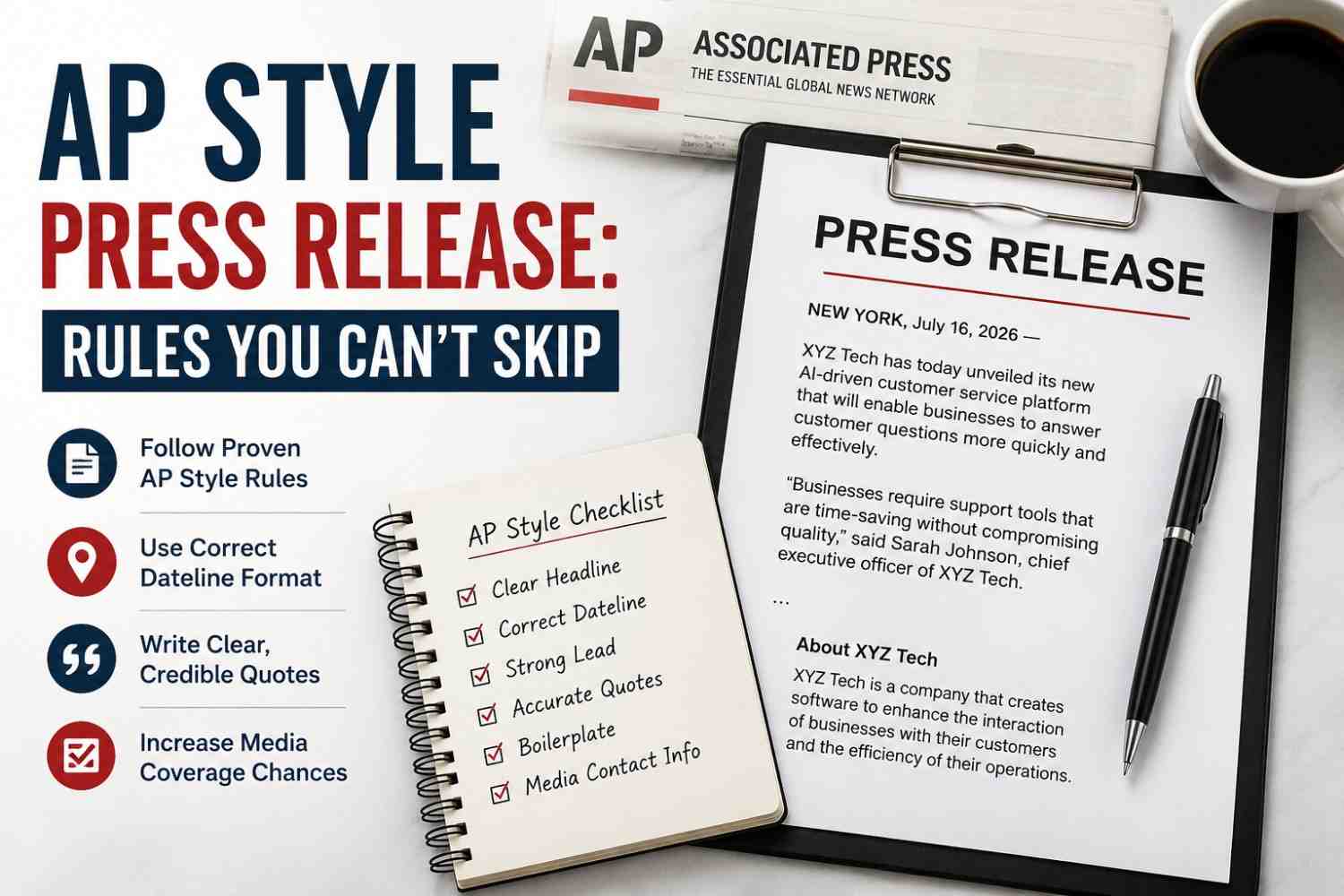
A standard AP-style press release format includes the following elements:
- Headline
- Dateline
- Lead paragraph
- Body content
- Quote
- Boilerplate
- Media contact information
Inverted Pyramid and Paragraph Length
AP-style releases follow the inverted pyramid: the most important facts come first, supporting details and quotes follow, and the least critical information sits at the bottom. Editors can then trim from the end without losing the core news. Keep paragraphs short, usually two or three lines, so the release is easy to scan.
The last two elements deserve care. The boilerplate is a short, standard paragraph describing what the company does, its goals and other key background. The media contact section should name a real person in your organization who can answer journalists’ questions, with an email address and phone number.
Fonts and Layout
Stick to standard fonts such as Times New Roman or Arial rather than decorative typefaces. A common size hierarchy is 14 pt for the headline, 13 pt for the subheadline and 12 pt for the body text, which keeps the release clean and readable.
Example:
XYZ Tech Launches New AI-Powered Customer Support Platform
NEW YORK, July 16, 2026 — XYZ Tech has today unveiled its new AI-driven customer service platform that will enable businesses to answer customer questions more quickly and effectively.
“Businesses require support tools that are time-saving without compromising quality,” said Sarah Johnson, chief executive officer of XYZ Tech.
The platform allows automated reactions, analytics, and multilingual help to companies of any size.
About XYZ Tech
XYZ Tech is a company that creates software to enhance the interaction of businesses with their customers and the efficiency of their operations.
Why This Format Works
Every section has its purpose. The headline is a summary of the news, the dateline is a location and time, and the lead paragraph contains the most crucial information first. Quotes add credibility, while the boilerplate gives background about the organization.
Most press release distribution platforms, such as King Newswire, suggest using this format, and following the right steps for how to distribute a press release ensures it meets newsroom requirements and AP Style.
AP Style Cheat Sheet for Press Release Writers
An AP Style cheat sheet is a guide to the most crucial formatting and writing rules applicable in press releases. It assists writers to prevent the normal errors and being consistent in their work.
Quick Rules to Remember
| Element | AP Style Rule | Example |
| Numbers | Spell out one through nine; use numerals for 10 and above | three employees, 12 offices |
| Dates | Use month, day, and year format | July 16, 2026 |
| Time | Use figures with a.m. or p.m. | 9 a.m., 3:30 p.m. |
| Percentages | Use numerals and the percent sign | 25% increase |
| Titles | Capitalize before a name, lowercase after | CEO Sarah Jones; Sarah Jones, CEO |
| States | Use AP abbreviations in datelines when required | Austin, Texas |
| Quotes | Attribute every quote to a named source | “We are excited,” Smith said. |
It is important to have an AP style cheat sheet because it will help you master the rules in less time.
Even more professional PR workers may fail to notice minor details of the format. A basic reference manual will aid in making your press releases right, professional and publishable. Before sending a release through platforms such as King Newswire, a quick AP Style review can help catch errors that might otherwise affect credibility. It also pays to optimize a press release for SEO before distribution, since search-friendly formatting extends its reach well beyond the newsroom.
Editing and Proofreading for AP Style Compliance
The final step before distribution is a careful edit. Applying AP Style consistently takes effort, but small errors can undermine the credibility of your news. Before you submit, check the release for:
- Spelling, grammar and punctuation errors
- Consistent number, date, time and title formatting
- A correctly formatted dateline
- Accurate names, titles and quote attributions
- Complete boilerplate and media contact details
AP Style Press Release FAQs
Can AP Style affect press release distribution outcomes?
Following AP Style makes a release easier to read and closer to what editors expect, which can support a smoother editorial review. Outcomes still depend on other factors, including newsworthiness, content quality, relevance and each publisher’s guidelines.
Does AP Style guarantee media coverage?
No. AP Style presents your news in a format journalists recognize, but whether a story is published depends on editorial review, newsworthiness and each outlet’s requirements.
Conclusion
AP Style enables you to write understandable and professional press releases that can be easily comprehended by journalists. It will enhance credibility and make your news even easier to publish by adhering to the proper formatting and writing rules.
Regardless of your experience with writing press releases or understanding how to do it, AP Style will teach you to communicate with the media more effectively. It can be paired with press release distribution via King Newswire to spread your news to a broader audience.
Additional Press Release Resources
For more on planning, formatting, and distributing your news, explore these related guides: