
How to Repurpose One Article Across Multiple Channels: A Complete Content Strategy

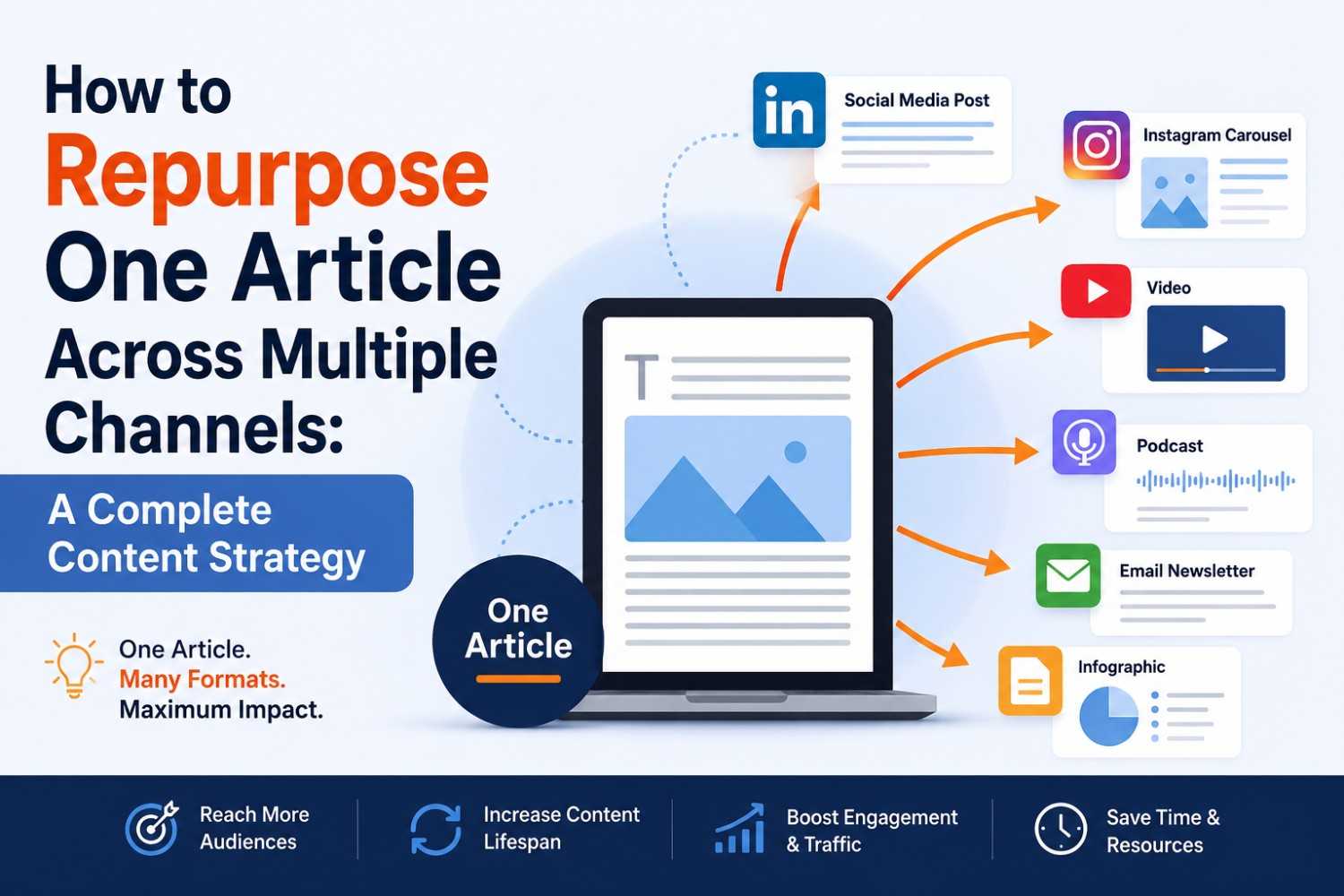
Quick Answer: Content repurposing turns one strong article into multiple content assets. One article can be turned into social media posts, emails, videos, podcasts, and infographics. The goal is not to copy the same content across channels. Instead, adapt the core message to each audience and platform.
Creating a valuable article takes time. This is especially true for a press release, where the announcement itself often contains data points, quotes, and key dates that can each stand alone. Producing strong source content requires effort in research, writing, editing and fact-checking. But lots of teams write an article and move on to the next topic. This may restrict the scope and worth of their work.
Repurposing content is a smarter alternative. A single article may be divided into a social media post, email newsletter, video, podcast, infographics, and any other content assets. This assists brands in reaching their audiences that follow alternative formats and channels.
Effective multichannel content is, however, not about copying and pasting the identical message. They all have their audiences, formats, and expectations. The main concept may remain the same, but it must be changed to suit each channel.
Key Takeaways
- Repurposing content helps teams derive additional value from a single article.
- One article can become social posts, emails, videos, podcasts, and visuals.
- Multichannel content is most effective when the format is custom-made for each platform.
- AI can speed up repurposing, but human review keeps content accurate and useful.
Why Content Repurposing Matters in a Multichannel Strategy
Repurposing content assists brands in deriving extra value from old content. It takes time and effort to create a useful article. Brands that already invest in professional press release distribution tend to have strong source material already, since each release is written to be clear and newsworthy. Repurposing helps teams to transform that work into additional content assets.
Brands can also target audiences on various platforms with the help of a multichannel strategy. Others include social media posts. Some of them are reels, videos, podcasts or visual content. These various preferences may be fulfilled by one article.
An article can also get a second life through repurposing of its contents. It may help amplify content, engage audiences, drive traffic and increase brand exposure. The difference is that you need to select the appropriate channels rather than attempt to spread everywhere.
Start With One Strong Source Article
An effective content repurposing plan begins with valuable source material. The original article is expected to contain a clear topic and a good central message.
It must also contain useful parts which can be recycled. They may contain statistics, quotes from experts, tips, examples, queries, and original ideas.
Beforehand, determine the most powerful components of the article. These are parts that can be used as content for social posts, emails, videos, infographics, etc.
Turn One Article Into Multiple Channel-Specific Assets
Repurposing content transforms a single source article into a series of useful content assets. The audience or content format of each asset can be different.
| Source Content | Repurposed Asset | Suitable Channel |
| Main argument | Professional post | |
| Key statistics | Infographic | LinkedIn, Instagram |
| Practical tips | Carousel | |
| Short insight | Post or thread | X |
| Key section | Newsletter | |
| Main topic | Video script | YouTube |
| Expert discussion | Podcast topic | Podcasts |
| Common questions | Answer content | Search and AI platforms |
This process is often called content atomization. It breaks a larger content asset into smaller pieces. Every artwork must be valuable in itself.
This approach isn’t limited to blog posts. A product launch press release, a new business press release, or an event press release can all be broken down into the same kind of channel-specific assets.
The idea is not to produce some content on all channels possible. Rather, select platforms that align with the audience, format and marketing objective.
Adapt the Message for Each Platform—Don’t Copy and Paste
Repurposing does not imply that you post the same paragraph all over. The audiences, formats, and expectations of each platform are different.
A LinkedIn post can focus on a professional insight. On Instagram, a carousel can offer a number of ideas. One strong point or statistic can be pointed out with the use of an X post.
Email can provide more context. A more detailed explanation can be provided on YouTube. A podcast has the potential to discuss the issue or interview people.
The fundamental concept can stay the same. The format, tone, hook, and call to action ought to be different.
Use AI to Speed Up Content Repurposing Without Losing the Human Voice
Identify Key Content Automatically
AI can read an article and determine which ideas, statistics, questions, and quotes are critical. This can assist marketers in locating valuable content within a shorter period.
Create First-Draft Content
AI has the ability to convert ideas chosen by the user into social posts, email drafts, video outlines, and captions. The initial content creation process can be expedited by these drafts.
Adapt Content for Different Channels
AI can be used to customise content length and form to suit various platforms. A marketer can take one article as the source and make channel-specific adaptations.
Keep Human Review in the Workflow
The AI-generated content is yet to be checked by humans. Check facts, context, tone, originality, and brand voice before publishing. The final content is useful and trustworthy, thanks to human judgment.
Guard the Home Brand Voice
AI must complement the current brand voice, but not emulate it. By adding their personal insights, industry knowledge, and appropriate examples, the editors will be able to make every asset more authentic.
Build a Simple Content Repurposing Workflow
A clear workflow makes content repurposing easier to manage. Use one good article and determine its most helpful concepts. Then compare those ideas with the channels that they fit best.
1. Extract the Content Atoms
Extract statistics, quotes, tips, examples, questions and main points. These smaller concepts can be transformed into single content assets. A 1200-word article may contain several ideas that can stand alone.
2. Match Ideas With Channels
Select an approach depending on the thought and target audience. LinkedIn might be a good place to post a professional lesson. A list of visuals can be suitable for Instagram. A brief opinion can be better suited to X.
3. Rewrite for the Platform
Do not simply shorten the original article. Alter the hook, structure, tone and format. Platform adaptation is widely considered one of the biggest challenges in content marketing, since the same core message has to work across very different formats and audience expectations.
4. Batch and Schedule the Assets
Produce multiple assets within a workflow. Next, plan them in a content calendar. This saves on repetitive labour; distribution of content becomes manageable.
5. Measure and Improve
Monitor engagement, clicks, traffic, leads and conversions. Determine the best ideas. Apply those lessons to inform your future content amplification approach.
How to Turn One Article Into a 30-Day Content Engine
A single article can be used to sustain several weeks. The trick is to disseminate its best ideas through various forms rather than releasing them all simultaneously.
Week 1: Launch the Core Content
Publish the original article first. Share on LinkedIn, X post, and in an email that quotes its best point.
Week 2: Create Visual Content
Transform statistics and key points into an infographic or carousel. It is also possible to make a short video based on one practical part.
Week 3: Start Conversations
Transform an article question into a discussion post. Make a comment, life hack, or question to the audience. Locate new content ideas with the help of comments and responses.
Week 4: Reuse the Best Performers
Discuss the performance of the month. Determine which posts, ideas, or formats received the most response. Reuse those winners as new videos, new newsletters, new posts, or new articles.
This approach makes repurposing content a repeatable process, especially when it starts from a well-structured press release distribution platform. It also helps teams not to treat each new post as a totally new project.
FAQs
Can I repurpose the same article on every platform?
The major idea can be reused, but the implementation must be different. Different platforms have dissimilar audiences, formats and expectations. Copy-pasting the same message everywhere is a common weakness in cross-platform workflows, which is why teams that work with a press release distribution service usually rewrite each announcement for the specific channel it is being shared on.
What is the hardest part of content repurposing?
The primary difficulty is usually getting one idea to fit another platform. The tone, formatting, brand consistency, and time spent on manual rewriting are also reported as the troubles by the marketers.
Should I use AI for content repurposing?
AI can assist in generating first drafts and searching for ideas in an article. However, human editing is still important. Check all the aspects: accuracy, originality, context, and brand voice.
How many pieces of content can one article create?
There is no fixed number. It is based on the depth of the article and the number of useful ideas it has. A good article can reinforce social articles, emails, videos, pictures, and discussion subjects.
Should every article become a 30-day content campaign?
Not necessarily. Strong-insight evergreen articles have greater repurposing opportunities. Short content life may be on time-sensitive or narrow subjects.
How do I know which channel to prioritise?
Start with your audience and business goals. Select outlets in which your audience is operating, and where your content format is naturally fitting. You do not need to publish on every platform.
Conclusion
Repurposing content assists in transforming a single powerful article into a broader content platform. This begins with valuable source material. Then, take its best ideas and modify them to fit channels.
It is to make more publications per volume, not quantity. It is to make every valuable idea work harder. The right workflow can expand the reach of an article, facilitate engagement, and give you additional chances to connect with your audience using multichannel content.
If your team already has a strong announcement to start from, the fastest way to build this kind of repeatable engine is to publish it through a reliable press release distribution and then break it down across every channel your audience uses.
Author Expertise
By Sarah Whitfield | Last Reviewed: August 31, 2026
The article is based on the hands-on experience related to content marketing, search engine optimisation, digital PR, social media marketing, and content distribution. It explains how teams can reuse existing content while maintaining quality, relevance, and brand voice.
Related Resources Compare press release distribution packages to find the right fit for your next announcement, or read this press release online distribution overview for a deeper look at how distribution and repurposing work together.