
Natasha Wang’s Zoen Finds Beauty in the Space Between Control and Chaos


For emerging designer Natasha Wang, clothing is not simply about what we wear. It can be a way of considering how we move through the world.
Her collection Zoen: The Landscaper takes its name and central philosophy from the idea of cultivating a garden, not a physical garden, but the internal and external landscapes that make up a life. Inspired by the quiet composition of a Zen garden, Wang explores what it means to intentionally shape one’s surroundings while accepting that life itself can never be completely controlled.
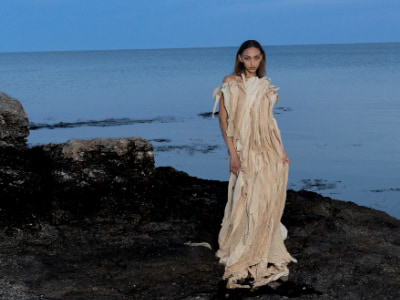
The result is a collection built around contrasts. Structured silhouettes meet soft draping. Carefully considered construction exists alongside deliberately irregular surfaces. Clean lines and negative space are interrupted by wrinkles, folds, and textures that appear almost naturally formed. The garments suggest that balance does not necessarily mean perfection; instead, it can exist within the tension between order and unpredictability.
That tension becomes particularly visible through Wang’s treatment of fabric. A self-developed biodegradable technique is used to shrink and wrinkle lightweight materials, creating semi-permanent creases and an organic, lived-in surface. The process gives the fabrics a sense of memory, as though they have been shaped by movement, environment, and time. Rather than treating imperfection as something to correct, Wang makes it part of the design language.
Natural materials further reinforce this relationship with the environment. Linen, cotton, and raw silk bring softness and movement, while bamboo reed boning introduces structure without completely restricting the body. Natural dyes derived from tree bark and acorns contribute earthy tones and connect the clothing to the landscape that inspired it.
The collection’s thoughtful balance of concept, material experimentation, and craftsmanship has also received significant international recognition. Zoen was awarded numerous Gold and Platinum distinctions across the Muse Design Awards, NY Product Design Awards, and French Design Awards, affirming Wang’s ability to translate an abstract philosophy into a compelling and highly considered body of work. These honors recognize the collection’s originality, visual language, and innovative approach to fashion design.
Visually, Zoen is restrained rather than decorative. Its palette draws from the muted colors of stone, sand, gravel, and natural landscapes, punctuated by deep black. Silhouettes are architectural yet fluid, with asymmetry, boxy forms, layering, and draping creating movement around the body.
Perhaps most importantly, Zoen is a collection shaped by making as much as by concept. Wang developed her own patterns and constructed the majority of the garments herself, allowing her to directly observe how each fabric responded to manipulation, shrinking, wrinkling, dyeing, and movement. The process became an extension of the collection’s philosophy: intentional, patient, and willing to embrace what cannot be completely predicted.
In Zoen, Wang ultimately asks a deceptively simple question: what would it mean to treat our lives the way we might tend a garden?
Not by attempting to control every element, but by deciding what deserves care, leaving space for change, and learning to find stillness within the inevitable disorder.
Like the Zen garden that inspired it, Zoen is not about creating perfection. It is about creating space for reflection and finding beauty in what happens there.