
Paris Human Rights Mobile Exhibit Brings Civic Education to a Busy Public Space

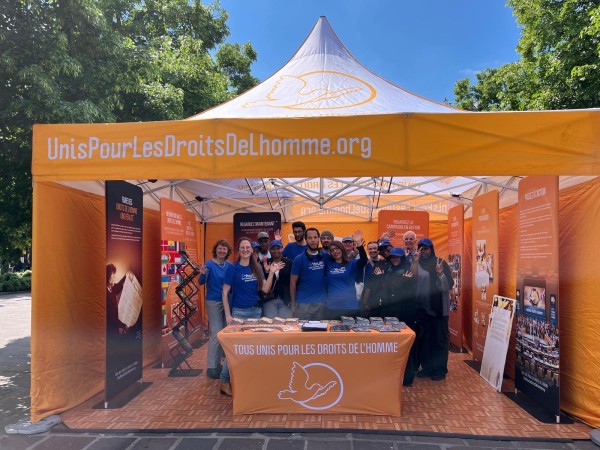
On Europe Day, volunteers distributed 1,500 educational items on human rights and their history, drawing steady public attention in the French capital.
Mobile Human Rights Education Exhibit
Brussels, Belgium, 14th May 2026 — A mobile human rights exhibit held in central Paris on 9 May brought a visible public education initiative to one of the city’s busy pedestrian areas, where residents and visitors were invited to learn more about the Universal Declaration of Human Rights and the long history of human rights ideas.
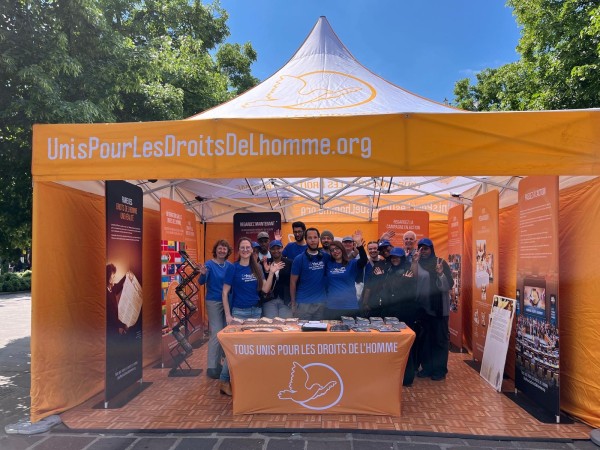
The exhibit, set up in a highly visible tent, drew the attention of passers-by throughout the day. Around 15 volunteers took part in the initiative, distributing approximately 700 flyers inviting people to visit the stand and 800 educational booklets presenting human rights and their historical development in accessible language.
The activity coincided with 9 May, widely marked across the European Union as Europe Day, a date associated with peace, cooperation and the civic values that shaped post-war Europe. In that context, the Paris exhibit placed human rights education at street level, offering short conversations, printed materials and visual displays to people of different ages and backgrounds.
Public Awareness and Civic Values
The mobile exhibit presented human rights not as an abstract legal concept, but as a practical subject connected to daily life, dignity and civic responsibility. Visitors were able to view panels, receive booklets and speak with volunteers about the origins and meaning of fundamental rights, including the importance of education in making those rights understood by younger generations.
The initiative forms part of the broader human rights education work supported by members and groups of the Church of Scientology, inspired by the writings of Scientology founder L. Ron Hubbard, who placed strong emphasis on human dignity, moral responsibility and the role of education in improving society. In France and across Europe, Scientology volunteers have taken part in public information activities focused on human rights, drug prevention, literacy, moral values and community support.
The Paris event also reflected the wider civic education approach promoted through Scientology Europe’s EU Values campaign, which presents European values such as human dignity, freedom, democracy, equality, rule of law and human rights as principles that require understanding and practical application in daily life. By placing educational materials directly in a public space, the Paris exhibit connected the universal language of human rights with the European civic framework in which those rights are protected and discussed.
Community Engagement in Paris
“Human rights become meaningful when they are understood by ordinary people, not only by institutions,” said Ivan Arjona, representative of the Church of Scientology to the European Union, the OSCE, the Council of Europe and the United Nations. “An exhibit like this in Paris reflects a very European idea: that dignity, freedom of conscience and responsibility belong in public life. It is also fully aligned with the spirit of Europe’s values, which depend on citizens who know their rights, respect the rights of others and take responsibility for building more inclusive communities.”
The Paris volunteers reported that the tent’s visibility helped bring a constant flow of people past the exhibit. Some stopped briefly to take a flyer, while others entered the tent, asked questions or received booklets. The format allowed the materials to reach both local residents and international visitors passing through the area.
The booklets distributed during the day presented the development of human rights through history, including the modern understanding reflected in the Universal Declaration of Human Rights, adopted by the United Nations General Assembly in 1948. By using simple language and visual presentation, the exhibit aimed to make the subject accessible to people who may not usually engage with formal legal or institutional documents.
Ongoing Human Rights Outreach
For the volunteers, the activity was also a practical expression of civic participation. Human rights education campaigns often depend on direct contact with the public, particularly in urban spaces where people from many cultures, languages and social backgrounds meet. In Paris, a city closely associated with the history of rights, citizenship and public debate, the mobile exhibit provided a setting where those themes could be presented in a direct and approachable way.
The Church of Scientology has long supported educational and social betterment campaigns carried out by its churches, missions and volunteers. These initiatives include human rights awareness, drug prevention, disaster response through Volunteer Ministers, and moral education based on common-sense principles. While each activity is adapted to local circumstances, the common emphasis is on prevention, education and individual responsibility.
The Paris exhibit reflected that approach. Rather than focusing on ceremony or speeches, the event relied on visibility, printed educational materials and one-to-one engagement. The presence of volunteers throughout the day allowed people to receive information at their own pace, ask questions and continue on their way with materials they could read later.
Scientology Europe Continental Presence
The Church of Scientology, its churches, missions, groups and members are present across the European continent. Scientology Europe reports a continent-wide presence through more than 140 churches, missions and affiliated groups in at least 27 European nations, alongside thousands of community-based social betterment and reform initiatives focused on education, prevention and neighbourhood-level support, inspired by the work of Scientology founder L. Ron Hubbard.
Within Europe’s diverse national frameworks for religion, the Church’s recognitions continue to expand, with administrative and judicial authorities in Spain, Portugal, Sweden, the Netherlands, Italy, Germany Slovakia and others, as well as the European Court of Human Rights, having addressed and acknowledged Scientology communities as protected by the national and international provisions of Freedom of Religion or belief.
Frequently Asked Questions (FAQs)
1. What was the purpose of the Paris human rights mobile exhibit?
The exhibit aimed to educate the public about human rights. It also explained their history and the Universal Declaration of Human Rights. In addition, volunteers shared materials and spoke with visitors in central Paris.
2. When did the Paris human rights exhibit take place?
The event took place on 9 May 2026. This date is also known as Europe Day in the European Union. In addition, it is linked with unity and shared civic values.
3. How many educational materials were distributed during the event?
Volunteers distributed about 700 flyers. They also handed out around 800 booklets. In addition, the activity took place during a one-day public event in Paris.
4. What topics were covered in the educational booklets?
The booklets covered the history of human rights. They also explained the Universal Declaration of Human Rights. In addition, they referenced the UN declaration from 1948.
5. Who organized or supported the human rights exhibit?
Volunteers supported the exhibit. Groups linked with the Church of Scientology also supported it. In addition, they took part in wider civic education activities across Europe.
6. Why was Paris chosen for the mobile exhibit?
Organizers chose Paris for its strong link to civic life and rights discussions. In addition, the city has a history of public debate and freedoms. This made it a suitable place for outreach.
7. How did visitors interact with the exhibit?
Visitors stopped at the tent and viewed displays. They also asked questions and received printed materials. In addition, some visitors stayed longer to discuss human rights topics.
8. What role did volunteers play during the event?
About 15 volunteers took part in the exhibit. They handed out materials and answered questions. In addition, they spoke directly with members of the public throughout the day.
9. What broader themes were highlighted during the exhibit?
The exhibit focused on human dignity and civic responsibility. It also highlighted freedom of conscience and human rights awareness. In addition, it promoted understanding in democratic societies.
10. Are similar human rights education activities conducted elsewhere in Europe?
Yes, similar activities take place in other European countries. Volunteers run campaigns on human rights and education. In addition, they also support outreach on drug prevention and community awareness.
Company Details
Organization: European Office Church of Scientology for Public Affairs and Human Rights
Contact Person: Ivan Arjona
Website: https://www.scientologyeurope.org
Email: Send Email
Address: Boulevard de Waterloo 103
City: Brussels
State: Brussels
Country: Belgium
Release Id: 14052645058