
What Should a Crisis Management Press Release Include to Control the Narrative?

What Should a Crisis Management Press Release Include to Control the Narrative?
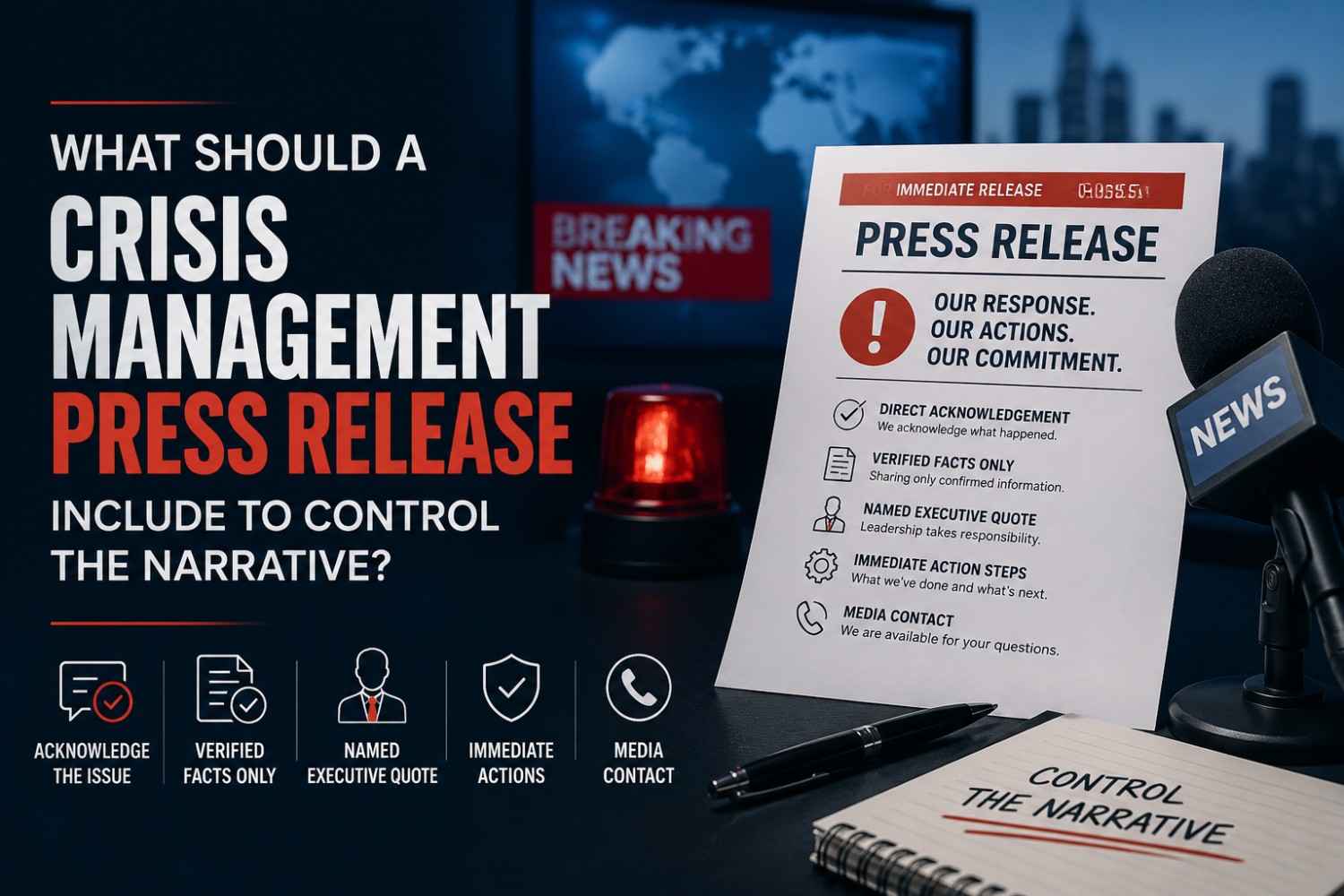
Quick answer: A crisis management press release should always include direct acknowledgement of what happened, only verified facts, a named executive quote, concrete immediate action steps, and an open media contact. Issued within the first four hours through a verified wire service, it is the fastest way to control the narrative before speculation does.
From the moment a crisis becomes public, the period before your first press release often defines the narrative that follows. A crisis management press release is more than a reactive document; it is your organisation’s first opportunity to shape the narrative before the media, social media, and rumours take control.
According to the 2026 Edelman Connected Crisis Study, organizations that issue a public statement within the first four hours of a crisis maintain significantly higher stakeholder trust than organizations that take their time with it. That trust gap is difficult to close once it opens. What you say and when determines whether the story ends with your response or continues without you.
King Newswire helps organisations prepare, write, and distribute crisis statements to over 1,000 verified media outlets including Yahoo Finance, Bloomberg, AP News, Business Insider, and MarketWatch. Review King Newswire’s distribution plans to choose the wire package that matches the urgency of a Level One or Level Two crisis.
What Is a Crisis Management Press Release?
A crisis management press release is a formal public statement that’s issued in connection with a reputation-related, operations-related, or safety-related event which is out in the open. Unlike usual press releases, communications teams must prepare it under extreme time constraints and with incomplete information. This sits within the broader discipline of crisis communication, and for a closer look at how the format itself functions in these moments, see why press releases remain the backbone of crisis management.
The document serves two functions simultaneously. As a public statement, it dictates your organisation’s stance on the documented version of events. Internally, it conveys a message to employees, partners and investors that leadership is transparent. Effective crisis statement distribution through a verified wire service will help ensure that the narrative gets to the right audiences before it becomes entrenched elsewhere.
What Makes a Crisis Press Release Different?
Every standard press release has the luxury of time. A crisis management press release does not.
- Speed is non-negotiable: A reputational crisis PR situation unaddressed for twelve hours has already been shaped by sources the organisation cannot influence. Issue the first statement as soon as verified facts allow. Avoid waiting for the whole story. Speak when you know enough to communicate accurately.
- Tone must be transparent without being defensive: A statement that reads like a legal disclaimer signals self-protection as the priority; a sincere statement demonstrates honesty and accountability. For any reputational crisis PR event, the purpose must focus on stakeholder reassurance. Every sentence must explain what happened, describe the actions your team is taking, and outline the next steps. For a closer look at the first-hour choices that shape coverage, see how organisations should respond before the story writes itself.
How Do You Classify the Severity of a PR Crisis?
Not every negative event requires the same response. Understanding the level of crisis escalation determines the scale and urgency of your press release strategy.
What Is a Level One Crisis?
A Level One crisis is a contained, lower-visibility incident with limited immediate media impact — such as a localised product complaint, a minor service disruption, or isolated social media criticism that has not yet spread. A holding statement should already be prepared. The media monitoring trigger for Level One is any sign the story is beginning to travel beyond its original audience.
What Is a Level Two Crisis?
A Level Two crisis carries significant public visibility and genuine reputational fallout risk. Product recalls, data breaches, executive controversies, and workplace safety incidents fall here. At this level, a formal crisis management press release distributed through a professional wire service is the minimum standard for a credible PR disaster response. Crisis statement distribution through King Newswire’s verified network ensures the organisation’s position reaches financial journalists and mainstream media before speculation fills the gap.
What Should a Crisis Management Press Release Always Contain?
- Direct acknowledgement: The opening paragraph names the situation without evasion. A vague line such as “We are aware of reports concerning” is not enough — name what happened and when.
- Verified facts only: Include only what is confirmed. If the full picture is unclear, say so and explain what investigation is underway.
- Named accountability: A senior executive must be quoted by name. A statement attributed to “a company representative” signals liability management rather than genuine leadership. Named accountability is the most powerful element in any PR disaster response.
- Immediate action steps: What has already been done? What is happening now? What will happen in the next 24 to 72 hours? Specifics are credible, general commitments are not.
- Media contact: One person clearly and openly available for follow-up with the media to answer journalist questions, not as part of a controlled message.
Why Does Crisis Media Outreach Through a Verified Network Matter?
A statement published only on a company website reaches the audience already looking for it. A crisis management press release distributed through King Newswire reaches those who shape the narrative, financial journalists at Bloomberg, editors at AP News, reporters at Business Insider and MarketWatch. For more on this dynamic, see the specific role a press release plays during a crisis.
If Yahoo Finance publishes a verified press release within hours of the incident, it indicates the company is responding in a formal and responsible way. That signal directly supports post-crisis recovery by establishing credibility before others define the story.
After every distribution, King Newswire provides a full placement report with verified links as evidence that the crisis media outreach reached authoritative platforms and created a verifiable public record.
What Should Happen After the Crisis Statement Is Issued?
- Produce follow-up updates: Keep the public record up to date as more facts become available. A second statement reporting investigative findings or corrective actions reinforces transparency over time.
- Do a review after the crisis: What went well in the response? Where did messaging gaps occur? The right answers to these questions increase preparedness for future crisis situations.
- Communicate what has changed: The post-crisis rebuild cycle is completed with a final message that outlines new policies, protection or commitments, showing that there is accountability beyond the initial announcement.
About the Author
From the King Newswire team: Developed by King Newswire’s editorial and crisis communications content group. King Newswire’s trusted verification enables you to deliver your press release to 1000+ outlets worldwide, so that your organisation can respond to reputation damaging incidents the quickest, most accurate and professional way.
Frequently Asked Questions
1. How quickly should a crisis press release go out?
Within four hours of a Level Two crisis becoming public. King Newswire optimizes its review and distribution process for time-sensitive submissions. King Newswire publishes most statements on the same day.
2. What if we don’t have all the facts yet?
Make a holding statement that acknowledges the situation, that an investigation is underway and set a timeframe for the next holding statement. At this point, it is more important to get accurate data than complete data.
3. Should every crisis press release include a quote from the CEO?
For significant Level Two crises, yes. Name the CEO or the most senior relevant executive. Their visibility signals governance accountability to investors and journalists.
4. Does King Newswire support follow-up distributions during an ongoing crisis?
Yes. King Newswire works with organisations across the full response arc from the initial statement through to post-crisis rebuild announcements. Explore King Newswire’s wire distribution packages to match the right tier to each stage of that response.
5. Can crisis statements be pre-drafted before a crisis occurs?
Yes, and they should be. Pre-drafted holding statements for the most likely crisis scenarios dramatically reduce response time when an incident occurs.
6. What does King Newswire’s placement report show after crisis distribution?
A verified list of every outlet that published the statement, with confirmed links evidence of timely, professional crisis media outreach for board reporting and stakeholder communications.