
Crisis Management Press Release: How to Respond Before the Story Writes Itself

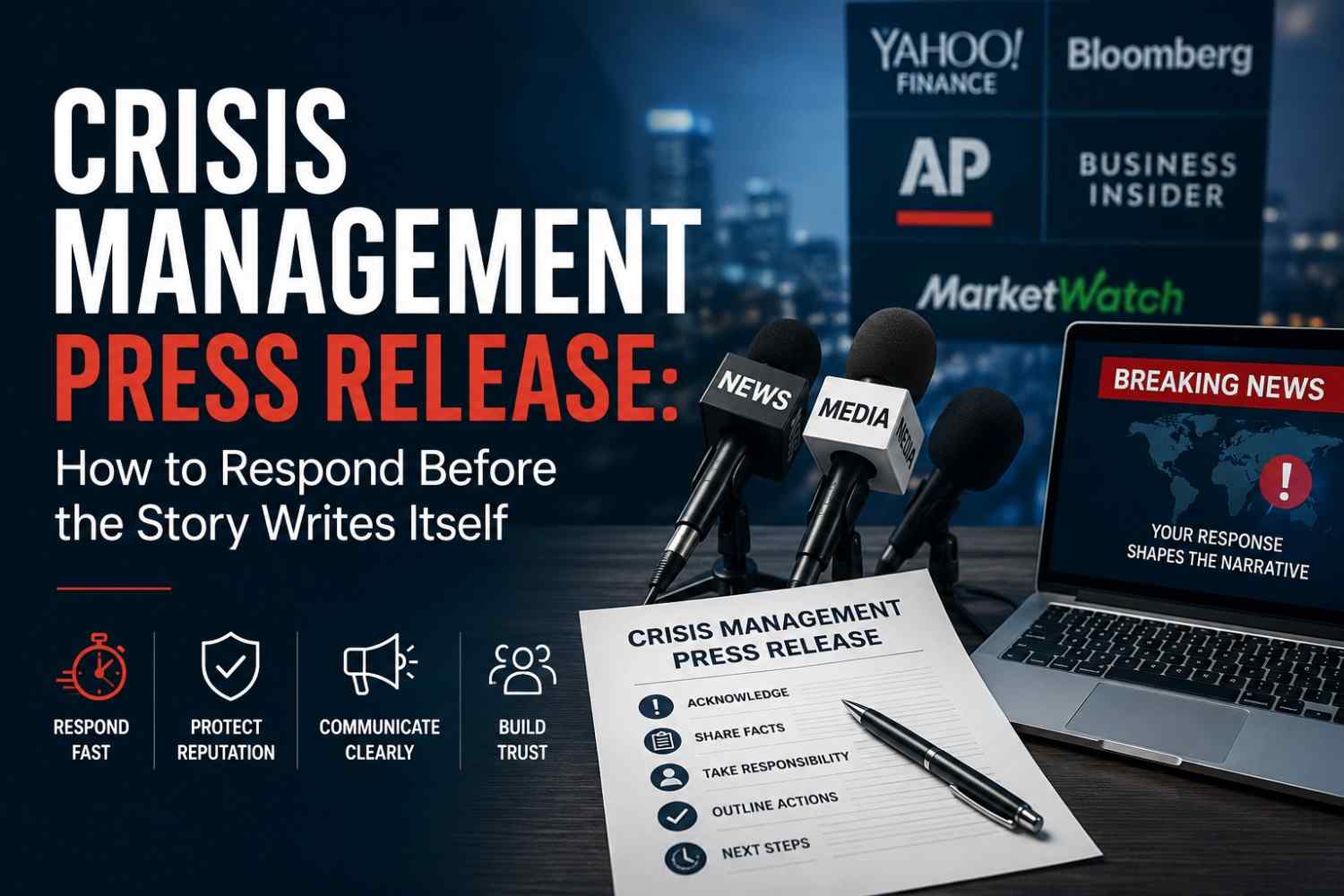
Crisis Management Press Release: How to Respond Before the Story Writes Itself
Every business will eventually face a crisis — a bad product recall, a data leak, a scandal, or a regulatory inquiry that plays out in the public eye. How quickly and clearly you communicate in that moment determines whether your brand’s reputation survives it, so the story doesn’t end up writing itself.
A crisis management press release is the tool that answers that question in your favour. King Newswire shares critical information about your organisation with 1000+ validated media partners, including Yahoo Finance, Bloomberg, AP News, Business Insider and MarketWatch ensuring your message reaches the media when it matters most.
Speed is not optional in a crisis. A delayed or defensive statement leaves a vacuum that media and social platforms fill on their own terms, and the first version of events — right or wrong — tends to stick in the public mind. Effective crisis management treats the first hours after a crisis breaks as the period that shapes stakeholder trust the most. That window is not recoverable through later communications. The first response defines the narrative.
What Makes a Crisis Management Press Release Different
A crisis management press release works under very different conditions to the usual corporate press release. Your audience isn’t just reporters and investors, it is everybody with an interest in the organization that has heard something and is waiting to see how the organisation responds.
The tone should be honest but not defensive. The facts must be accurate even when uncomfortable. The timing must be fast even when internal processes are still evolving. King Newswire’s emergency media statement review is designed for exactly these conditions, combining fast editorial checks with crisis news distribution that reaches authoritative platforms within hours of submission.
The Core Elements of an Effective Crisis Announcement
Immediate Acknowledgement
The opening paragraph must acknowledge the situation directly, not through vague or legalistic language that implies nothing happened. Organisations that open crisis statements vaguely signal to every reader that they are more concerned with protecting themselves than being honest. That signal accelerates the loss of trust.
King Newswire’s editorial review checks acknowledgement clarity before every statement enters the distribution pipeline.
Verified Facts and Current Status
The body must contain only what is verified. Speculation and unconfirmed timelines create follow-up problems that compound the original crisis. If the full picture is not yet clear, say so and explain how your team is establishing the facts.
What the organisation knows, what it is doing, and what stakeholders can expect next are the three things every reader of a reputation recovery press release needs before going elsewhere for information.
Named Accountability
Every crisis communication needs a named executive taking visible responsibility. Not a generic corporate “we,” but a named chief executive or board representative whose quote acknowledges the situation and outlines the immediate response. This is the same governance principle behind a strong new executive leadership press release or a well-crafted new CEO announcement — visible, named leadership builds more trust than any anonymous statement.
Named accountability is a governance signal. An emergency media statement attributed to “a company spokesperson” suggests the organisation is managing liability rather than managing the situation.
Action and Timeline
The closing section must communicate what the organisation is doing right now and what stakeholders can expect. Specific actions a third-party investigation commissioned, a product recall initiated carry credibility. Vague commitments to “take this matter seriously” do not.
The Role of Speed and Distribution in Crisis Communications
A crisis not formally addressed within the first few hours becomes one the media defines for you. Journalists fill silence with information from sources the organisation cannot control and narratives it may later struggle to correct.
King Newswire’s crisis news distribution pipeline is designed for this environment. King Newswire can distribute approved statements across its verified outlet network within hours of submission. This helps organisations reach financial and mainstream media before external narratives take shape. See how our distribution process works from submission to live placement.
Reaching the Right Audiences First
A reputation recovery press release placed on Yahoo Finance, Bloomberg, Business Insider, and AP News carries implied credibility that owned channels cannot provide. When investors encounter a crisis statement on Bloomberg rather than a social media post, the framing changes entirely. They are reading verified corporate crisis communication not a reactive update from an account they are already suspicious of. Explore King Newswire’s media placement packages to choose the distribution tier that fits your organisation, and get your crisis management press release in front of the outlets that matter most.
Common Mistakes in Crisis Press Releases
- Waiting too long: Every hour of silence adds weight to the version of events the organisation did not write. The first statement doesn’t have to be comprehensive, it needs to be sincere, and it needs to be now.
- Overreliance on Legal Language : A statement written solely to minimise legal risk often fails to connect with stakeholders. There must be a balance between legal caution and genuine acknowledgement of the situation.
- Be specific: No detail is too small to include — vague statements like “an incident” invite speculation, and honest, direct language is far more convincing than any spin. The same discipline applies across every type of announcement; see these common press release mistakes that hurt credibility for a wider view.
- Keep it to one statement: Crisis communications are unlikely to be solved with one statement. King Newswire supports organisations across the full arc of a crisis response from the initial emergency media statement through to follow-up updates — explore King Newswire’s follow-up distribution plans to keep stakeholders updated as the situation develops.
Conclusion
A crisis management press release issued quickly, written honestly, and distributed through a verified professional network is the most powerful tool an organisation has following a reputational event. It helps to frame the story before it can be told by others, reflects governance confidence at a time when trust is at its lowest ebb, and provides a public record of what the organisation did in response. King Newswire gives organisations the editorial support and distribution reach to make that response the one that defines the story.
About the Author
King Newswire editorial: Content produced by the King Newswire writing team, with review from distribution specialists experienced in time-sensitive corporate and executive communications. King Newswire has a trusted press release distribution system that reaches 1,000+ media outlets in all key markets worldwide. The editorial team has guided organisations across finance, healthcare, technology, and consumer sectors through product recalls, data incidents, and leadership transitions, reviewing each statement for factual accuracy, tone, and governance signal before it goes out. Article last reviewed and updated: July 2026.
Frequently Asked Questions
1. Does the first crisis statement need to contain all the facts?
No. An honest acknowledgement that the organisation is aware of the situation and is actively investigating is sufficient in the first hours. Accuracy matters more than completeness, never include unverified information.
2. Who should serve as the spokesperson in a crisis press release?
The most senior available executive relevant to the situation. A CEO, chief communications officer, or board chair gives the statement more weight than a generic spokesperson credit.
3. How does King Newswire distribute crisis announcements so quickly?
King Newswire’s editorial review is optimised for time-sensitive submissions. Approved crisis statements enter the distribution pipeline rapidly, with placements going live across the verified outlet network on the same day.
4. Can King Newswire help structure a crisis statement from scratch?
Yes. The editorial team helps organisations frame accurate, appropriately toned, and distribution-ready responses.
5. Should we issue follow-up releases as the crisis develops?
Yes. Reputation recovery rarely happens through a single statement. Factual and regular updates that provide explanations as to what you are doing, demonstrate accountability and keep stakeholders informed.
6. What tone is appropriate for a crisis press release?
Transparent, factual, and human. Avoid legal language that sounds evasive and promotional language that sounds tone-deaf. The statement should reflect an organization that understands the seriousness of the situation.
7. How is a crisis press release different from a standard corporate announcement?
A standard announcement may be prepared and refined over a period of several days, and may be used by teams. The timing, uncomfortable facts and the focus on reassuring stakeholders outweigh corporate messaging in a corporate crisis communication.
8. Does placing a crisis statement on major outlets help or make things worse?
It helps, consistently. An organization that disseminates information during a crisis via trusted and credible sources is transparent. If there is only one channel, then people may perceive that organisations are controlling the message rather than dealing with the issue.