
BOT Chain Debuts at Korea Web3 Carnival as Infrastructure for Next-Gen On-Chain Collaboration

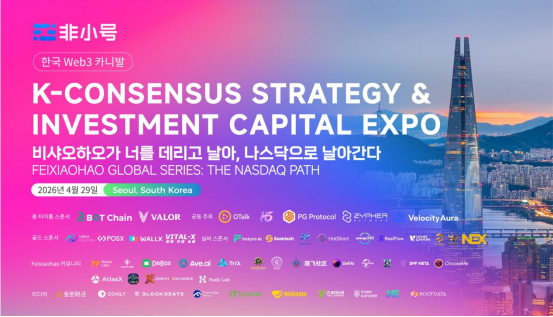
China, 7th May 2026 – On April 29,2026, the “Feixiaohao Takes You Flying: Korea Web3 Carnival,” organized by Feixiaohao.ai, was held in Seoul, South Korea. As one of the dual title sponsors of the event, BOT Chain made a high-profile appearance at this summit gathering over 3,000 industry elites and institutional representatives. Its two key representatives delivered in-depth presentations on the projects underlying logic, ecosystem architecture, and future plans, systematically articulating its core value and establishing BOT Chain as a highly distinctive force within the conferences foundational technology sector.
BOT Chain Seoul Strategy
For BOT Chain, participating in this Seoul event holds significance that extends far beyond brand exposure. The Korean market has consistently placed greater emphasis on the actual scalability and subsequent ecosystem development potential of infrastructure projects. The core focus of the “Non-Xiao Hao Takes You Flying” Korea session was precisely how Web3 projects can be understood within a framework that aligns more closely with mainstream capital valuation logic. By entering this arena as the official title sponsor, BOT Chain has elevated itself from a mere “technical concept” to a topic worthy of capital discussion, laying a solid foundation for future connections with global investors and expansion into the Northeast Asian market.
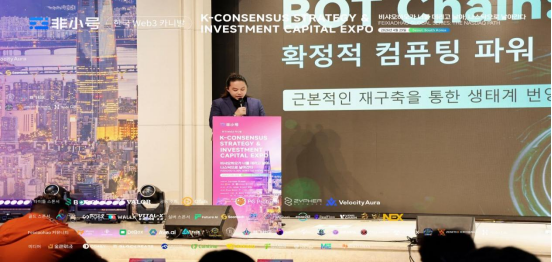
At the summit, KAI, representative of BOT Chain, delivered a keynote speech titled “The Productivity Revolution in the Modular Era and BOT Chains Underlying Logic,” providing an in-depth analysis of the projects technical core and future development roadmap. KAI emphasized that as modularity becomes the dominant trend in Web3 infrastructure development, BOT Chain positions itself as a modular algorithm network designed for AI Agent and DePIN collaboration scenarios. Through its self-developed parallel engine, the chain delivers high-performance support with tens of thousands of TPS, overcoming the rigid, one-size-fits-all architecture limitations of traditional public chains.
BOT Chain Modular Architecture Development Update
It establishes a modular foundation that allows flexible composition and independent upgrades—breaking down core modules like consensus, execution, and storage into pluggable components enabling developers with diverse needs to adapt to their specific requirements, thereby achieving the core objective of “the chain serving applications.” This represents BOT Chains technological strength in addressing the demands of large-scale collaboration in the AI era.
Moving forward, BOT Chain will continue optimizing its underlying technologies, focusing on implementing privacy-preserving computing and quantum-resistant algorithms to further stabilize its high-performance TPS capabilities. It will also refine its integrated hardware-software computing network architecture, strengthening its technical competitive edge to better align with the real-world requirements of diverse collaboration scenarios such as AI Agents and DePIN, ultimately building a system-level foundation tailored for large-scale Web3 applications.
Ecosystem Architecture Expansion
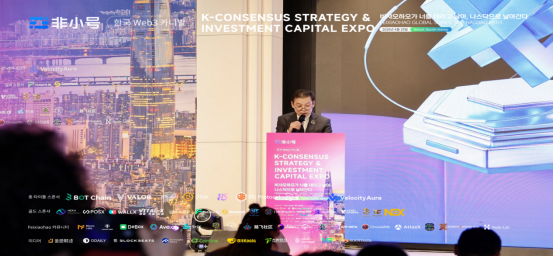
Subsequently, Kevin Ji, the core representative of BOT Chains ecosystem development, delivered an expanded presentation titled “BOT Chains Premier Ecosystem and Super Traffic Gateway,” clearly outlining the projects ecological framework and long-term strategic plan. Ji emphasized that BOT Chains core focus lies not merely in building a public blockchain, but in establishing a comprehensive closed-loop ecosystem characterized by “infrastructure first, application follow-up, and traffic aggregation.” The future mission centers on “creating a super traffic gateway for the ecosystem” to drive its full-scale implementation and expansion.
Specifically, the ecosystem development will advance along three key directions: First, enhancing the ecosystems infrastructure by continuously optimizing five core components—the main chain, the decentralized BDEX exchange, cross-chain bridges, on-chain browsers, and BO Wallet—to streamline asset circulation, application interoperability, and user access, thereby lowering entry barriers for developers and users. Second, expanding diversified ecosystem applications by focusing on mainstream sectors such as DeFi, AI Agents, GameFi, and RWA, with the goal of supporting 10,000 on-chain protocol instances by the end of 2027 to achieve widespread ecosystem adoption.
Third, building a traffic aggregation system centered around BO Wallet as the unified gateway, integrating asset management, DApp interoperability, and on-chain governance capabilities while establishing 8–10 regional hubs worldwide to consolidate and retain user traffic, thereby solidifying the ecosystems growth. Value and traffic value create a positive feedback loop. Additionally, Kevin Ji revealed that the project will employ a dual economic model combining “deflationary mechanisms and equity incentives” to ensure the long-term stable development of the ecosystem, positioning the BOT token as the value anchor for the AI computing power economy and enabling all ecosystem participants to share in the growth dividends.
Global Web3 Positioning Vision
The presentations by the two representatives were seamlessly connected and logically complementary, enabling BOT Chain to present not merely a standalone public chain narrative, but a comprehensive development framework encompassing everything from underlying performance to application interfaces, and from technical architecture to ecosystem implementation. Based on existing project materials, BOT Chain—a modular algorithm network designed for AI Agent and DePIN collaboration scenarios—stands out for its dual strengths: high-performance underlying infrastructure and a clear roadmap for ecosystem deployment. This is precisely what sets it apart in the current Web3 infrastructure landscape. As AI-f实体 integration scenarios proliferate, the market is re-evaluating “which blockchain can truly support large-scale collaboration,” and BOT Chains technical architecture and ecosystem strategy perfectly address this demand.
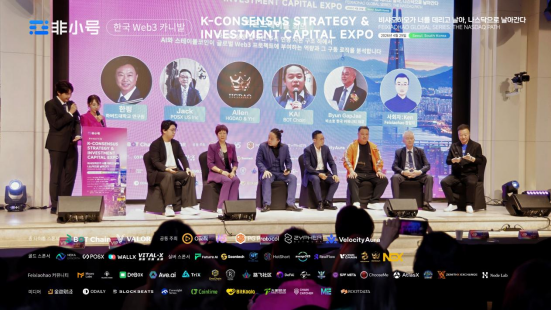
From a post-conference perspective, BOT Chains debut in Seoul aligns with Feixiaohao.ais ongoing advocacy for the “coin-share linkage” narrative. The conference serves not merely as a showcase for projects, but also facilitates deeper capital engagement among initiatives across various sectors. For infrastructure projects like BOT Chain, this signifies that their value proposition extends beyond technical white papers into a collaborative evaluation framework involving institutions, media, and the market—laying the groundwork for securing mainstream capital and achieving capitalization-driven growth.
BOT Chain Korea Web3 Carnival Debut
With the successful conclusion of “Nonxiaohao Takes You Flying: Korea Web3 Carnival,” BOT Chain, as the main sponsor project, made a high-profile debut in the Northeast Asian market. For a modular infrastructure project still in its ecosystem expansion phase, the value of participating in this event lies in positioning BOT Chain closer to real-world market selection mechanisms.
The presentations by its two core representatives also provided global industry leaders and investors with a clear understanding of the projects technical capabilities and long-term growth potential. Moving forward, BOT Chain will continue advancing technological iterations and ecosystem implementation, fulfilling its vision to “become the foundational platform for next-generation on-chain collaboration scenarios” and achieving sustained breakthroughs in the Web3 infrastructure sector.
About BOT Chain
BOT Chain is a modular algorithm network designed for AI Agent-DePIN collaboration scenarios, powered by a self-developed parallel engine. It delivers tens of thousands of TPS and robust underlying capabilities for large-scale Web3 applications, forming a complete ecosystem through five core infrastructures. Having secured $15 million in funding and passed CertiK security audits, BOT Chain aims to serve as the system-level foundation for next-generation on-chain collaboration, driving Web3 infrastructure toward greater adaptability, usability, and scalability.
Frequently Asked Questions (FAQs)
1. What is BOT Chain?
BOT Chain is a modular algorithm network designed for AI Agent and DePIN collaboration scenarios. It focuses on scalable blockchain infrastructure. In addition, it offers high transaction throughput and a flexible architecture. This design supports large-scale Web3 applications and ecosystem development.
2. What event did BOT Chain participate in during 2026?
BOT Chain participated in the Korea Web3 Carnival organized by Feixiaohao.ai. The event was held in Seoul on April 29, 2026. Moreover, it brought together industry representatives, investors, and blockchain organizations from across the Web3 sector.
3. Why was BOT Chain’s appearance at the Seoul event significant?
According to the release, the event gave BOT Chain a platform to present its infrastructure strategy. It targeted investors, institutions, and Web3 participants. Furthermore, the Korean market values scalability and ecosystem potential. Therefore, the conference was highly relevant for infrastructure-focused blockchain projects.
4. What technology focus does BOT Chain emphasize?
BOT Chain emphasizes modular blockchain architecture and high-performance infrastructure. It separates key components such as consensus, execution, and storage into independent modules. As a result, developers can customize blockchain environments. This avoids reliance on fixed system structures.
5. What are AI Agent and DePIN collaboration scenarios?
AI Agent scenarios involve autonomous software systems. These systems interact directly with blockchain networks. On the other hand, DePIN refers to decentralized physical infrastructure networks. BOT Chain positions its infrastructure to support both systems. It enables collaboration and data exchange between them.
6. What infrastructure components are included in the BOT Chain ecosystem?
The ecosystem of BOT Chain includes five main components. These are the main blockchain network, BDEX decentralized exchange, cross-chain bridges, on-chain browsers, and BO Wallet. Together, they support asset management, interoperability, and user access. In addition, they work across multiple blockchain environments.
7. What role does BO Wallet play in the ecosystem?
BO Wallet acts as a unified access gateway in the BOT Chain ecosystem. It combines several functions into one interface. These include asset management, DApp interaction, and governance participation. Therefore, it helps users access ecosystem services more efficiently.
8. What scalability goals has BOT Chain discussed for the future?
BOT Chain plans to expand its ecosystem significantly. It focuses on DeFi, AI Agents, GameFi, and RWA applications. Additionally, it aims to support thousands of on-chain protocol instances by the end of 2027. This forms part of its long-term growth strategy.
9. What security and funding information was mentioned in the release?
The release states that BOT Chain secured $15 million in funding. Moreover, it completed security audits through CertiK. These audits review smart contracts, infrastructure, and potential vulnerabilities. As a result, the system is better prepared for wider deployment.
10. What is BOT Chain’s long-term vision for Web3 infrastructure?
BOT Chain aims to build infrastructure for large-scale on-chain collaboration. It focuses on improving scalability, adaptability, and usability. In addition, it combines modular architecture with ecosystem applications. Ultimately, the goal is to support evolving blockchain and AI-driven use cases.
Company Details
Organization: CHINA SHUNHE GROUP CO., LIMITED
Contact Person: Alice
Website: https://zpnchain.io/
Email: Send Email
Address: RM 21 UNIT A 11/F TIN WUI IND BLDG NO 3 HING WONG ST TUEN MUN NT HONG KONG
Country: China
Release Id: 07052644757