How to Write a Personal Branding Press Release That Builds Authority and Trust

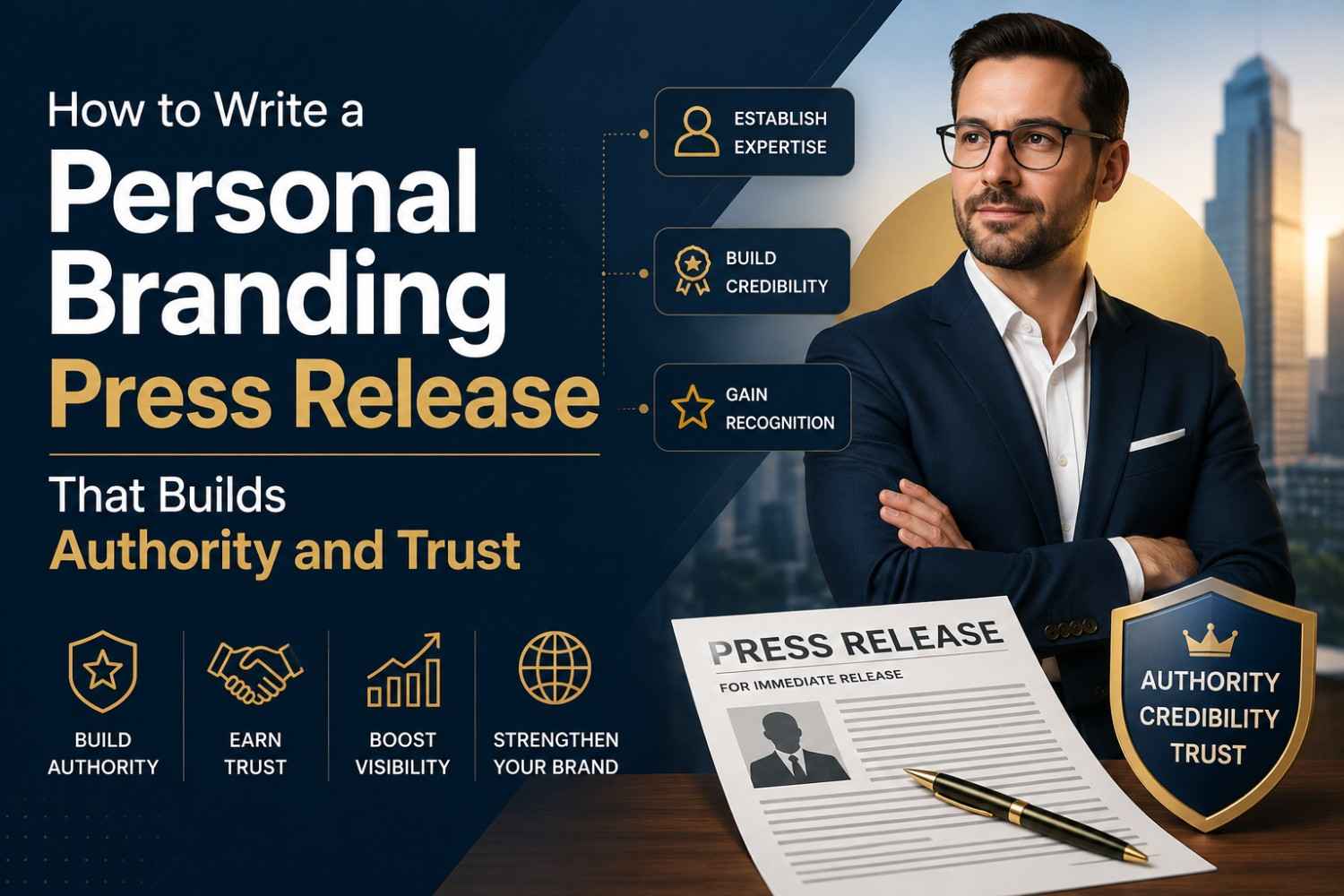
How to Write a Personal Branding Press Release That Builds Authority and Trust
Author Bio
Written by: King Newswire Editorial Team — Press Release Strategy & Personal Branding Desk | 10+ Years in Digital PR & Media Distribution
Credentials: 10+ Years Experience in Press Release Writing, Media Distribution, Personal Branding PR, and Digital Visibility Strategies | 5,000+ Brands, Founders, Executives, and Professionals Served Worldwide
Published: June 2026 | Sources: Reuters Institute Digital News Report 2025, Google Search Quality Guidelines 2026, LinkedIn Professional Network Data, AI Search & Digital PR Industry Research
In 2026, trust is established before a first meeting ever takes place. Before someone meets you, calls you, or responds to your pitch, they have already Googled your name, reviewed your LinkedIn profile, and likely queried an AI tool to learn about you. Your digital reputation now precedes you in every professional interaction.
Given these new realities, a personal branding press release is one of the most effective tools available to build and establish a trusted, publicly positive image. It formalises your accomplishments in a news story format that journalists, search engines, and AI tools can all process and verify.
It is also helpful in the building of trust and authority because it provides readers, journalists, search engines, and AI tools with verifiable information about your work. With more than 1.3 billion professionals on LinkedIn, the competition for visibility and credibility has never been greater — which is exactly why a well-crafted press release gives you a meaningful edge.
What Is a Personal Branding Press Release and Why Does It Matter?
Quick Definition: A personal branding press release is a structured news announcement about an individual professional — designed to build credibility, establish expertise, and improve online visibility across Google Search, AI tools, and media platforms. It is not a sales pitch; it is a factual record of your professional achievements distributed through credible news channels.
A personal branding press release is a formal news announcement about an individual. Unlike a company press release, the focus is on the individual’s story, expertise, achievements, or milestones of leadership.
For example, a business founder can announce a business milestone or achievement. A consultant can announce a new piece of research. A keynote speaker has an opportunity to announce a new speaking engagement. A new book can be announced via a book launch by the author. If you are unsure what format to follow, reviewing real press release examples from professionals in your industry is a helpful starting point.
A personal branding announcement explains your identity, your profession, and the significance of your work. It systematically formalises your personal brand message. In 2026, online trust is harder to earn than ever — and a press release is one of the few formats that search engines, journalists, and AI Overviews all treat as a credible, citable source.
Reuters Institute’s 2025 Digital News Report notes that as traditional media continues to lose trust and audience engagement, the demand for communication that is clear, well-sourced, and independently verifiable is growing significantly.
The Essential Elements of a Personal Branding Press Release
A personal branding announcement should be clear, factual, and informative. Avoid a sales tone. Aim to communicate the announcement clearly to the reader. Understanding the correct press release format before you begin writing will save you significant revision time.
● Create a Headline That Highlights Authority
Your brand announcement headline should concisely state your announcement in simple language. An example would be substituting “John Smith Makes a Big Move” with “John Smith, FinTech Consultant, Launches New Research on Small Business Payments”. This provides necessary context for search engines and your audience.
● Write an Introduction That Establishes Credibility
The first paragraph must include and answer the who, what, when, where, and why. It must also include and support the main person’s role and area of expertise. Personal brand writing is simple when professional value is easily communicated and understood. If you need a step-by-step walkthrough, our guide on how to write a press release covers every section in detail.
● Add Achievements, Results, and Supporting Proof
State awards, results, numbers, growth, your audience size, funding, research, events, and cite your references. Instead of the vague claim “well-known expert,” cite the specific research study or award that earned you that recognition.
● Include a Professional Quote and Bio
A quote needs to describe an insight and not just an opinion. A strong quote explains what the person sees as their mission and what goals they are working toward for their industry. Follow this with a brief author bio that includes credentials, a website link, and contact information. Bio sections are powerful E-E-A-T signals because they give readers — and Google — a clear picture of who is speaking and why they are qualified to do so.
How to Turn a Personal Achievement Into a Newsworthy Story
Not every professional update warrants a press release. A strong personal branding press release requires a clearly defined, newsworthy update — one that signals genuine professional progress rather than routine activity.
Promotions and leadership appointments are strong news angles because they signal career growth and growing organisational trust. A great example would be someone advancing from a senior individual contributor role to a member of the executive board or upper management.
Product launches and presentations demonstrate your contribution to your field and your willingness to push the industry forward. A research study is a particularly strong authority update because it introduces new, citable information to the professional conversation.
Other strong news angles for founders include entering a new market, securing a high-profile partnership, or closing a significant funding round. In each case, the PR writer’s job is to frame the milestone in terms of its impact on the industry — not just as a company announcement.
Personal Brand Writing Tips That Build Authority and Trust
The most effective personal brand writing strikes a balance between professionalism and human voice — it sounds like a credible person speaking to a reader, not a marketing brochure. Above all, it relies on facts rather than superlatives.
1. Focus on Facts Instead of Self-Promotion
Your releases should not be filled with accolades. They should include evidence instead. Consider including the project scope, measurable results, the size of your audience, the specific award received, or the market value created. With this approach, the announcement will be more credible, more useful to journalists, and more likely to rank well in search.
2. Use Clear and Consistent Brand Communication
Your personal branded communication should be consistent with your LinkedIn, website bios, media kits, and public communications. If there are discrepancies between platforms, trust erodes. A clear, consistent message helps with client recall and reinforces your authority in every channel where people discover you.
3. Support Claims with Data and Examples
Support your claims with data as much as possible. AI Overviews and AI Mode, according to Google, display links in different ways and provide a broader diversity of ranking results. In both Google and AI searches, discovery is supported by clear, structured, and evidence-backed content — not keyword stuffing. Learning how to write an SEO press release will help you structure your content for maximum search visibility.
2026 SEO and AI Search Optimization for Personal Branding Press Releases
In 2026, press releases serve two distinct functions. First, they help attract coverage through traditional editorial channels. Second, they give search engines and AI tools structured, authoritative signals to understand your professional identity. This dual purpose makes them one of the highest-ROI content investments available to professionals today. To understand what distribution options are available for your goals, learn what a press release is and how it works before publishing.
Avoid generic writing like ‘Sarah Khan is announcing a program’ and instead write ‘Sarah Khan, a leadership coach for startup founders, is announcing a new executive training program.’ This specificity helps Google identify the person, their niche, and the announcement — strengthening your entity authority in search.
For AI tools to surface clear and accurate information about you, ensure your bio features your profession, your industry, your major accomplishments, and reputable links back to your work. Every well-structured personal branding press release you publish adds another layer to the public information graph about your professional identity. Google confirms that AI Mode users can ask more detailed questions and discover sources across a wider range of links than traditional search.
Do not cram your writing with keywords. Instead of vague phrases like “this is a big deal,” quantify the value: state the dollar amount raised, the percentage growth achieved, or the number of people impacted. Content that answers the reader’s actual question will always outperform content that simply repeats a keyword.
E-E-A-T Signals That Strengthen Every Personal Branding Press Release
Google’s 2026 Search Quality Guidelines place significant weight on E-E-A-T — Experience, Expertise, Authoritativeness, and Trustworthiness. A well-crafted personal branding press release directly addresses all four signals:
- Experience: Include specific case studies, client results, or projects that demonstrate real-world application of your expertise — not just titles.
- Expertise: Reference credentials, publications, research, or awards that establish subject-matter depth in your stated field.
- Authoritativeness: Distribute through credible news outlets. Third-party publication of your release is itself an authority signal to both human readers and search algorithms.
- Trustworthiness: Link to verifiable sources. Cite real data. Ensure all claims can be independently confirmed. Factual accuracy is the foundation of every E-E-A-T signal.
Why Press Release Distribution Matters After Writing
For personal branding press releases, the greatest value is unlocked when the release is placed on reputable, high-authority news sites. The published backlinks that result from this press release distribution process strengthen search visibility and reinforce your professional authority in the eyes of both readers and Google.
At King Newswire, we support professionals with press release writing structured around 2026 SEO principles, alongside media distribution and detailed publication reports. These reports give clients a verified record of every outlet that published their release. Professionals can use this distribution infrastructure to systematically build personal brand visibility and authority across the web. Explore our press release distribution plans and pricing to find the right package for your personal branding goals.
A consistent archive of distributed press releases helps individuals build a verifiable, public narrative around their professional accomplishments — one that increases authority, trust, and long-term digital visibility for their personal brand.
Conclusion
Professionals who invest in a personal branding press release gain a structured, credible channel for communicating their achievements to the world. It strengthens their brand communications, amplifies their visibility, and establishes the kind of professional authority that search engines, AI tools, and human audiences all respond to. For professionals who want to start immediately, reviewing our available press release distribution plans is the fastest path to getting your story in front of the right audiences.
This is especially vital in 2026 when Google Search, AI Search, LinkedIn, and other media platforms shape how audiences perceive professional credibility. To achieve the intended results, write with accuracy, provide evidence and context, and distribute through reputable media channels.