
The Complete Research Press Release Checklist: 6 Things to Do Before Distribution

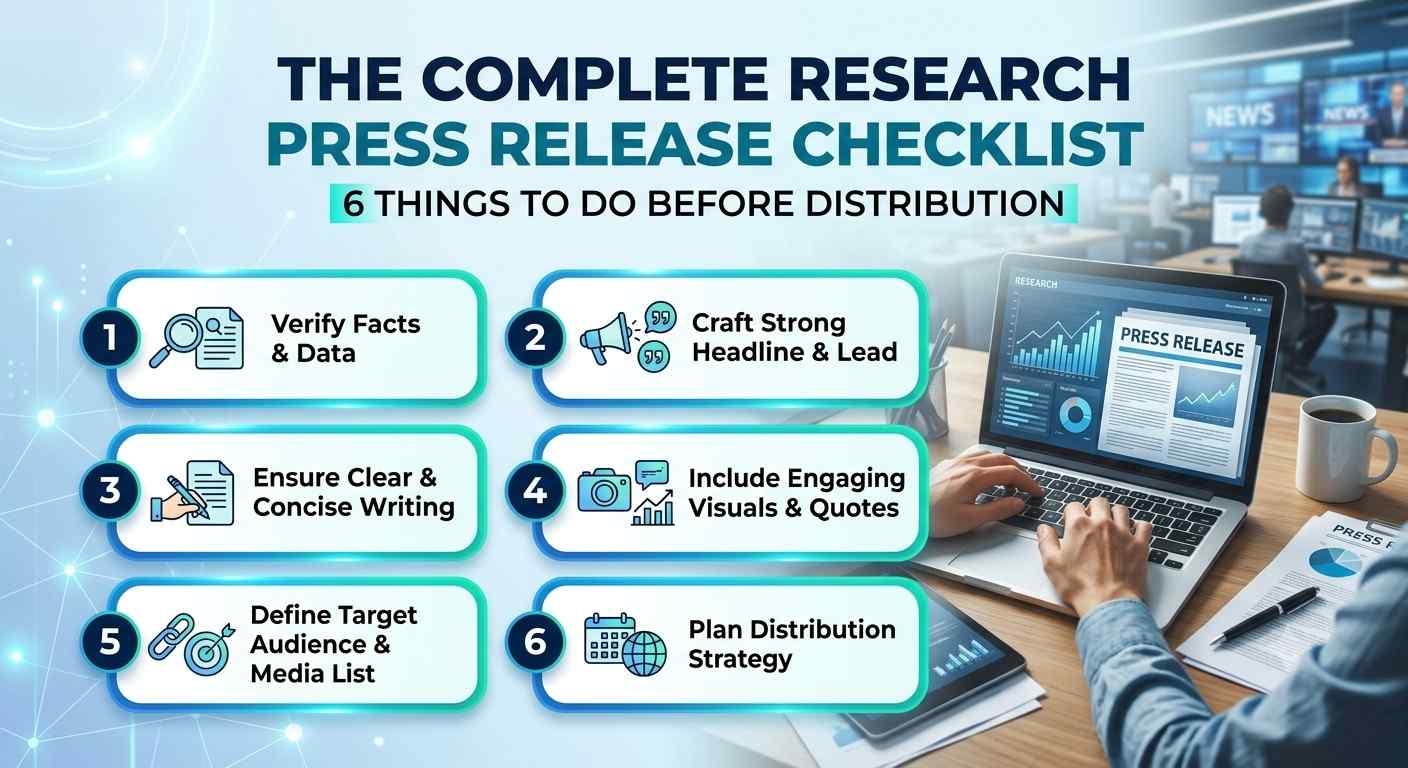
The Complete Research Press Release Checklist: 6 Things to Do Before Distribution
Written by the King Newswire Editorial Team — specialists in research PR, media outreach, news distribution, and SEO-focused press release publishing.
Published: July 2026 | Category: Research Communication, PR Strategy, SEO, Press Release Distribution | Last Updated: July 2026 | Reviewed by King Newswire’s Senior Editorial Team for accuracy and E-E-A-T compliance
Product announcements can be about features or about when a product is going to be released. But before a research announcement gets to the media, it needs to be accurate, sourced, and it should provide public value.
Factual, clear and well-prepared releases now double the support for journalists in media review as well as for enhanced search visibility via AI tools, as 82% of journalists reported using at least one AI tool in 2026 according to Muck Rack.
Why Research Press Release Preparation Matters Before Distribution
Research press release preparation safeguards trust. When a company releases before they’re ready, presents weak evidence, or omits evidence of limitations, the release may hurt credibility. For this reason, all research announcements should be more thoroughly reviewed before distribution. Skipping this step is one of the common mistakes in research project announcements, and it can quietly undermine brand credibility for years.
Media pick-up is also facilitated by preparation. Facts are frequently needed by journalists to check rapidly. They seek the research phase, the institution, the researcher, the method, the source and impact. If this information is clear, story coverage is easier.
Additionally, robust preparation boosts Google indexing and AI search visibility. Google indicates that people-first content is about providing content for readers, not primarily to game the rankings. This means that a research release must provide useful information, a clear focus, and solid information. This also contributes to the E-E-A-T signals, including experience, expertise, authority, and trust. Brands that work with a dedicated research development press release service are better positioned to meet these E-E-A-T requirements from day one.
The Complete Research Press Release Checklist: 6 Things to Do Before Distribution
1. Confirm the Research Is Validated and Ready for Public Release
First, make sure that the research is ripe for the public. Obtain approval from internal leadership, study team and legal review as needed. Review peer review status, journal acceptance, embargo rules and limitations of the study. For a full breakdown, see the core elements every research release should include before you draft anything.
This step is crucial as research language can be easily misinterpreted. For instance, preliminary lab tests should not be called conclusive. A pilot result should not be the success that is written down as market. Rather, make sure to give a clear description of the stage.
Ask before distribution: Is the information correct? Do the assertions have justification? Do the restrictions apply? Is the wording approved by the research team? If the answer is no, then put the publication on hold.
2. Build a Clear Research Announcement Template
Then, develop a robust template for your research announcement. A well-prepared template can guide the journalists to grasp the story quickly. It should contain a headline, dateline, opening paragraph, research purpose, key findings, expert quote, boilerplate and media contact. If you need a starting point, this step-by-step guide to writing a research and development press release walks through each section in detail.
The opening paragraph should address the 5Ws: who, what, when, where and why. Then, the body should describe the study in simple language. Avoid academic-heavy language. Rather, describe the research question and its importance.
It is helpful to have a clear quote as well. It should describe the research, not the headline! Lastly, add a brief company or institution boilerplate and media contact information.
3. Add Evidence, Sources and Research Credibility Signals
After the structure is ready, add evidence. More evidence is required in research press releases compared to regular PR. Present data, DOI, journal name, financial source, institution, credentials of the individual(s), methodology, and limitations. Since the goal is public communication rather than a journal submission, it helps to understand how research releases differ from scientific publications before deciding what level of detail to include.
Such information enhances the trustworthiness of the science. They also assist journalists and investors to determine if the research is worthy of their consideration. Investors can search for patents, funding, pilot results or commercial use, for example. Journalists might search for ways to make a public impact, get approval from experts, and find sources that link to them.
Specify whether the research is peer-reviewed; if it is not. If based on preliminary testing, describe the testing phase. When you can trust and avoid overclaiming, it is because of honest wording.
4. Make a Research-Specific Media Checklist
It’s not a normal media list. The following is a science media checklist for research: Science reporters, trade media, investor media, contacts of the university newsroom, editors of the industry and local or foreign journalists.
Make a media kit, too. Include images, charts, graphs, researcher photos, logos and links in the full report or study page. It is easier to understand complex research through visuals.
Next, draft your follow-up e-mail. Keep it short. Explain why it is important to the journalist’s audience. Avoid large attachments—use links. This increases the professionalism and usability of the outreach.
5. Optimize the Press Release for SEO and AI Search
Now get ready the release for search and AI discovery. Utilize natural language (e.g. research press release checklist, R&D press release checklist, press release preparation, research communication checklist). But refrain from artificially repeating them. For a deeper look at the ranking impact, this guide on how research releases improve SEO and AI search visibility explains how this translates into brand authority over time.
Add entity SEO. This will involve adding the name of the company, institution, researchers, research field, location, type of study, funding body and product category (if applicable).
Also contextualize the brand. Do not write “Company X announces research”; just write “Company X, a healthcare technology company in the clinical workflow space, announces new research”. This aids in Google AI Overviews, ChatGPT, and Perplexity comprehending the announcement.
6. Review Distribution Timing, Channels, and Reporting Plan
Finally, review distribution. Press release preparation encompasses planning, distribution, media syndication, tracking links, reporting on publication, and metrics. For the full workflow, see this guide on distributing research press releases effectively, and compare our distribution plans to match your reach and budget.
Send the release when it is likely journalists will be on the ground. Tuesday to Thursday morning is the safest time for a lot of non-urgent research news. If there is an embargo date, conference, patent submission or announcement of funding for the release, however, then this should be followed first. For more detail on optimal scheduling, see the best times to publish a research and development announcement.
Monitor performance after publication. Track publication metrics, media coverage, referrals, backlinks, search visibility, social share and journalist feedback. These reports can be used to refine the next campaign.
What Makes a Research Press Release Checklist Different From a Normal PR Checklist
Believe it or not, a research release requires stronger proof than a regular company news release. A typical PR checklist would include the headline, the quote, the media contact, and distribution.
But there’s also a checklist for research communications that needs to include scientific accuracy, peer review, embargo, researcher approval, ethics, funding, and methodology.
It should also be investor-ready. Investors are interested in whether the research can be developed into a product, patent, partnership or commercial asset. Public readers, however, require easy reading and boundless restraint.
In 2026, AI-readable facts are also crucial. The use of AI chatbots for news has risen from 7% last year to 10%, Reuters Institute said. So, structured research facts now make it easier for human users and AI systems to understand the announcement.
How King Newswire Helps With Research Press Release Preparation and Distribution
1. Research Press Release Writing
King Newswire’s technical research is translated into media-ready, journalist-friendly, and public-friendly press releases. Our research development press release service handles this translation end-to-end, from drafting to review.
2. Editorial Review
The team checks grammar, structure, clarity, factual wording, sources, limitations and E-E-A-T signals before posting.
3. Media Outreach
With its media outreach capabilities, King Newswire assists brands in connecting with relevant journalists, editors, research publications and investor-focused media.
4. News Distribution
The Research Development Press Release service is used to disseminate research news in media and publication channels to increase the visibility of research.
5. SEO and AI-Friendly Publishing
Natural keywords, entity signals, structured headings, and brand context for Google and AI search tools are included in each release.
6. Reporting and Performance Tracking
Following distribution, King Newswire offers reporting and publication links, enabling companies to gauge the performance of their distribution efforts and optimize future campaigns. Explore our distribution plans to find the reporting depth that fits your campaign.
Frequently Asked Questions
What should be included in a research press release checklist?
The process must contain validation, approval, headline, 5W’s, evidence, sources, researcher quote, limitations, media kit, SEO review, distribution plan, and reporting setup.
Should a research press release be distributed before peer review?
Usually no. Share before peer review; make sure to state the research stage and refrain from final claims.
What is the difference between an R&D press release checklist and a normal press release checklist?
More evidence, researcher approval, technical review, limitations, funding details, and ethics wording are needed for an R&D checklist.
How do I prepare a research announcement template for journalists?
Follow the elements of a clear headline, dateline, 5Ws, research purpose, key findings, expert quote, source links, boilerplate, and media contact.
Can a research press release checklist improve SEO and AI visibility?
Yes. A checklist provides structured facts, entity signals, natural keywords, source links and clear context that assist Google and AI search.
Final Thoughts
To protect accuracy, trust, visibility and credibility during a press release, consider using a research press release checklist. These six steps include research validation, defining a clear template, evidence-based information, a media checklist, SEO and AI optimization, and a reporting plan.
Don’t publish too early, lack a supporting argument, forget to include limits, keyword stuff your content, or post at inappropriate times. From research press release writing to editorial review, King Newswire serves brands as a powerful tool for preparing more robust research announcements for media, search and long-term authority. Ready to publish your findings? Start with our research development press release service and put this checklist into practice.
Related Blogs: