
Research Press Release vs Scientific Publication: 8 Key Differences Explained

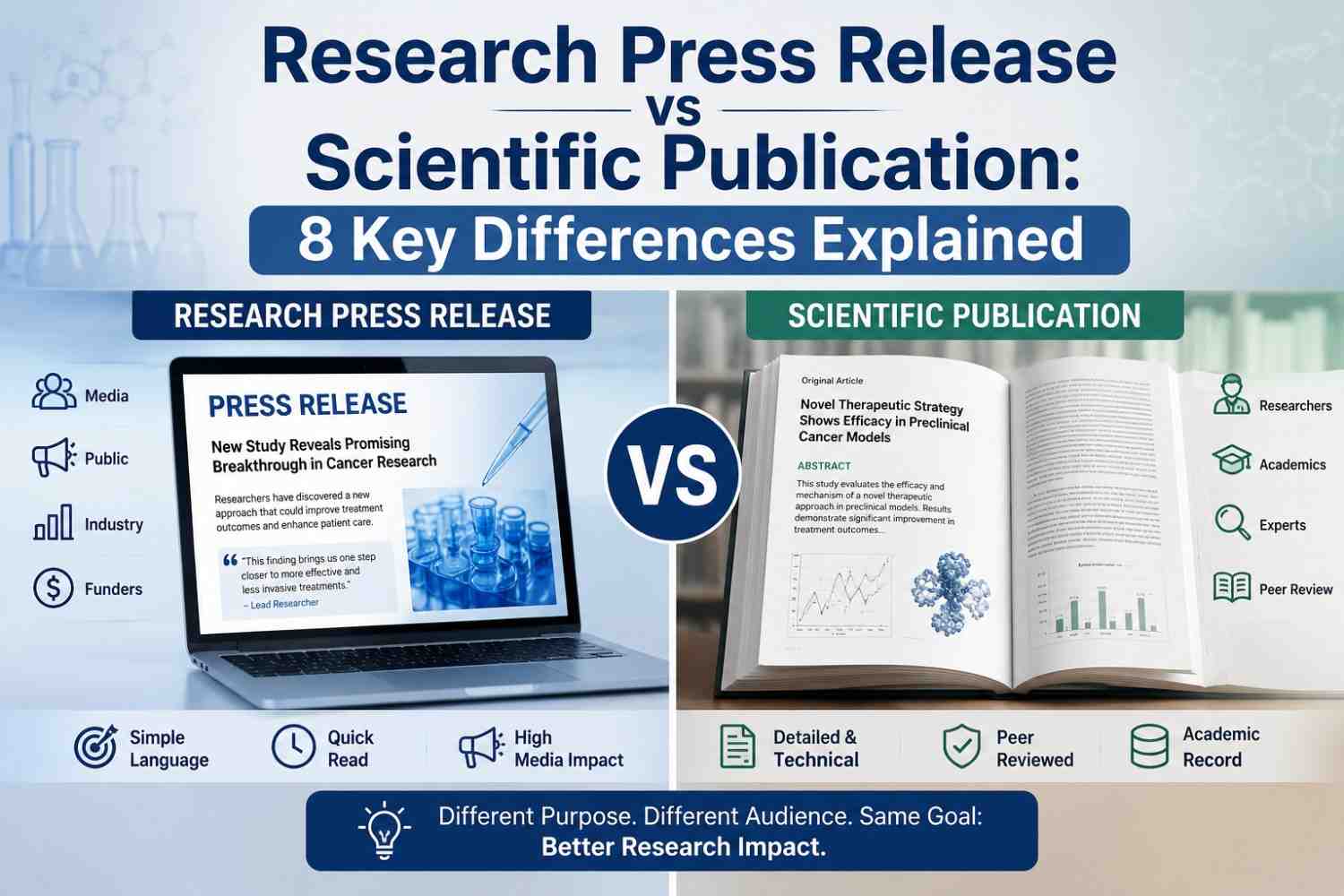
Research Press Release vs Scientific Publication: 8 Key Differences Explained
Written by the King Newswire Editorial Team — specialists in research PR, academic press release distribution, media communication, and SEO-focused news publication.
Published: June 2026 | Category: Research Communication, Academic PR, SEO, Press Release Distribution | Last Reviewed: June 2026
Both a research press release and a scientific publication are related to research; however, they are not exactly alike. The study is proven in a scientific publication through detailed peer review. A research press release is a description of the finding to journalists, funders, policy readers, industry audiences, and the public.
Therefore, this distinction is important in 2026 since the communication of research is now in favour of media announcement, search visibility, and AI discovery. A report by Muck Rack 2026 State of Journalism revealed that 82 per cent of journalists have some AI tool, and it demonstrates why factual and clear research summaries are becoming essential to media teams.
What Is a Research Press Release?
A research press release is any announcement about a study, discovery, report, trial, innovation or technical finding made publicly through the media. It explains the main result in simple words. In addition, it also provides a context where non-expert readers can grasp why the research is important.
An effective academic press release will contain the research question, important finding, researcher quote, institution name, study limitations, source of funds, journal reference, and contact information. However, it is not a substitute for the journal article. Rather, it assists journalists and lay readers in determining the relevance of the study.
For this reason, King Newswire assists research teams, universities, companies and institutions in preparing their media-ready research press releases that are well structured, edited and distributed. Teams can start from the King Newswire homepage to see how the platform positions research communication, while its research and development press release service outlines exactly how this kind of announcement should be structured before distribution.
What Is a Scientific Publication?
A scientific publication is a formal academic paper. It is composed for researchers, reviewers and experts in the subject. It typically has an abstract, introduction, methods, data, results, discussion, citations, DOI, and author affiliations.
A scientific publication provides complete technical evidence, unlike a press release. It describes the design, methodology, data collection, and the methods and limitations of the study. As a result, due to this, it tends to be lengthier, more descriptive and technical.
In short, academic credibility is established in a scientific publication. Research press releases create awareness among the population and media.
Research Press Release vs Scientific Publication: Quick Comparison Table
| Feature | Research Press Release | Scientific Publication |
| Purpose | Explain findings to media and public | Record full scientific evidence |
| Audience | Journalists, public, funders, industry | Researchers and experts |
| Language | Simple and clear | Technical and academic |
| Review | Editorial and researcher review | Peer review |
| Length | Shorter and focused | Longer and detailed |
| Distribution | Newsrooms, PR platforms, media | Journals and databases |
| Media Value | High | Indirect |
| SEO and AI Value | Strong public visibility | Strong academic reference |
8 Key Differences Between a Research Press Release and Scientific Publication
1. Purpose
The primary aim of a press release about research is to show why the finding is relevant at this moment. It takes complicated studies and converts them into an easy-to-understand story. There is, however, a scientific publication, which records evidence, methods, and results to be used in academia.
2. Audience
A research press release is aimed at journalists, editors, general readers, investors, funders and industry audiences. By contrast, a scientific publication is aimed at researchers, reviewers, academics, and specialists who are familiar with the field.
3. Writing Style
A press release is written in plain English; it has short paragraphs and context. A scientific publication is written in technical terms, is detailed, and contains discipline-specific language and references. Even so, they need to be both correct, but they are addressing two different readers.
4. Review Process
Peer review is conducted on a scientific publication before publication. Editors, communications staff and usually the researchers themselves check a research press release. In this case, this is a review that verifies accuracy, clarity, and responsible wording. The peer review process is what gives a scientific publication its academic weight, and understanding it helps writers frame press release claims responsibly. For a practical walkthrough of building the release itself, King Newswire’s press release writing guide covers format, tone and structure in detail.
5. Level of Detail
A scientific article provides complete information and facts. A research press release of a research provides the key finding, context, limitations and relevance. For example, according to Science Editor, a science news release may not provide all the information about a journal article, but may provide reporters with a summary and background.
6. Distribution
A scientific work gets published in a journal, library or scholarly database. A research press release is posted on websites, newsrooms, media outlets, PR networks, and has been dispatched to journalists. As a result, this facilitates finding it by non-academic audiences.
7. Media Impact
Press releases tend to assist in reporters reporting science more quickly. In a study by JAMA, it was found that, out of 142 newspaper stories that used journal articles, 119 or 84%, mentioned an article in the press release. Therefore, this demonstrates the potential of press releases in media coverage of research.
8. SEO and AI Search Value
The research press release can assist Google, ChatGPT, Perplexity, and other AI tools in comprehending the research entity. It must comprise the name of the institution, the names of the authors, the journal, the DOI, the type of study, the source of funding and concise findings. Moreover, Google further explains that its ranking systems are created to reward useful, reliable, people-first content, and not content created with the sole purpose of manipulating rankings. For a fuller breakdown of what each of these entity signals should look like in practice, see King Newswire’s guide to the key elements every research initiative release needs.
When Should Researchers Use Both Together?
When scholars require scholarly evidence and outreach, they need to employ both. To begin with, the research must be published or accepted in a scientific journal. Then, the finding can be explained in public language in the research press release.
Next, the journal article or DOI should be attached to the press release. It must also contain quotes by the researcher, study limitations, funding information, and the real worth of the discovery. As a result, this provides a nice entry point to journalism without eliminating the necessity of the scientific paper.
King Newswire facilitates this process by facilitating the translation of technical findings into comprehensible research communication to journalists and broader audiences by research teams. Researchers who are ready to pair a published study with public communication can go straight to King Newswire’s research and development press release page, or follow the step-by-step R&D press release writing guide for a more detailed walkthrough.
How to Avoid Research Hype in an Academic Press Release
Hype in research undermines credibility. Consequently, an academic press release cannot be too boastful of findings. Avoid such words as breakthrough, “cure” or “proven” unless they are really backed up by evidence.
Be explicit on the study level. When the discovery is in mice, in cell culture, early lab work, or in a small sample, indicate this. Discuss limitations, uncertainty and future research requirements as well.
It is particularly vital in health, climate, AI, and biotechnology studies. A study by Reuters concerning the use of AI assistants revealed that they err greatly in most of their answers on news content, which confirms that source content and wording have to be accurate and understandable.
SEO and AI Search Value of Research Communication in 2026
In 2026, journalists are not the only ones who practice research communication. It also assists engines and AI to search through the verified facts of research. The 2025 Digital News Report by Reuters Institute points out that traditional news media are low-trusted and shifting to digital interaction, with clear, reliable information becoming more influential in communicating with the public.
A good research press release must contain:
- Research title
- Research institution
- Author names
- Journal name
- DOI or article link
- Funding source
- Study type
- Key finding
- Limitations
- Contact information
Such information is used to create entity signals. They also assist AI systems in tying the research to the appropriate field, author, institution and topic.
How King Newswire Helps With Research Press Release Distribution
● Research PR Writing
King Newswire assists in transforming complicated research reports into understandable and media-friendly press releases. The text concentrates on accuracy, social worthiness, and responsible marketing of research. This writing service is detailed further on the research and development press release distribution page.
● Editorial Review
The releases should be checked for their structure, readability, clarity of facts and publication readiness. This assists in minimizing mistakes prior to distribution.
● Media Distribution
King Newswire disseminates research press releases via media and publication networks to enable universities, research groups, technology companies and institutions to reach a broader audience. Institutions can compare distribution packages on the King Newswire plans page before choosing a distribution tier.
● SEO and AI-Friendly Publishing
Natural keywords, entity signals, journal information, author names, and obvious brand context can be supported in each release to enable Google search and AI discovery. Readers new to any of this can start with King Newswire’s complete guide to what a press release is for the fundamentals behind these SEO practices.
● Publication Reporting
King Newswire offers reporting and publication connections to enable research teams to monitor their visibility and media coverage once distributed. Full pricing and reporting details for each tier are listed on the plans page.
Frequently Asked Questions
Is a research press release the same as a scientific publication?
No. A research press release is an explanation of findings to the media and people. A scholarly article provides complete peer-reviewed information to the scholarly audience.
Should a research press release be published before the journal article?
Usually no. The press release should only be published once the journal is accepted or published unless there are embargo restrictions permitting earlier publication of the press release.
Can an academic press release help research get media coverage?
Yes. An effective academic press release provides journalists with the key finding, context, quotes and source links to review the story in a matter of seconds.
What should researchers avoid in a research press release?
Scientists must not hype, make vague statements, omit limitations, make empty promises, or use jargon that laypeople will not comprehend.
How can research communication improve SEO and AI visibility?
Include succinct headings, the title of the institutions, names of the authors, links to journals, DOI, source of funding, the type of study, and precise summaries. This assists search engines and AI systems in comprehending the research in the right manner.
Key Findings:
Research is proven by a scientific publication. A research press release makes it known to the world. The publication provides the technical evidence to experts, whereas the press release provides a clear path to the study for journalists and the general readers.
Each is useful, although they complement each other. Through proper writing, ethical framing and the aid of King Newswire, research teams have the ability to enhance media presence, understanding by the general public, search engine optimisation, and search engine AI visibility. When a study is ready to be announced, King Newswire’s research and development press release service is the natural next step from this comparison.
Related Blogs:
- 9 Mistakes Companies Make When Announcing Research and Development Projects
- Step-by-Step Guide to Distributing a Research Initiative Press Release in 2026
- How Research Press Releases Improve SEO, AI Search Visibility, and Brand Authority
- 8 Best Times to Publish a Research Development Press Release for Maximum Exposure
- Top 10 Research Press Release Examples That Attracted Journalists and Investors
- Top 12 Benefits of Publishing a Research and Development Press Release for Your Business
- The Complete Research Press Release Checklist: 6 Things to Do Before Distribution