
Beyond GEO: Why Share of Model Is the Metric That Matters Next

Written by Daniel Whitfield, Senior Content Strategist at King Newswire | Published: 29 Aug 2026 | Last Reviewed: 29 Aug 2026 | Reviewed by the King Newswire Editorial Team
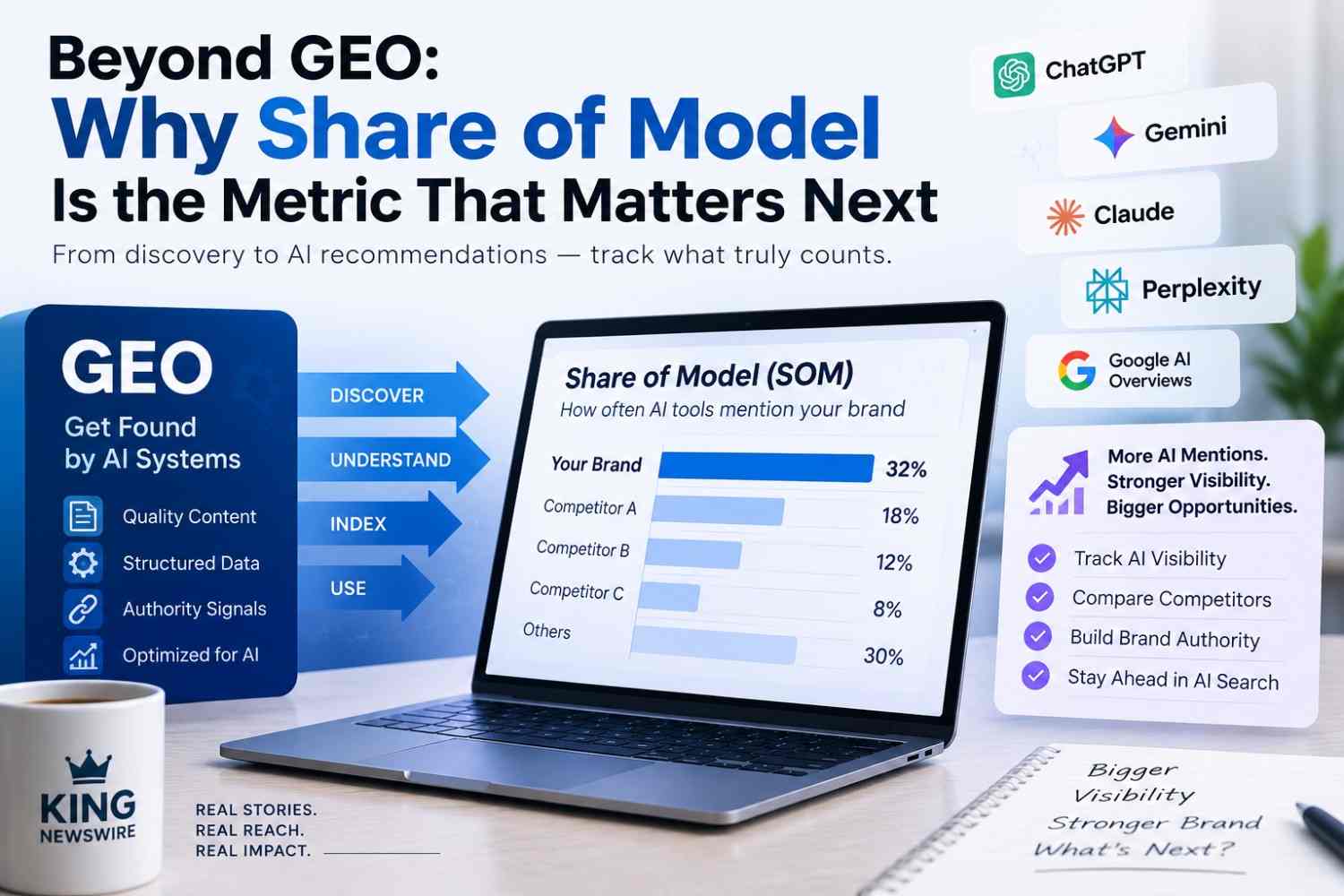
Quick Answer: Share of Model (SOM) is used to determine the frequency and accuracy of a given brand in AI responses. These responses come from platforms like ChatGPT, Gemini, Claude, and Google AI Overviews. Whereas Generative Engine Optimisation (GEO) assists AI systems in finding your content, Share of Model reveals whether AI tools mention or suggest your brand. SOM has emerged as an important visibility metric as AI search increases.
For many years, marketers focused on improving search rankings, increasing website traffic, and growing their Share of Voice. The aim was not that complicated: ensure that more individuals view and identify the brand online. Increased exposure usually resulted in additional trust, awareness, and customers.
Nowadays, people are discovering information differently. Many users do not need to open several websites and post their queries on websites such as ChatGPT, Gemini, Claude, Perplexity, and Google AI Overviews. Such AI tools offer direct answers and tend to refer to a handful of brands or sources.
Because of this change, a new metric is becoming important: Share of Model. Generative Engine Optimization (GEO) assists AI systems in identifying your content, whereas Share of Model determines if AI tools actually reference or recommend your brand. With the rising popularity of AI search, companies should monitor their frequency of appearing in AI-generated responses.
Key Takeaways
- Share of Model measures brand visibility in AI-generated answers.
- GEO helps content get discovered by AI systems.
- SOM identifies the presence of your brand on AI platforms.
- AI search frequently underlines several brands or sources.
- SOM can be enhanced with strong authority and consistent messaging.
- Tracking AI mentions is used to gauge brand influence in AI search.
What Is Share of Model (SOM)?
Share of Model (SOM) indicates the frequency of a brand in AI-generated responses to relevant queries. It is similar to Share of Voice, but it focuses on AI platforms such as ChatGPT, Gemini, Claude, Perplexity, and Google AI Overviews. Brands that already rely on a press release distribution platform to publish structured, well-cited announcements tend to have an early advantage here, since that same content often becomes a source AI systems draw on.
For example, if users ask AI tools to recommend the best SEO agencies and your brand appears in 30 out of 100 relevant responses, your visibility is higher than a brand that appears in only 10. SOM makes it possible to compare your AI visibility with competitors this way. Weak or inconsistent brand signals are often the reason a brand falls short here — this rundown of common press release mistakes that hurt AI visibility covers the most frequent causes.
SOM examines beyond mere mentions, too. Marketers can monitor brand mentions, recommendations, descriptions, and positioning in an AI response. Due to the ability of AI responses to vary by prompt and over time, repeated measurement can provide a more accurate view of visibility. Consistent use of press release distribution services across announcements gives AI systems the same repeated brand cues to draw from, which supports a steadier SOM over time.
Share of Voice vs Share of Model: Understanding the Difference
Share of Voice (SOV) is used to determine the amount of attention a brand obtains in traditional marketing channels. These can include search, social media, advertising, PR, and media coverage. Share of Model is concerned with the frequency of responses given by AI systems to include a brand.
The main difference is the visibility channel. SOV quantifies the visibility with human viewers and SOM quantifies the visibility within AI-generated responses. A strong traditional presence may be accompanied by a weak presence in AI search. This gap shows up clearly for founders and executives, where traditional name recognition does not always translate into AI-generated mentions — see this personal branding press release guide for how individual visibility and AI visibility differ.
| Share of Voice | Share of Model |
| human | human |
| Media, search, and ad Focused on social | Focused on social and AI-generated answers |
| human-facing exposure Tracks | human-facing exposure Tracks |
| Uses traditional marketing data | Uses AI prompt and response data |
The two metrics should work together. Strong PR, useful content, and consistent brand information can support wider digital visibility, while SOM shows whether that visibility is reflected in AI answers.
Why AI Search Is Changing the Rules of Online Discovery
AI search transforms the way people search and compare information. Users can prompt ChatGPT, Gemini, Perplexity, or other AI tools to condense a topic or suggest a solution, instead of scanning multiple links.
This presents another brand competition. Instead of displaying a long list of search results, an AI response can name just a few companies. Without your brand, your users might never encounter your brand at that point of decision-making.
Google AI Overviews and other generative search experiences are an extension of traditional search. Recent studies also indicate that AI visibility may not be the same across platforms and sources; thus, no universal formula can ensure that AI is visible everywhere. This is one reason brands increasingly pair their owned content with professional press release distribution – it spreads consistent brand signals across the third-party sources AI models pull from.
That is why brands should think outside the rankings. It is good to be discoverable, but it can be better to be a part of the response.
GEO vs Share of Model: Why Brands Need Both
Share of Model and Generative Engine Optimization (GEO) differ in their use. The strategy is GEO, and a measurement of the result is Share of Model.
GEO emphasizes clarity, utility, authoritativeness, and ease of understanding and usage by AI systems. It may contain structured information, powerful entity cues, quality brand information, professional content and reliable third-party reporting.
Share of Model then assists in answering another question: Is that work actually making us more visible in AI answers?
As an example, a brand could post valuable information and reinforce its digital authority in the context of a GEO approach. It is then able to follow a predetermined number of applicable prompts in AI platforms and document the frequency of the brand’s appearance. Repeated testing matters because AI answers can vary between runs.
Together, GEO and SOM create a useful feedback loop: optimize → monitor → compare → improve.
How AI Models Decide Which Brands to Mention
AI models do not just select brands due to their top status on Google. They can rely on various sources and signals to form their answers, such as websites, third-party publications, professional platforms, videos, and other things found online. The latest AI-search studies indicate that interplatform-source patterns might also be different.
It is important to have uniform brand information. When your company name, services, expertise, and key claims are outlined in consistent information through reliable sources, AI systems have more information to utilize. A brand identity press release service is one practical way to establish that consistent record before AI systems ever encounter it.
The structure of content is important, as well. Direct answers, clear headings, handy examples, frequently asked questions, and well-defined entities simplify the understanding and reuse of information. The visibility of an AI can also be enhanced through strong E-E-A-T signals, entity relationships, digital PR, and authoritative third-party coverage.
The goal is not to force an AI model to mention your brand. It is to build a strong, credible digital presence that gives AI systems reliable reasons to recognize and recommend it. A well-documented brand identity announcement is one of the more direct ways to create that credible record.
5 Proven Ways to Increase Your Share of Model
The first step to increasing Share of Model is to make your brand understandable and trustworthy to AI systems. Concentrate on the five areas:
1. Create Clear, Structured Content
Answer questions directly. Effective headings, short paragraphs, facts, examples and frequently asked questions. This simplifies the content on your site for users and AI systems. For a step-by-step reference, this 2026 SEO and AI press release checklist walks through the same structuring principles applied to press releases.
2. Keep Brand Information Consistent
Use the same brand name, services, experience, and important facts on your site and elsewhere. Regular data assists AI systems in learning about your brand.
3. Build Digital PR and Mentions
Post helpful information on industry websites and relevant sites. Gain mentions from reputable sources and press to boost brand authority. King Newswire’s brand identity press release service is built for exactly this, and the press release distribution plans page outlines how many outlets and mentions each option covers.
4. Answer Real User Questions
Get answers to the questions your readers have. Develop content which will answer them, rather than concentrate on keywords alone. This favoursfavors GEO, as well as AEO.
5. Track AI Mentions and Competitors
Ask relevant prompts on ChatGPT, Gemini, Perplexity, Claude, and Copilot. Track mentions, citations, recommendations, and competitor visibility over time. Brands that distribute consistently through a press release distribution network tend to find this tracking easier, since every release carries the same verifiable brand data for AI systems to reference.
Frequently Asked Questions
What Is Share of Model?
Share of Model compares the frequency of a brand in AI-generated answers with competitors on relevant searches.
How Do You Measure Share of Model?
Create relevant prompts, test them across AI platforms, and track brand mentions, citations, and recommendations against competitors.
Can Google Rankings Give Low SOM?
Yes. A brand can rank well on Google but still appear less often in AI-generated answers.
Does GEO Improve SOM?
GEO can enhance the visibility of AI by simplifying content, making it more useful, authoritative, and easier to comprehend by AI systems.
How Often Should You Track SOM?
Monitor it frequently with similar prompts and AI platforms. This assists in determining changes and gauging progress.
Why Does AI Mention My Competitor Instead?
Competitors can possess better brand cues, clearer content, have more authority or coverage on trusted third-party sources. Earning that third-party coverage is often the deciding factor — this industry recognition press release guide breaks down how to win it.
Conclusion:
Traditional rankings are no longer the only means of search visibility. Now AI services are used to make comparisons between brands, locate products, and receive recommendations.
Share of Model assists in gauging the presence of your brand in such responses. GEO offers the strategy, and SOM assists in the measurement of the results.
To improve your visibility, create useful content, build authority, maintain consistent brand information, and monitor AI responses. With the rise of AI search, Share of Model may play a significant role in your online marketing campaign. Reviewing the press release distribution plans available to you is a practical first step toward putting these ideas into action.
Ready to strengthen your brand’s Share of Model? King Newswire’s brand identity press release service helps you publish the structured, consistent brand signals AI systems look for — whether you are launching a product, refreshing your identity, or building out personal branding press releases for entrepreneurs.
Author Expertise
This article is written by Daniel Whitfield, Senior Content Strategist at King Newswire, and draws on research in AI search, Generative Engine Optimization (GEO), Answer Engine Optimization (AEO), semantic SEO, and digital PR. It investigates the way AI platforms find, assess, and suggest brands. The observations are informed by the existing trends that define visibility in AI-driven search.