Josiah Roche Explains How SEO and Google Ads Help Businesses Generate More Leads

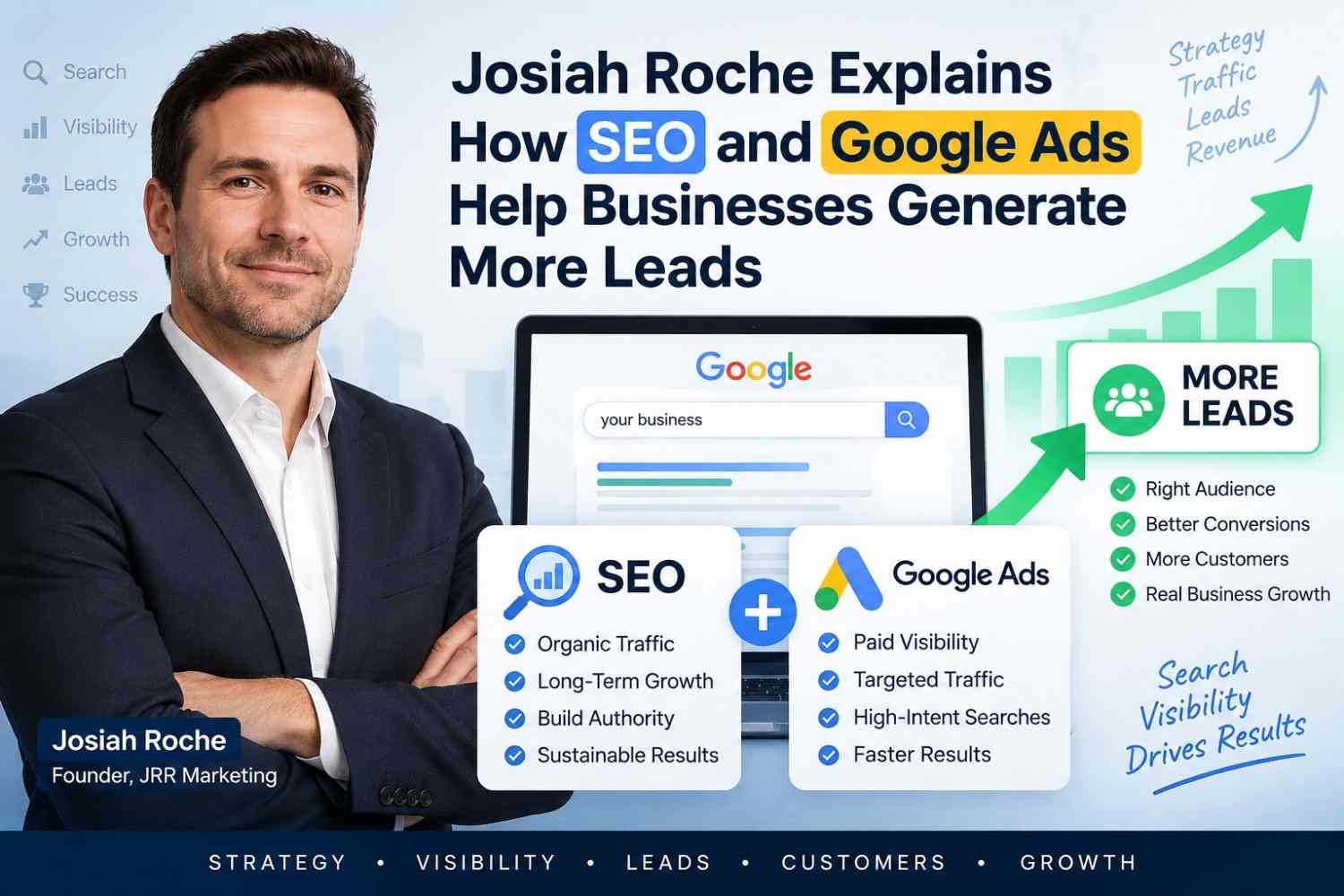
Quick Answer: SEO and Google Ads help businesses capture search demand. SEO develops organic presence in the long run. Google Ads offers paid traffic from relevant searches. Both can convert search traffic into leads and customers with effective landing pages, clear offers, and conversion tracking. Last Reviewed: August 29, 2026
Customers tend to begin their purchasing process in search. However, visibility does not translate into revenue. Companies need to draw the right individuals. They also have to generate trust and ensure that action is easy to take.
This is where Google Ads and SEO can collaborate. SEO assists companies in gaining organic visibility. Google Ads offers paid visibility for relevant searches.
Josiah Roche, the founder of JRR Marketing, specialises in performance-based search marketing. His work covers SEO, Google Ads, conversion optimisation, and lead generation. His strategy interrelates search visibility and leads, customers and business outcomes.
Google also recommends creating helpful, reliable, and people-first content. SEO is not about rankings; it should be user-friendly.
Key Takeaways
- SEO creates an organic presence for relevant searches.
- Google Ads offers quicker paid visibility to companies.
- When combined with powerful landing pages, both can generate leads.
- Traffic alone is not enough; revenue and the quality of leads are.
Why Search Visibility Is Only the First Step
Search visibility helps companies get in front of potential customers. But visibility alone does not create revenue — a visitor still has to land on the right page, understand the offer, and take action.
The customer journey often looks like this:
Search → Visibility → Click → Landing Page → Lead → Customer → Revenue
SEO has the potential to attract organic traffic in related searches. Ads can be used on Google to gain paid search demand. But they both require an effective conversion process to generate business results.
Traffic Is Not the Same as Lead Generation
Traffic numbers can look impressive on paper. However, that traffic delivers little business value unless the visitors are the right, targeted customers.
Businesses should look beyond traffic. They should track qualified leads, conversions, customers, and revenue. This demonstrates that search marketing is in fact contributing to growth.
SEO vs. Google Ads: Which One Should a Business Use?
Both SEO and Google Ads enhance the online presence. However, they work in different ways. The decision that is right is based on the business, budget, competition and goals.
When SEO Makes More Sense
SEO assists companies in developing organic search visibility. It is able to sustain long-term traffic and lead generation.
SEO is useful when a business wants to:
- Build sustainable organic visibility
- Target informational and commercial searches
- Create useful content
- Build topical authority
- Grow organic leads over time
When Google Ads Makes More Sense
Google Ads offers paid searches. Businesses are able to focus on certain keywords and find individuals who are actively seeking a solution.
Google Ads may be helpful when an enterprise needs to:
- Reach searchers quickly
- Promote specific services
- Test offers and keywords
- Capture high-intent searches
- Generate leads faster
Why SEO and PPC Can Work Together
There is no need to compete between SEO and PPC. They are able to promote the same search marketing strategy.
SEO has the potential to develop a long-term organic presence. Google Ads can be used to get quicker paid exposure. They can assist businesses in capturing more relevant search demand together.
The Missing Link: Turning Search Clicks Into Qualified Leads
Getting a click is only the beginning. Companies need to convert the right people into qualified leads.
Search intent is the beginning of a powerful conversion process. The home page must be similar to what the visitor was searching for. It also has to be clear what the service is.
The decision can be reinforced with trust signals. They can be reviews, testimonials, results, or pertinent case studies.
The following step must be obvious as well. A business might use a contact form, phone call, booking option, or purchase button.
Measures to Be Taken by Businesses
Businesses ought not only to track clicks. Important metrics include:
- Conversion rate
- Qualified leads
- Cost per lead
- Customer acquisition cost
- Customer value
- Marketing ROI
- Revenue
These measures indicate the presence of real business value that is being generated by SEO and Google Ads.
How PR, SEO, Google Ads, and AI Search Fit Together
The same business objective can be supported by PR, SEO, and Google Ads working together. PR generates media coverage and third-party validation. SEO builds useful content that ranks in organic search. Google Ads puts the right offer in front of people with urgent, high-intent needs.
Each channel supports a different stage of the customer journey. PR builds awareness and trust. SEO captures ongoing organic demand. Google Ads delivers faster access to targeted searches. Combined, they create a more complete search marketing strategy — one where public relations builds the credibility signals that SEO and paid search then convert into clicks.
A press release distribution service is often the fastest way to add that credibility layer. Businesses use what a press release actually does to turn company news — a product launch press release, a new business press release, or a business expansion press release — into a structured announcement that reaches journalists and gets indexed by search engines. Distributed correctly, a press release becomes another organic visibility asset alongside SEO content and Google Ads campaigns.
This applies to individual experts just as much as it does to companies. A personal branding press release can support an author or consultant the same way a company announcement supports a brand, and a new executive leadership press release or brand identity press release can reinforce the trust signals a business is trying to build through SEO and paid search. Businesses that distribute a press release alongside their SEO and Google Ads efforts get compounding visibility across owned, earned, and paid channels.
AI-driven search is another discovery channel altogether. Tools such as ChatGPT, Gemini, Perplexity, and Microsoft Copilot draw on publicly available information to answer questions. Accurate brand information from reliable, well-indexed sources helps both people and AI systems understand a business more clearly. That said, no strategy can guarantee a presence in AI-generated responses or Google AI Overviews.
What Josiah Roche’s Approach Gets Right About Search Marketing
Josiah Roche has a performance-based view of SEO and Google Ads. His work is centred on search visibility, lead generation, conversion optimisation, and customer acquisition through JRR Marketing. This maintains a business-results orientation as opposed to rankings only.
His strategy also begins with the economics of demand and business. Businesses should know what customers are searching for, what a customer is worth and how many leads they need before growing traffic. This assists in establishing the location of marketing where the most influence can be made.
The other value principle is tracing the entire customer journey. A company can be able to come up with traffic without getting productive leads. It can also create leads without having knowledge of the leads that turn into customers. Relating search activity to conversions and revenue gives a better picture of marketing performance.
A Practical Search-to-Lead Framework for Businesses
1. Identify Search Demand
Begin by finding out what potential customers are searching for. Target the questions that relate to the products or services that the business is able to offer.
2. Match Content to Search Intent
Design pages which respond to the needs of the searcher. It must be well articulated about the solution and should deliver informative content, not meaningless filler.
3. Choose SEO, Google Ads, or Both
SEO should be used to develop organic reach, and Google Ads should be used to attract paid search traffic. The correct combination is determined by the business objectives, budget, competition and urgency.
4. Build for Conversion
A relevant visitor still needs a reason to act. Make concrete offers, credibility indicators, effective calls to action, and easy contact or reservation.
5. Track Qualified Leads
Measure more than clicks. Track conversions, good leads, cost of acquiring customers and sales to know the true worth of search marketing.
6. Connect Leads to Revenue
The last process is the connection of marketing activity to business outcomes. This demonstrates what channels and campaigns lead to real customers and revenue.
FAQs of SEO and Google Ads
Is SEO superior to Google Ads in lead generation?
Neither is necessarily superior. SEO has the potential of assisting in the generation of organic leads over the long-term, and Google Ads could provide more immediate access to searching for relevant content. The superior alternative would be based on the business, competition, budget and goals.
Can a small business use SEO and Google Ads together?
Yes. A small business may utilise either channel in various ways. Google Ads would help to fill urgent demand, and SEO would establish an organic presence over a longer period.
How do I know if my Google Ads campaign is profitable?
Look beyond clicks and impressions. Track conversions, qualified leads, cost to acquire a customer, sales and revenue. These metrics give a better idea of the profitability of the campaign.
Does PR contribute to SEO and AI search visibility?
PR generates credible third-party coverage and brand mentions that help people discover and learn about a business. Reading how press release distribution works is a good starting point for businesses new to earned media. That said, PR does not guarantee higher rankings or a place in AI-generated responses — it strengthens the trust signals that SEO and AI systems draw on.
Conclusion
Being found online is only the beginning. SEO and Google Ads can enable businesses to tap into search demand, but visibility has to go somewhere worthwhile.
Organic visibility can be created by SEO. Google Ads are able to retrieve pertinent paid searches. Qualified leads and customers can then be converted into customers through strong conversion strategies.
The most effective strategy connects search intent, visibility, conversions, leads, and revenue — and, increasingly, credibility signals from channels like press release distribution. That combination is what turns search marketing from a traffic tactic into a measurable driver of business growth.
Businesses ready to pair their SEO and Google Ads strategy with professional PR can get started with press release distribution to add another layer of visibility and trust.
Author Expertise
Josiah Roche is a digital marketing strategist, Google Ads consultant, author, and former journalist. He founded JRR Marketing, where his work spans Google Ads, SEO, conversion optimisation, landing pages, and lead generation. His background in journalism shapes how he approaches search visibility and client acquisition, combining editorial judgment with performance marketing discipline.
Related Resources
- See the press release approval checklist for tips on getting a release approved fast.
- Review the benefits of publishing a press release for a broader look at what earned media adds to a search marketing plan.