
How to Write a Press Release That Gets Approved in 24 Hours (Real Editorial Checklist)

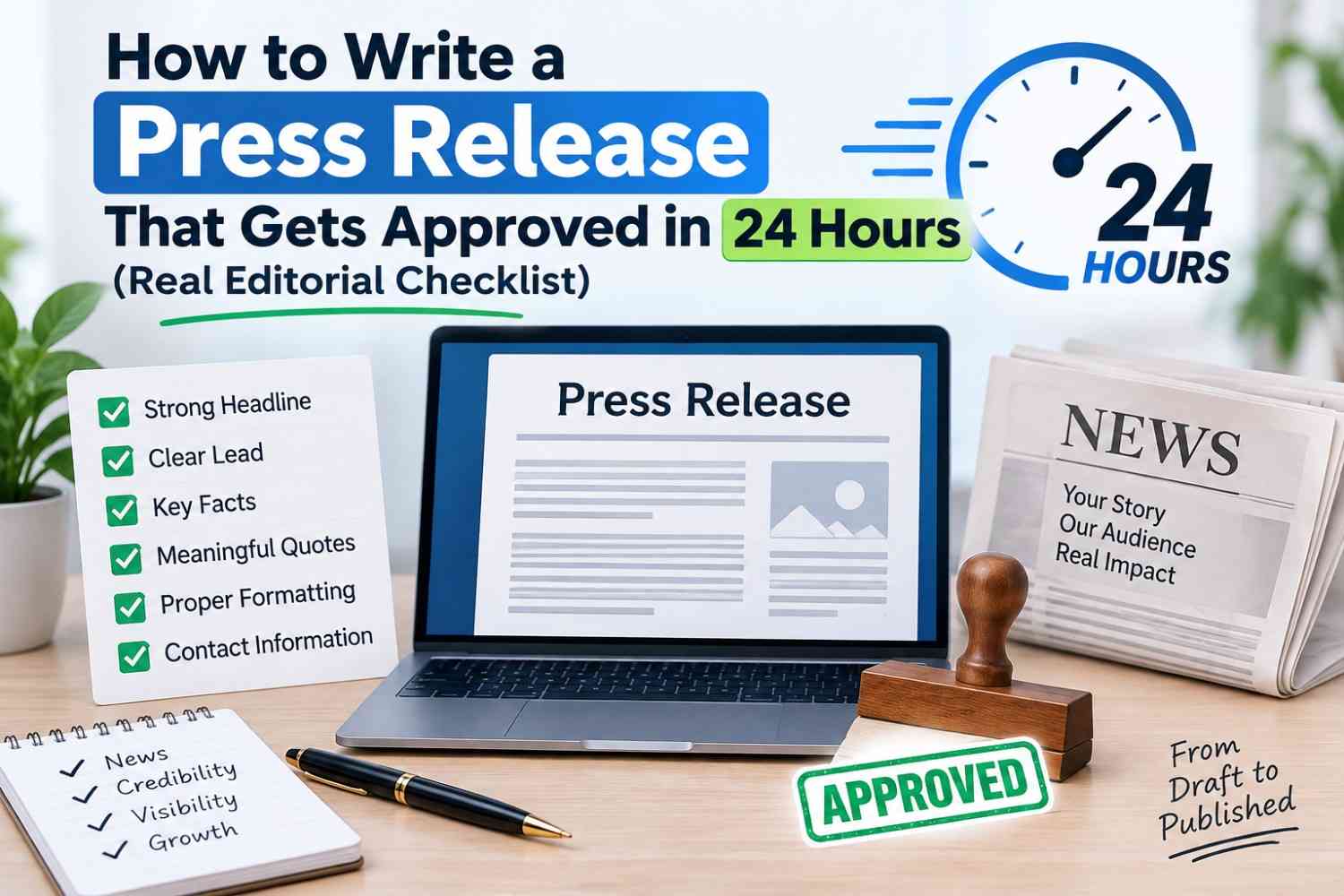
Quick Answer: The first step to write a press release is understanding the value of news to the reader. A good release would include a good headline, brief lead, correct facts, helpful quotes, and proper contact information. It must concentrate on actual news.
A press release is a type of news release that assists companies and organisations in communicating key news to journalists, editors, and the media. Firms utilise press releases when launching products, collaborating with others, securing capital, events, changes of leadership, among other significant developments. Choosing a reliable way to publish a press release matters just as much as writing one well.
Nevertheless, the release of a press release does not ensure media coverage. Most releases are ignored due to being too promotional or not elaborating on why the news is important. An effective release emphasises viable information, factual material, and a pertinent news angle.
The ability to write a press release entails making the story easy to read as well. Have a clear headline and a strong lead. Include quotes and correct information. Provide journalists with sufficient information to get a sense of the story and whether it is worth it.
Key Takeaways
- Focus on news, not promotion.
- Write a clear headline and lead.
- Support claims with facts and data.
- Add meaningful quotes.
- Review the release before submission.
Is This Actually Newsworthy?
Before you start press release writing, ask a simple question: Is this real news?
Many companies issue announcements that matter internally but hold little interest for journalists or readers. A press release is most effective when it provides something that is helpful to the public.
A story is usually more newsworthy when it includes:
- A product or service launch
- New funding or investment
- A major partnership
- Industry research or data
- A company milestone
- An event or community impact
- Leadership changes
A quick test can help.
Ask yourself:
- What happened?
- Why does it matter now?
- Who is affected?
- What makes it different?
- Would someone outside the company care?
How to Write a Press Release: The Essential Structure
For a step-by-step walkthrough of every section below, see our complete guide on how to write a press release.
Write a Headline
The headline should clearly explain the announcement. Keep it specific, factual, and easy to scan.
Weak headline:
Company X Announces Exciting New Growth Opportunity
Better headline:
Company X Launches AI Platform for Small Businesses
To see this structure applied across different announcement types, browse these press release examples.
Have a Good Lead
The opening paragraph should answer the most important questions:
- Who?
- What?
- When?
- Where?
- Why?
Readers should understand the main news without reading the entire release.
Build the Body
Following the lead, offer supporting details.
Include:
- Key facts
- Relevant statistics
- Important background
- Context for readers
Use short paragraphs and simple language.
Add a Meaningful Quote
A quote must be informative as opposed to redundant with the headline.
Instead of saying:
“We are excited about this announcement.”
Explain why the development matters to customers, the industry, or the community.
If drafting a strong quote is difficult in-house, a press release writing service can shape quotes that add real editorial value.
Close With a Boilerplate
The boilerplate is a concise description of the company.
Include:
- Company overview
- Website
- Contact information
This helps journalists quickly learn about the organisation.
Once the boilerplate is ready, you’re set to submit your press release for distribution.
Write It for a Journalist, Not Like an Advertisement
One of the biggest press release mistakes is writing marketing copy instead of news.
Journalists are not seeking sales messages. They want the information that can help them comprehend and analyse a story.
For example, avoid phrases such as:
- Best in the world
- Revolutionary product
- Industry-leading solution
- Unmatched innovation
Instead, focus on facts.
Explain:
- What happened
- Why it matters
- Who benefits
- What are the supporting facts?
Think about the journalist’s audience, not your company.
An effective press release simplifies the work of the reporter. It presents understandable facts, supporting details, and a news perspective that readers might find useful.
If you’re unsure whether your draft reads as news or as an ad, a professional press release writing service can reframe it for editorial standards before you submit it.
The Editorial Red-Flag Audit: The reasons behind rejection of Press releases
These are the most typical red flags to check before you submit your release.
For the full set of submission rules, see King Newswire’s editorial guidelines.
No real news angle
The announcement is not timely, relevant and does not give anything important. When the story does not provide an apparent cause of public interest, the editors might come to a conclusion that they should not publish it.
Unsupported claims
Certain statements like best, leading or revolutionary should be supported. Releases which include statements that lack supporting facts or data are frequently rejected by the editors.
Weak headline
The headline should clearly communicate the main announcement. A vague or weak headline can reduce interest and confuse the story.
Unclear lead paragraph
The opening lines must clearly convey the main news so readers understand it immediately. Journalists may stop reading if the lead fails to explain the announcement.
Generic quotes
Quotes should add insight, context, or expertise. Restating what has been stated elsewhere in the release does not add much value.
Formatting errors
A release is hard to read since it is composed of long chunks of text and has bad formatting. Clarity will assist journalists in scanning the information fast.
Good formatting also supports search visibility — see our guide on optimizing a press release for Google.
Lost links or contact numbers
Journalists may require more information or explanation. The lack of links or contacts may complicate follow-up.
No audience relevance
A company can have a story that is significant but not to society. Announcements made by the editor need to be valuable to the readers or viewers.
Quick Editorial Checklist
Before distribution, ask:
- Is the announcement really newsworthy?
- Does the headline explain the news?
- Does the lead answer the key questions?
- Are all claims supported by facts?
- Does the quote provide useful insight?
- Is the release easy to scan?
- Are contact details accurate?
- Have you checked grammar and formatting?
Ready to Get Your Press Release Approved and Published?
You now have the editorial checklist that decides whether a release gets approved or rejected. The next step is putting it into action. If you’d rather have this handled for you, our press release writing service can shape your announcement’s headline, lead, and quotes into a submission-ready release. Once it’s ready, compare our press release distribution plans to match your budget and reach, or head to the press release submission page to see how to get your announcement published and in front of journalists within 24 hours.
FAQs
Should a press release include statistics?
When they support the story, yes. An announcement can also be more credible with relevant statistics that can provide journalists with some facts to work with.
Should I include quotes in a press release?
Yes. An excellent quote may contain a professional touch or indicate the reasons why the announcement is important.
What makes a press release newsworthy?
A quality press release is one that includes news that is important, useful, or timely. Strong stories can be made of product launches, new research, significant partnerships, funding and key updates in the company.
How do I make a press release interesting to journalists?
Begin with a definite news angle. Explain why the story matters. Add useful facts, data, and quotes. Also, target journalists who cover your industry or topic.
Verdict
An effective press release begins with actual news. It must describe what it is and why it is significant. Make it uncomplicated and the information straight.
Make a powerful headline, brief lead, helpful facts, and pertinent quotes. Do not use sales language or claims that are not supported. Lastly, proofread the release to ensure that the facts, links, and contact information are accurate.
Get this right and a release can move from draft to approved, published news in as little as 24 hours. When you’re ready, you can send your press release for review, or check the distribution plans to pick the reach that fits your announcement.
Author Expertise
This guide is written by Daniel Reyes, a Senior PR Strategist with 12 years of experience in media relations and press release editorial review. Daniel has personally reviewed and edited thousands of press releases for newsroom acceptance, and has trained editorial teams on the standards journalists and distribution platforms use to approve or reject a release. This guide adheres to the standard practices of PR, newsroom, and press release distribution, and is written to assist businesses, startups, and PR professionals in designing valid, sensible, and publishable press releases.