
What Makes a Press Release Successful? What Research Says About News Factors

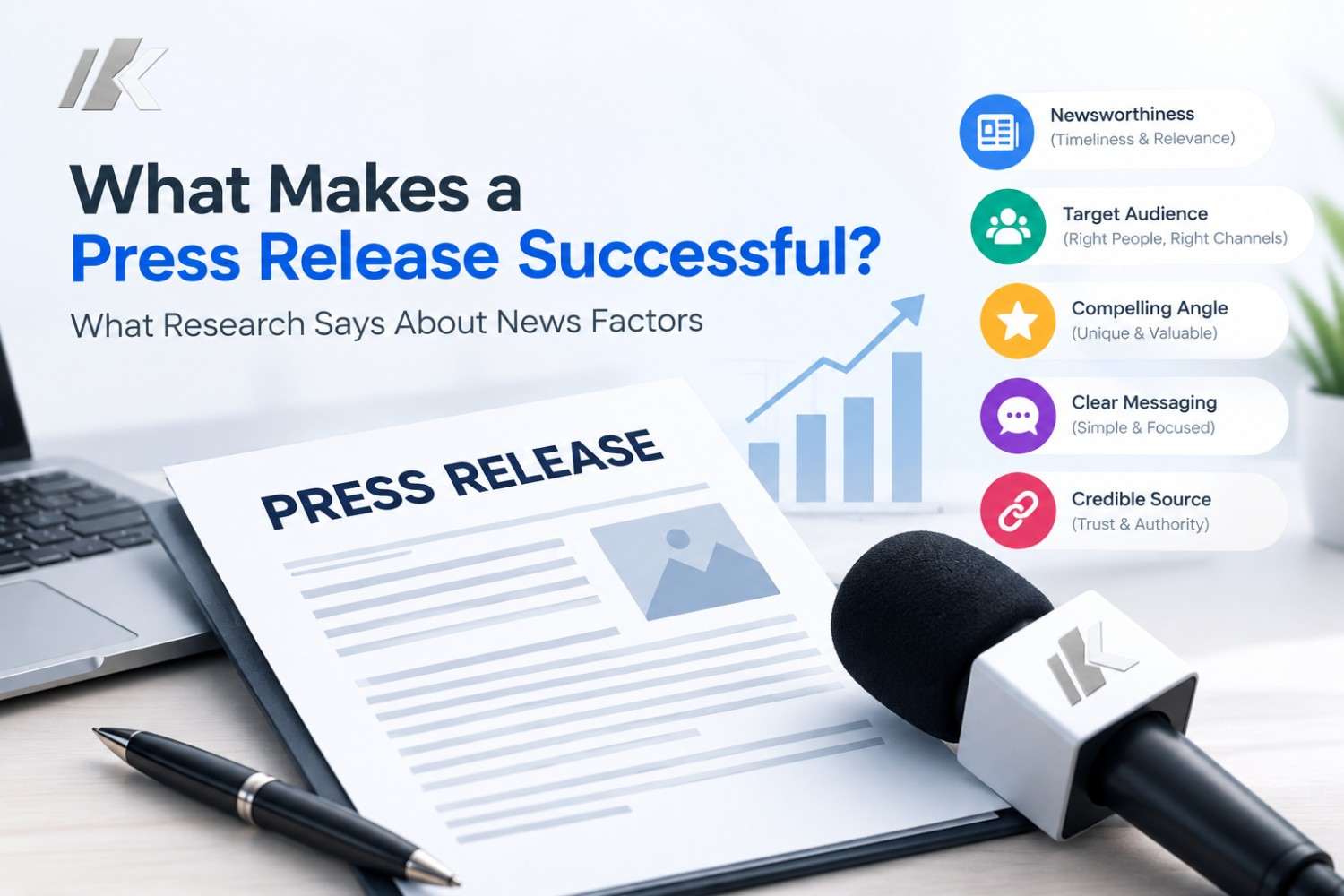
What Makes a Press Release Successful? What Research Says About News Factors
Written by the King Newswire Editorial Team — specialists in press release writing and media distribution. Last updated: September 2026.
Disclosure: This guide is published by a press release distribution service. The research cited below is independent, peer-reviewed work by third-party academics, and the findings are reported as the authors published them.
Quick Answer: A press release succeeds when it carries a clear news angle, genuine novelty, societal relevance, verifiable evidence, and visuals that explain something. Research on 84 university press releases found that different news factors were linked to different outcomes: some predicted webpage engagement, others predicted media pickup, and the two rarely overlapped. No combination of factors guarantees coverage, because journalists still make editorial decisions.
Most press releases never get covered. That is not usually a distribution problem — it is a content problem.
A release earns attention when it answers, quickly and plainly, what happened, what is new about it, and why anyone outside the company should care. Research on news selection has long shown that factors such as novelty, relevance, impact, and prominence shape whether journalists pay attention (Galtung & Ruge, 1965; Harcup & O’Neill, 2017).
A 2026 study put that theory to a practical test. Researchers examined 84 science press releases from the Faculty of Science at Utrecht University and compared the news factors in each release against four outcome measures: page views, time on page, scroll depth, and media uptake. The headline result was counter-intuitive — the factors that drove readership were largely not the factors that drove media coverage (ten Dam, Vergunst & Bos, 2026).
For businesses, universities, and PR teams, the practical lesson is the same regardless of sector. Decide which outcome you actually want, then build the release for that outcome. A professional press release distribution platform can put your announcement in front of the right networks, but the content has to carry the story.
Key Takeaways
- A press release needs one clear, authentic news angle — not several competing ones.
- Novelty was linked to both webpage engagement and social-media pickup, but the strength differed by metric.
- Societal relevance was linked to page views and time on page.
- Certain visual types were linked to page views, reading time, and scroll depth — but not to media pickup.
- Media pickup and webpage engagement measure different things and often reach different audiences.
- Fear-based emotional framing correlated with media pickup, but it should never replace evidence.
- Adding caveats did not reduce journalist uptake, and exaggeration did not increase coverage.
- Distribution extends reach; it cannot manufacture newsworthiness.
The Four Questions Every Press Release Must Answer
Before worrying about distribution or SEO, make sure your draft answers four questions in the first two paragraphs:
- What happened? The concrete event, decision, launch, result, or milestone.
- What is new? What changed compared to what existed before.
- Why does it matter? Who is affected, and what decision or outcome does this influence.
- What evidence supports it? Data, a study, a named source, a verifiable number.
If a reader cannot answer all four after the opening, the release is not ready — no matter how wide the distribution.
News Factors vs News Values: Why the Difference Matters
These two terms get used interchangeably, and that causes confusion when people try to “optimise” a release.
- News factors are observable features in an event or a text — novelty, scale, proximity, conflict, prominence. A communicator can choose to include or emphasise them.
- News values are the judgments journalists and audiences make about those features. They are not fixed, and they shift with the newsroom, the audience, and the day (Caple & Bednarek, 2016).
Here is what that looks like in practice. A release announces a new scientific finding. The novelty of that finding is a news factor — it is in the text, and you can point at it. Whether a reporter decides the finding is worth 600 words is a news value judgment, and you do not control it.
The 2026 study makes this distinction useful because it shows factors behaving differently depending on what you measure. The total count of news factors correlated with page views and time on page. The count of textual news factors correlated with media uptake. Those are two different levers pulling two different outcomes.
This does not mean stuffing more factors into a release makes it better. The researchers measured the presence of factors, not their intensity, frequency, or how they combine — a limitation the authors themselves flag. A release crammed with five competing angles is usually worse than one with a single sharp angle.
Media Pickup and Audience Engagement Are Not the Same Goal
“Successful” means different things to different teams, and the 2026 study is one of the few to measure both at once.
A university might want journalists to cover a finding. It might also want members of the public to land on its site, read the explanation, and understand the science. Those are separate goals with separate audiences.
The researchers measured webpage engagement through page views, time on page, and scroll depth. They measured media uptake using Altmetric data, which tracks mentions of a research output across online news, blogs, and social media platforms.
The gap between the two audiences was stark: only around 2% of the webpage visitors were journalists. The people reading the press release page and the people generating media coverage were, for the most part, entirely different groups (ten Dam, Vergunst & Bos, 2026).
Which factors correlated with which outcome
| News factor group | Page views | Time on page | Media uptake |
| All news factors combined | ρ = 0.34 | ρ = 0.29 | — |
| Textual news factors | ρ = 0.26 | — | ρ = 0.22 |
| Visual news factors | ρ = 0.29 | ρ = 0.31 | Not significant |
These are correlations, not evidence of causation, drawn from a single institution’s output. Read them as signals about where to focus, not as a formula.
Do Visuals Make a Press Release More Successful?
Visuals helped — but only for on-page behaviour, and only certain types.
The 2026 study found that visual news factors correlated with page views and time on page, while releases without visuals showed weaker on-page engagement. Critically, no visual factor showed a significant relationship with media uptake (ten Dam, Vergunst & Bos, 2026).
The type of visual mattered:
- Illustrations correlated with page views.
- Portraits of researchers and photographs of the research subject correlated with longer time on page.
- Scientific graphs, charts, and maps correlated with deeper scrolling.
The pattern is straightforward: visuals that explain something keep people reading. Visuals that merely fill a slot do not. Caple and Bednarek make a related argument — that photographs themselves construct news values, rather than just decorating the text around them (Caple & Bednarek, 2016).
Practical rule: include a visual because it clarifies the news, not because the template has an image box. If you are announcing a facility, show the facility. If you are announcing data, show the chart.
Which News Factors Were Linked to Which Outcomes
The individual-factor results are where the study gets genuinely useful for writers.
For webpage engagement:
| Factor | Outcome | Correlation |
| Societal relevance | Page views | ρ = 0.27 |
| Societal relevance | Time on page | ρ = 0.22 |
| Novelty | Page views | ρ = 0.29 |
| Timeliness (recency of the event) | Page views | ρ = 0.24 |
| Geographic reach | Time on page | Positive |
| Negative framing | Scroll depth | Positive |
For media uptake:
| Factor | Outcome | Correlation |
| Journal impact factor | Media uptake | ρ = 0.53 |
| Journal impact factor | Social-media uptake | ρ = 0.59 |
| Fear-based emotional appeal | Media uptake | ρ = 0.36 |
| Fear-based emotional appeal | Social-media uptake | ρ = 0.26 |
| Novelty | Social-media uptake | Positive |
| Scientific relevance | Social-media uptake | Positive |
Media uptake was also associated with follow-up coverage, mixed emotional framing, and references to specific regions (ten Dam, Vergunst & Bos, 2026).
Two warnings before anyone acts on the fear column. First, these are associations within one dataset — fear did not cause coverage. Second, deliberately engineering fear into an announcement is a credibility risk that outlasts any single news cycle. The finding is a description of how attention behaves, not a recommendation.
Evidence From Earlier Studies
The 2026 results sit on top of a body of earlier work pointing the same direction.
Vonk, Bos, and van Sebille analysed 84 press releases about ocean plastic research alongside 495 English-language newspaper articles. They found that prestige, negative news, magnitude, and social or economic relevance were each associated with higher levels of coverage. They also found that the specific wording of a press release tends to carry through into the resulting news articles (Vonk, Bos & van Sebille, 2024).
That second finding is the one most PR teams underuse. If journalists reproduce your phrasing, then the sentences you write become the sentences the public reads. Sloppy wording in a release becomes sloppy wording in coverage.
Sumner and colleagues tested the other side of this. Across 534 journal press releases, the 534 papers behind them, and 582 resulting news stories, they found that exaggerations in press releases were mirrored by exaggerations in coverage — but exaggeration did not produce more coverage. Meanwhile, including caveats did not reduce journalist uptake, and caveats in releases were associated with more caveats appearing in news stories (Sumner et al., 2016).
In plain terms: overselling buys you nothing and costs you accuracy. Honesty is free.
The Structure of a Press Release That Works
Research explains what to emphasise. Structure determines whether a journalist can use your release in the three minutes they will give it.
- Headline — the news in under 12 words, no adjectives that cannot be verified.
- Dateline — city and date, so the release has a place and a time.
- Lead paragraph — the four questions answered in 40 to 60 words.
- Supporting paragraphs — evidence, context, and the specifics a reporter would otherwise have to ask for.
- Quote — from a named person with a real title, saying something only they could say. Skip the “We are thrilled to announce” quote entirely.
- Boilerplate — a short, factual company description.
- Media contact — a name, an email, and a phone number that a human will answer.
Most releases run best at 400 to 800 words. Our press release submission guidelines set out the formatting requirements in detail, and our research initiative press release guide covers the elements specific to study announcements.
How to Make a Press Release More Newsworthy
1. Lead with genuine novelty
State what the announcement adds that did not exist before. Drop unverifiable superlatives like “revolutionary” or “groundbreaking” — journalists filter them out, and so do readers.
A structure that works:
Previous work established X. This announcement reports Y, under Z conditions.
Novelty correlated with both page views and social-media uptake in the 2026 study, though the strength varied by metric.
2. Explain why it matters
Tie the announcement to a real problem, a specific audience, or a decision someone has to make. Societal relevance was among the strongest predictors of on-page engagement in the Utrecht data.
Keep confirmed findings separate from possible future applications. If something might be useful in five years, say so in those words — do not let a possibility read like a result.
3. Show the evidence
Include the study type, sample details where relevant, publication information, the people responsible, and the limitations.
Match your verbs to your evidence:
- “The study found…”
- “Researchers observed…”
- “The analysis showed an association between…”
- “The findings do not establish causation.”
This matters most in science and health communication, where simplifying a result is one short step from misrepresenting it. Our comparison of a research press release versus a scientific publication goes deeper on where that line sits.
4. Use visuals with a purpose
Choose a portrait to introduce the person, a chart to carry the evidence, a map to establish where. The 2026 data tied portraits to reading time and scientific charts to scroll depth.
A useful test: if removing the image would cost the reader information, keep it. If it would not, it is decoration.
5. Include your caveats
Naming the limits of your evidence does not cost you coverage — Sumner and colleagues demonstrated that directly. It buys you accuracy in the resulting articles and credibility the next time you issue a release.
Say clearly what the evidence supports, and what it does not.
What We See in Practice
Ten years of running a press release distribution and media outreach service has made a few patterns unmistakable, and they line up closely with the research above.
The releases that get picked up are almost never the ones with the longest feature lists. They are the ones where a single verifiable number sits in the first sentence — a funding figure, a user count, a measured improvement, a named partner. Announcements that lead with positioning language and bury the number tend to land, get read, and go nowhere. For a related look, see what U.S. businesses can learn from a published release.
The second pattern concerns quotes. Reporters reuse quotes far more often than they reuse body copy, which means a quote that only restates the headline wastes the most reusable part of the release. A quote that explains why the decision was made frequently survives into published coverage intact.
The third is timing, and it is the most commonly ignored. Identical releases perform very differently depending on when they are issued. Our guide on why timing is critical in crisis communication covers the sharpest version of this problem, but the principle applies to routine announcements too.
If you want the specific mistakes we see most often in research and R&D announcements, we catalogued them in 9 mistakes companies make when announcing R&D projects.
Why News Factors Do Not Guarantee Coverage
News factors influence newsworthiness. They do not decide it.
Whether a release gets covered also depends on timing, what else broke that day, available column space, the outlet’s audience, the reporter’s beat, your organisation’s credibility, and publication schedules that have nothing to do with you.
The 2026 study reinforces this. Correlations between news factors and outcomes varied substantially across page views, time on page, scroll depth, media uptake, and social-media uptake. A release engineered for one of those will not automatically perform on the others.
The authors are explicit about the limits of their own work: the sample came from a single institution and consisted of 84 releases in one scientific domain. These findings describe a pattern worth knowing. They are not a universal formula for every organisation, sector, or announcement type (ten Dam, Vergunst & Bos, 2026).
Matching Your Press Release to Your Communication Goal
Start by deciding what success means for this specific announcement. The research points to two different playbooks.
If your goal is reader engagement — people landing on the page, reading, and understanding — prioritise societal relevance, clear novelty, timeliness, and explanatory visuals. Write for someone with no background in your industry.
If your goal is media pickup — journalists writing about it — prioritise a hard news angle, third-party credibility, verifiable specifics, and everything a reporter needs to file without calling you. Give them the quote, the number, the context, and the contact.
If you need both, write for the journalist first and layer the explanatory material below the fold. Journalists rarely scroll; readers do.
Responsible communication runs underneath both. The OECD’s Responsible Science Communication Framework (2023) sets out six principles worth applying to any evidence-based announcement: transparency, inclusivity, integrity, accountability, freedom and autonomy, and timeliness.
Once the content is right, distribution determines how far it travels. Our press release distribution service places announcements across a verified network of news outlets and publishers — you can review the media outlet network or compare distribution plans to see what suits your announcement. Different announcement types benefit from different targeting, whether that is a product launch, a business expansion, an R&D initiative, or an award or industry recognition.
Press Release SEO, GEO, and AEO in 2026
Search visibility should be a consequence of clear writing, not a constraint on it. That said, a few specifics genuinely help — and they help with AI-generated answers for the same reasons they help with search.
- Name your entities explicitly. State the organisation, the people, the study or product, the publication, the location, and the date in full at least once. Both search engines and AI systems resolve entities from explicit mentions, not from pronouns and implications.
- Put the answer first. If the release answers a question, answer it in the opening paragraph. Answer-engine systems extract from the top of a document far more often than from the middle.
- Link to primary sources. Linking the underlying study, dataset, or filing lets readers verify your strongest claim — and gives AI systems a citation path back to something authoritative.
- Use plain, specific language. Short sentences, concrete nouns, real numbers. Vague marketing copy is difficult to extract and easy to ignore.
- Structure it properly. Descriptive headings, short paragraphs, and a factual boilerplate. Structure is what makes a document machine-readable without making it worse for humans.
- Do not keyword-stuff. A release loaded with repeated keywords reads as promotional to editors and gets rejected before distribution. Write the news; the keywords follow naturally.
One realistic note: most press release links are nofollow, so they do not pass ranking signal the way editorial backlinks do. The value is brand visibility, indexed pages carrying your name, and the discovery paths those create. For more on how announcements perform across search and AI surfaces, our press release insights and guides are updated regularly.
Conclusion
There is no single ingredient that makes a press release succeed. The research points consistently at the same set: a real news angle, evidence that holds up, relevance to someone outside your organisation, context that helps a non-expert, and honesty about limits.
What the 2026 study adds is precision about the trade-off. Webpage engagement tracked with novelty, societal relevance, and explanatory visuals. Media uptake tracked with third-party credibility and emotional framing. Optimising for one does not deliver the other, so decide which you want before you start writing (ten Dam, Vergunst & Bos, 2026).
The underlying discipline is simple: say what is new, show why it matters, provide the evidence, and state the limits.
Ready to distribute your announcement?
Strong content deserves to reach the outlets that matter. Explore press release distribution services built for journalists, search engines, and AI platforms, or compare all plans to find the distribution level that fits your announcement and budget.
FAQs
What makes a press release newsworthy to journalists?
A press release becomes newsworthy when it presents information that is new, relevant, timely, and meaningful to a specific audience — and when it gives the journalist everything needed to write the story without a follow-up call. Research on press release uptake shows that particular news values measurably affect whether journalists pick up an announcement (Schröder, 2021).
Can a press release be successful if journalists do not pick it up?
Yes. The 2026 Utrecht study measured page views, time on page, and scroll depth separately from media uptake, and found the two often move independently. A release that reaches customers, investors, or partners directly has done real work even without a single article.
Should a press release focus on one main news angle?
Yes. One sharp angle outperforms several competing ones. Supporting details should reinforce the main story, not compete with it for the reader’s attention.
Does adding more news factors make a press release better?
Not automatically. The 2026 study measured whether factors were present, not how strongly or in what combination — a limitation the authors note. Adding factors without a clear purpose usually dilutes the release rather than strengthening it.
How long should a press release be?
Between 400 and 800 words is the practical range for most announcements. Shorter releases are easier for editors to scan and more likely to be used as written.
Do press release links help SEO?
Most press release links are nofollow, so they do not pass ranking signal the way editorial backlinks do. The benefit is brand visibility, additional indexed pages mentioning your organisation, and the discovery paths those create across search and AI platforms.
What makes a science press release responsible as well as newsworthy?
It reports findings accurately, states relevant uncertainty, identifies the supporting evidence, and avoids overstating results. The OECD framework emphasises transparency, inclusivity, integrity, accountability, freedom and autonomy, and timeliness (OECD, 2023).
References
- Caple, H., & Bednarek, M. (2016). Rethinking news values. Journalism. https://doi.org/10.1177/1464884914568078
- Galtung, J., & Ruge, M. H. (1965). The structure of foreign news. Journal of Peace Research. https://doi.org/10.1177/002234336500200104
- Harcup, T., & O’Neill, D. (2017). What is news? News values revisited (again). Journalism Studies. https://doi.org/10.1080/1461670X.2016.1150193
- OECD (2023). Responsible Science Communication Framework. https://doi.org/10.1787/5c3be7ce-en
- Schröder, J. (2021). Journalism Studies. https://doi.org/10.1080/1461670X.2020.1819861
- Sumner, P., et al. (2016). Exaggerations and caveats in press releases and health-related science news. PLOS ONE. https://doi.org/10.1371/journal.pone.0168217
- ten Dam, Vergunst & Bos (2026). Journal of Science Communication. https://doi.org/10.22323/383620260709155700
- Vonk, Bos & van Sebille (2024). Journalism Studies. https://doi.org/10.1080/1461670X.2024.2409836