
What Should a Crisis PR Strategy Include in a Crisis Management Press Release?

What Should a Crisis PR Strategy Include in a Crisis Management Press Release?
Published by the King Newswire Editorial Team | Reviewed for accuracy by King Newswire’s senior PR strategists | Last updated: July 2026
Most organisations prepare for a crisis in theory. They write a crisis communications plan, run a tabletop exercise, and file it somewhere safe. Then when a real event occurs, the press release gets written by whoever is in the room fast, under pressure, and without the structure that gives it any chance of controlling the narrative. If you want to see exactly how that structure holds up under pressure, this breakdown of how to respond before the story writes itself walks through the same failure pattern from the newsroom side.
A strong crisis PR strategy is knowing what to include, what to leave out, and why the difference matters when a journalist decides in thirty seconds whether to publish your release. King Newswire distributes brand crisis statements to over 1,000 verified media outlets including Yahoo Finance, Bloomberg, AP News, Business Insider, and MarketWatch and this guide reflects what that experience has taught about the elements that make crisis announcement writing succeed or fail. For a closer look at why press releases work for crisis management in the first place, that companion piece covers the mechanics this article builds on.
According to the 2026 Arthur W. Page Society Crisis Communications Study, organisations with a pre-approved crisis PR strategy and documented rapid response protocol resolve reputational events 47% faster than those improvising their response.
Key Takeaways
- A named acknowledgement, verified facts only, and a named executive quote are the three non-negotiables of any crisis management press release.
- Organisations with a documented rapid-response protocol resolve reputational events roughly 47% faster than those improvising, per the 2026 Arthur W. Page Society study.
- Pairing pre-approved messaging with verified wire distribution keeps the narrative in your hands, not the story’s.
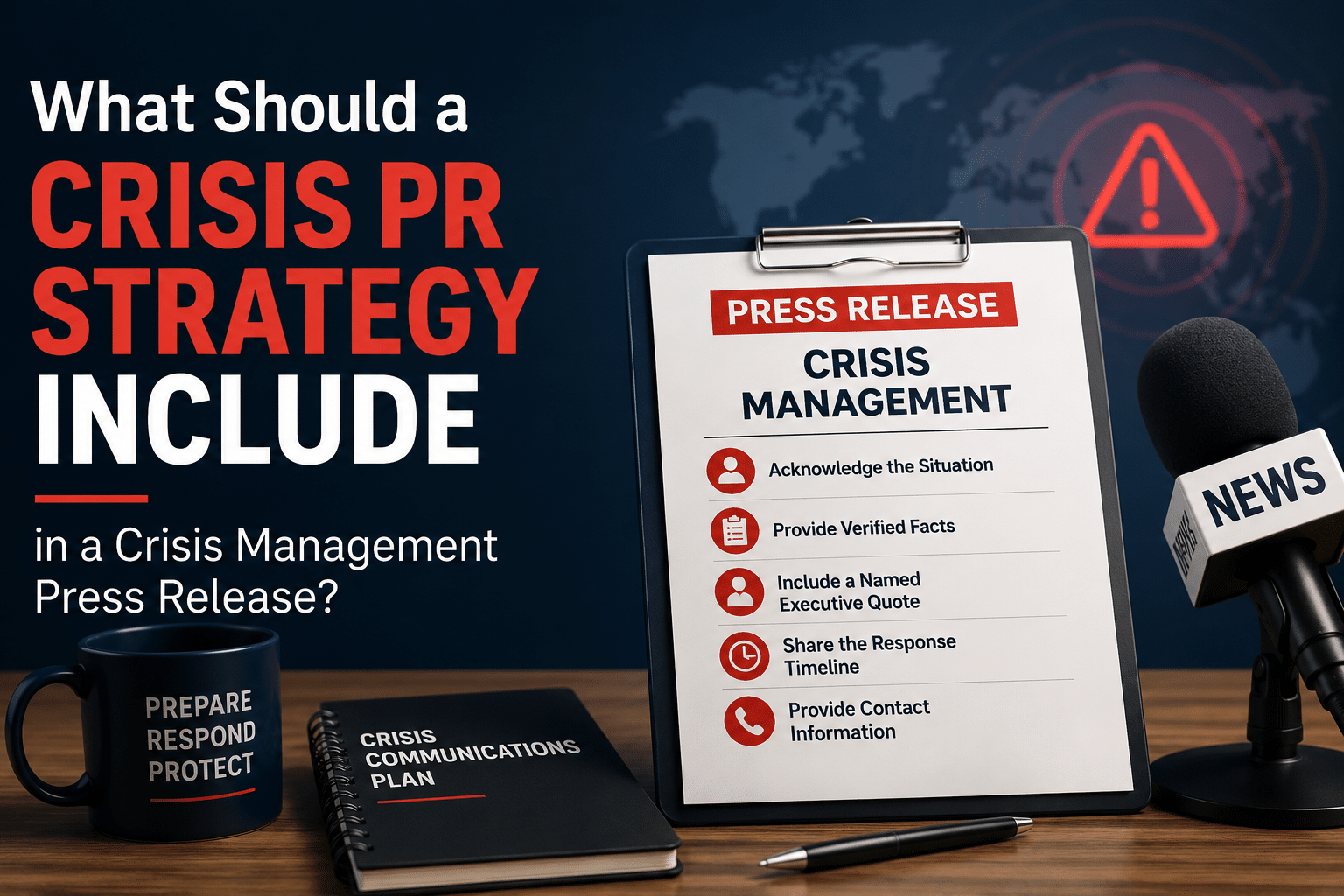
What Belongs in a Crisis Management Press Release
The Acknowledgement Line
The first sentence of any brand crisis statements must acknowledge the situation by name. Not “we are aware of recent reports” name the event specifically and confirm the organisation is responding.
Editors and audiences look for signs of evasion in opening lines. If the first sentence hedges, the statement loses credibility before readers reach the second sentence. This is precisely the role a press release plays during a crisis — establishing that leadership is present and speaking, not hiding.
Verified Facts — And Only Verified Facts
The body of your crisis announcement writing must contain only what is confirmed. Every fact that later turns out to be incorrect adds a correction cycle to the crisis and extends the reputational triage period.
If you have not yet established the full picture, say so directly. “The full scope is under investigation. We will provide an update within 24 hours” is more credible than unverified specifics that need retracting.
A Named Executive Quote
Every effective crisis PR strategy places a named executive at the front of the statement. Not “a company spokesperson” a named CEO or board member with full title. This signals strong governance. Investors and journalists assess whether leadership is visible and accountable.
The Response Timeline
What has already happened? What’s going on right now? Is it going to happen tomorrow or in the coming 24-72 hours? A sound crisis PR messaging strategy takes into account all three questions and not just the first one. Investors need operational stability confirmed. Customers need to know whether the situation affects them.
A Clear Stakeholder Contact Point
Every crisis press release should close with a genuine invitation for affected parties to make contact with a named media spokesperson with direct contact details, and a customer channel if the event involves product or service impact. Organisations with a pre-built stakeholder notification sequence include these without friction. Those improvising often omit them entirely.
Building each of these five elements into a template before a crisis hits is what separates a controlled response from a scramble — it is also exactly what a pre-approved core structure of a crisis management press release is designed to lock in ahead of time.
What Does Not Belong in a Crisis Press Release
- Unverified speculation: Any claim about cause, scale, or impact not independently confirmed should be removed. If it later changes, every correction extends the crisis timeline.
- Promotional language: Crisis press release is definitely not the right place to tell about the achievements or values of your organization. It will simply get edited out.
- Legal disclaimers replacing transparency: Standard legal language belongs at the end. When it replaces the acknowledgement or response sections, it signals that lawyers wrote the statement. Audiences notice.
- Unattributed quotes: Any quote not cited fully by name and title should either get attributed or deleted. Uncited quote has no accountability and journalists are unlikely to use it in their article.
- Guesses about resolution timelines: Promising resolution “by Friday” and missing that deadline creates a second failure cycle. If the timeline is uncertain, communicate that it is uncertain.
How King Newswire Supports Crisis Announcement Writing
Pre-Distribution Editorial Review
Every crisis statement submitted to King Newswire passes through editorial review before reaching any outlet. The team checks acknowledgement clarity, verified facts, named attribution, and response timeline completeness. Submissions missing key structural elements receive specific feedback before entering the distribution pipeline an independent quality check at the point of maximum pressure. Businesses that would rather have this built by a professional team can use King Newswire’s professional press release writing and distribution service instead of drafting under pressure.
Verified Distribution Within Hours
Once a statement clears review, King Newswire’s network places it across financial media, mainstream news platforms, and trade publications simultaneously. A statement that reaches Bloomberg and Yahoo Finance within three hours gives you far more narrative control than one posted only in your company newsroom. No follow-up communication can fully recover that lost advantage.
Follow-Up Statement Distribution
Effective PR crisis messaging rarely resolves in a single release. As the investigation progresses and corrective actions are taken, King Newswire supports the full sequence of follow-up communications ensuring each statement in the crisis communications plan reaches the same verified outlets as the original. Teams that have not yet mapped their escalation path can review how to prevent a PR crisis from escalating for the sequencing that keeps a single incident from turning into a prolonged story.
Compare word counts, outlet lists, and turnaround times on the crisis distribution plans and pricing page before you need them, not while a statement is already late.
Conclusion
A crisis press release that includes the right elements and excludes the wrong ones earns credibility rather than losing it. The discipline required verified facts, named accountability, clear response timeline, genuine stakeholder contact is the same discipline that a well-prepared crisis PR strategy builds in advance. Good PR crisis messaging is never improvised the day it is needed. If your team has not yet reviewed what a crisis management press release should include line by line, that is the natural next step before finalising your own template. King Newswire provides the editorial review and verified distribution reach to make that discipline visible to the audiences that matter most, at the moment when it matters most, and every well-structured crisis management press release we distribute is built on this same framework.
This structure mirrors established practice in crisis communication theory more broadly: acknowledge quickly, communicate only what is verified, and keep a single accountable voice at the centre of the response.
About the Author
Written by the King Newswire Editorial Team, with expertise in crisis and corporate communications and experience supporting announcements distributed across a verified network of 1,000+ media outlets, including Yahoo Finance, Bloomberg, AP News, Business Insider, and MarketWatch.
The team’s editorial standards are shaped by direct submission review work across thousands of press releases, and every claim in this guide reflects patterns observed in that review process rather than general advice. Questions about a specific crisis scenario can be directed to King Newswire’s editorial desk via King Newswire’s press release distribution services page.
Frequently Asked Questions
1. How long should a crisis press release be?
Between 400 and 600 words. Your statement should be long enough to cover the issue, action taken by your organization, and contact information. At the same time, your statement shouldn’t be too long to allow for its complete reading.
2. Should we add the whole investigation results in the first press release?
No. The first release acknowledges the situation and outlines immediate response steps. Investigation findings belong in a follow-up statement once they are verified.
3. What is a crisis holding statement?
A pre-written, pre-approved press release that could be issued at the outset of a crisis within an hour after the onset of the crisis.
4. Does King Newswire recommend issuing a press release for Level One crises?
Not always. A prepared crisis holding statement may be sufficient for a contained incident. King Newswire’s editorial team can advise on whether a full distribution is warranted based on the situation.
5. What happens if a fact in the original release turns out to be incorrect?
Issue a correction statement immediately with the accurate information. King Newswire can distribute correction updates through the same verified network as the original release.
6. Should social media posts accompany the press release?
Yes. Social media and wire distribution serve different audiences and should be coordinated — the press release reaches media and investors, while social posts reach existing followers. Both should go out simultaneously. Ready to put a plan in place before you need one? Explore King Newswire’s distribution plans and get a holding statement pre-approved today.