
What Mistakes Should Businesses Avoid in a Crisis Management Press Release?

What Mistakes Should Businesses Avoid in a Crisis Management Press Release?
Last Updated: July 2026 | Reviewed by King Newswire Editorial Team
A poorly crafted crisis management press release will not only fail to fix the problem but aggravates it. Bad tone, slow reaction time, or even one bad, unverified claim can turn a small crisis into a long-running reputation issue.
King Newswire distributes crisis press releases to over 1,000 verified news organizations including Yahoo Finance, Bloomberg, AP News, Business Insider, and MarketWatch. The crisis communication errors that appear most consistently in submissions follow predictable patterns. This guide identifies the most damaging ones.
According to the Weber Shandwick 2026 Reputation Recovery Index, 64% of crisis scenarios where the company lost its reputation had at least one of the following mistakes in communication at the very beginning of the situation.
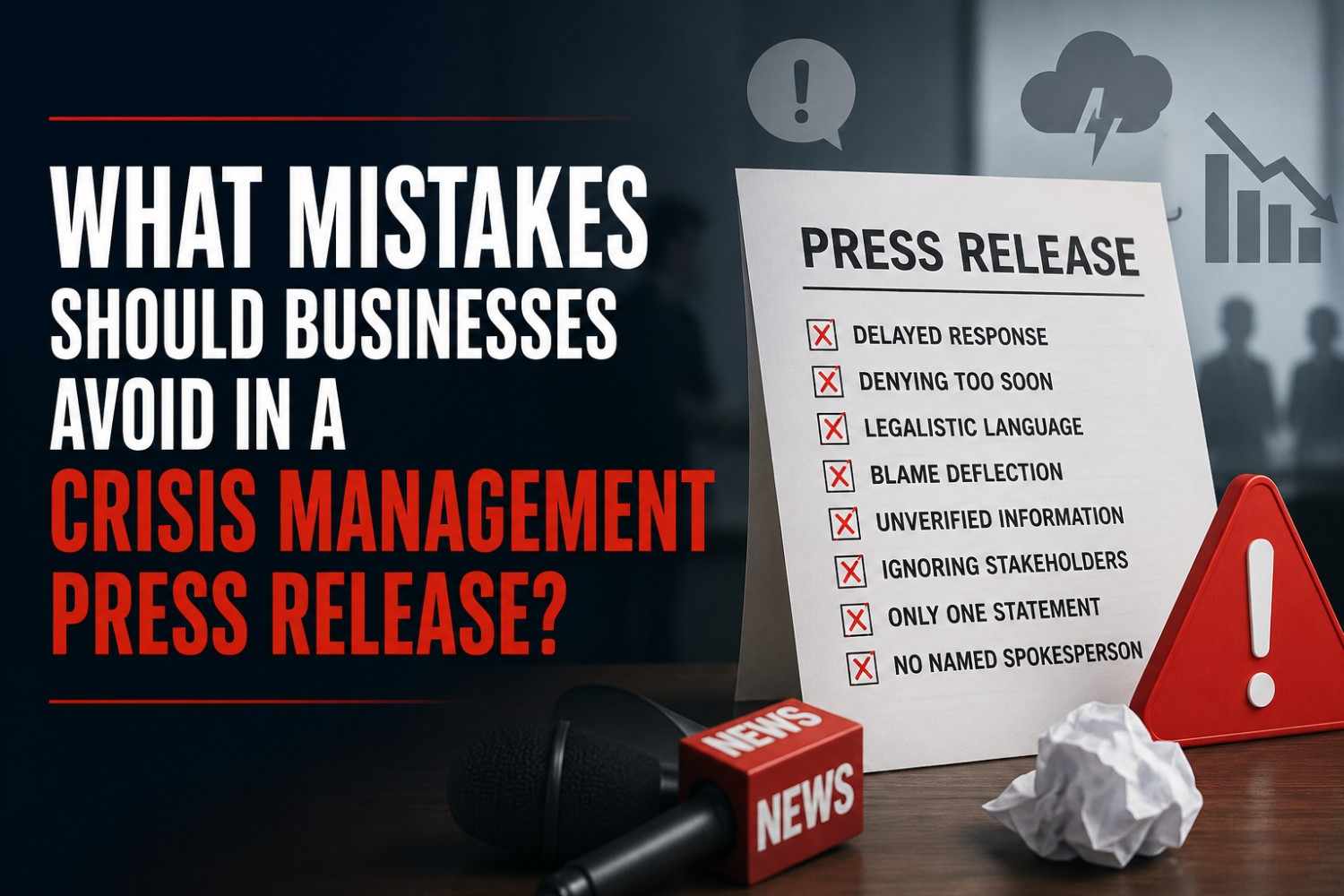
Quick Answer: The most damaging crisis management press release mistakes are delaying the response, denying before investigating, using legalistic language, deflecting blame, sharing unverified details, ignoring internal stakeholders, publishing only one statement, and leaving out a named spokesperson. Fixing these before a crisis hits protects both immediate reputation and long-term trust.
Mistake 1: Delaying Response
Delay is the most common and most costly PR crisis response mistake. Every hour without an official statement is an hour in which journalists and social media fill the information vacuum with their own interpretations.
A crisis management press release does not need to contain every answer to be published. A holding statement confirming awareness and committing to a specific update timeframe is always preferable to silence. King Newswire can review and distribute a holding statement within hours of submission, preventing the silence penalty from the very first news cycle. For a full breakdown of what an effective first statement should look like, see our guide on how to respond before the story writes itself.
Mistake 2: Denying Before Investigating
To deny something before facts are found out is one of the worst crisis management press release mistakes because each further communication will have this credibility problem.
A reputation management press release issued in the first hours should acknowledge the situation and confirm an investigation is underway to assert conclusions that have not yet been established. The correction cycle risk created by a premature denial is always more damaging than the original event itself. This mirrors the logic behind the Situational Crisis Communication Theory, a widely cited academic framework for matching response strategy to reputational risk.
Mistake 3: Overloading Statement With Legal Terms
One of the easiest PR crisis response mistakes to recognise is a press release filled with legalistic language, passive voice, and vague statements, and lacking any concrete admission. Audiences read this as evasion. A reputation management press release written this way signals that the organisation is prioritising legal exposure over the concerns of affected parties. King Newswire’s editorial review addresses defensive framing before any statement reaches a media outlet. This is also part of why press releases remain the fastest way to regain control of a crisis narrative, compared to a scattered mix of social posts and media call-backs.
Mistake 4: Using Blame Deflection Language
Terms such as “outside of our control circumstances” or “in response to the behavior of a third party” indicate deflection and are always recognized as such by journalists. Even when there are external forces involved, stating them first in relation to their effect on those involved sounds self-serving.
An effective press release sample starts with the customers, then states the reasons why it happened, and ends with what was done to fix it. This pattern is as important as the content itself. Understanding the role a press release plays during a crisis makes it easier to keep this sequencing consistent under pressure.
Mistake 5: Sharing Unverifiable Information
Among recurring PR crisis response mistakes, promising a resolution timeline the organisation cannot meet ranks high. Include only confirmed information. If specific figures are not yet available, say so and commit to a specific update timeline. Editors treat honest uncertainty more favourably than confident claims that later require revision. Businesses unsure of the right structure can review everything a crisis statement needs to include before drafting their own.
Mistake 6: Targeting Media but Neglecting Other Stakeholders
One of the most frequent crisis communication errors is issuing a release to wire services while your employees find out about the situation from the media. As a crisis press release example of what not to do, this creates a secondary internal trust failure alongside the original event. The same verified core message must reach employees, partners, and investors simultaneously. Following proven crisis press release best practices ensures employees and investors never learn sensitive news from a headline first.
Mistake 7: Issuing Only One Statement
A single crisis management press release is rarely sufficient. Most reputational events evolve over days. An organisation that goes silent after the first statement appears to have stopped engaging. Each follow-up should report a specific development, a completed investigation, a corrective action, a compensation process opened. King Newswire supports the full distribution sequence from first response through to final update. A consistent follow-up cadence is also one of the most effective ways of stopping a PR crisis from escalating further once the first statement is out.
Mistake 8: Not Including a Named Spokesperson
Crisis management press release mistakes consistently include statements attributed to “a company representative” without a named individual. This removes accountability at the moment when visible accountability matters most. A senior executive, ideally the CEO or most relevant department head must be named and quoted. That attribution signals to journalists and investors that leadership is personally engaged in the response. Getting the tone, structure, and attribution right consistently is easier with the core elements of a solid crisis PR strategy mapped out in advance. Businesses without in-house PR support can also rely on King Newswire’s press release writing and distribution service to draft and format each statement correctly.
How King Newswire Helps Avoid These Errors
King Newswire’s editorial review checks every crisis statement for the errors above before distribution. Defensive framing, unverified claims, and missing attribution are flagged before any outlet receives the release. A verified placement report follows every distribution, confirming exactly which outlets carried the statement. This process is built directly into every crisis management press release King Newswire distributes, from the first holding statement through the final resolution update. Businesses can compare King Newswire’s distribution plans to find the right level of reach for a fast-moving situation, and explore the full range of press release distribution services on the King Newswire homepage.
Conclusion
Crisis management press release mistakes are rarely caused by bad intentions; they are caused by speed, pressure, and the absence of a clear structural framework. Understanding the most damaging patterns before a crisis occurs is the only way to avoid them when one does. King Newswire’s editorial review and verified distribution network exist to support exactly that preparation and execution. Businesses that invest time in crafting a crisis management press release that protects their reputation before a crisis occurs are far better positioned than those improvising in real time. Comparing King Newswire’s press release plans in advance also means there is no delay choosing a distribution package once a statement is ready to go out.
King Newswire Author Note:
Written by the King Newswire PR content team, drawing on editorial experience across hundreds of time-sensitive corporate communications. King Newswire provides organisations from all industries with a validated distribution service reaching more than 1,000 media outlets around the globe. This guide was reviewed by King Newswire’s senior editorial staff for accuracy and updated in 2026 to reflect current crisis communication and press release distribution standards. The review process draws on direct experience editing and distributing crisis statements for clients across finance, technology, healthcare, and consumer industries.
Frequently Asked Questions
1. Why do most organisations wait too long before issuing a statement?
Internal approval chains are too slow for crisis situations. Pre-establishing a rapid sign-off process is the most effective fix.
2. Is a partial statement better than saying nothing at all?
Always. A holding statement with limited facts prevents the silence penalty; silence reads as either guilt or indifference.
3. Can a single poorly worded statement permanently damage a brand?
It extends the crisis window and reduces trust in every statement that follows, but lasting damage usually requires repeated communication failures over time.
4. Does the CEO always need to be the named spokesperson?
Not necessarily. The most credible spokesperson is the most senior executive directly relevant to the crisis which may vary depending on what the incident involves.
5. What is the correction cycle risk?
It is the compounding reputational cost of issuing a statement that later requires public correction, each cycle reducing audience trust in subsequent communications.
6. How does King Newswire catch defensive framing before distribution?
The editorial team reads each submission from a journalist’s perspective, flagging language that appears evasive or legally protective rather than transparent.
7. Does King Newswire distribute crisis follow-up statements?
Yes, the full response sequence from initial holding release to final post-crisis update, distributed to the same verified network each time.
8. How quickly can a crisis statement go live after submission?
Approved statements typically go live within hours of editorial sign-off, including submissions made outside standard business hours.