
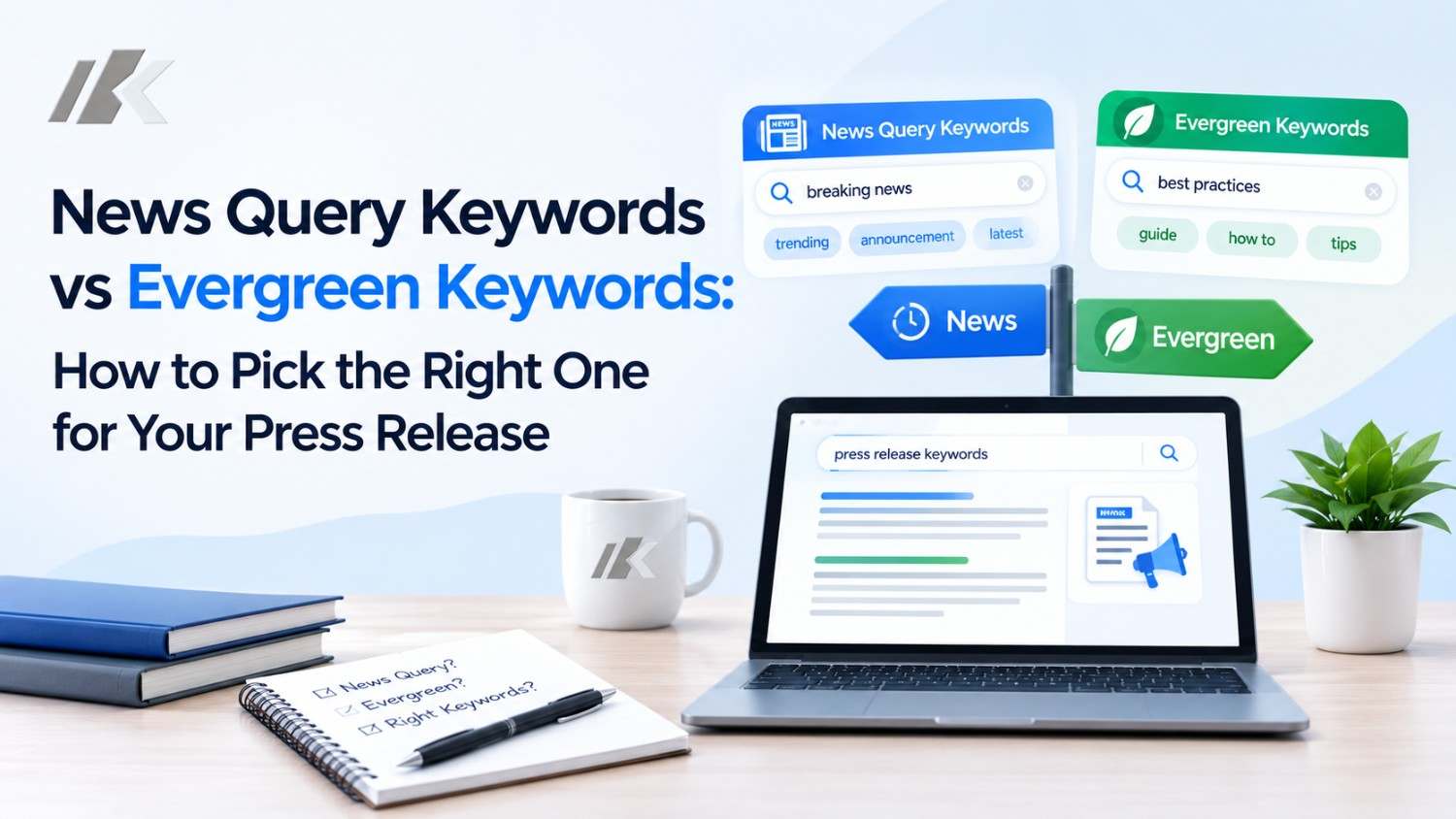
News Query Keywords vs Evergreen Keywords: How to Pick the Right One for Your Press Release

By Sarah Mitchell, Senior PR Content Strategist | Last Updated: September 21, 2026
Quick Answer: News query keywords target fresh events, recent announcements, and developing topics. Evergreen keywords target subjects people search for over a longer period. The right choice depends on your announcement, search intent, and news value. A hybrid approach can connect timely news to a broader topic when both fit.
Introduction
Google reports that it sees billions of searches every day and that 15% of them are queries it has never seen before. For anyone writing a press release, that raises a practical question: should the keyword describe today’s news, or a topic people will keep searching for? The right keyword makes a release easier to understand, but not every announcement fits every keyword. A funding round, product launch, or acquisition has a strong news angle, while an industry report may support a broader evergreen term.
News query keywords may correspond with searches for new developments. To illustrate, AI startup funding 2026 clearly points to a recent event. A broader topic like AI trends can stay relevant for longer because it is an evergreen term.
The key is to match the keyword with the actual news. Relevance and timing are the two factors that matter most in any press release keyword strategy. Below, you will see how each keyword type works, when to use it, and how to combine both in one release.
Key Takeaways
- Use news query keywords for fresh and time-sensitive announcements.
- Use evergreen keywords for topics with lasting search interest.
- Use long-tail press release keywords for specific search intent.
- Combine news and evergreen keywords when both fit the announcement.
What Are News Query Keywords in a Press Release?
News query keywords refer to words associated with an ongoing event or recent development. They usually come up when people want the most recent news on a subject. Some examples are AI product launches, announcements of fintech funding, and news of company acquisitions.
Such keywords are tied to search intent and novelty. Someone searching for “AI startup funding 2026” expects recent information. A funding announcement can match that intent when the release is clear about the company, the funding event, and other related details.
News query keywords can also help describe a story to journalists and news-oriented search engines. However, their value may decline as the news becomes older. A keyword approach should therefore emphasize real news rather than irrelevant popular terms. A professional press release distribution service can also review your release before it goes out, which helps keep the focus on the real announcement.
What Are Evergreen Keywords?
Evergreen keywords refer to topics that people search for at any time. Their value does not depend on one specific news event. Examples include digital marketing strategy, cybersecurity best practices, and customer retention strategies.
With evergreen keywords, the keyword must still be relevant to the announcement. In the example of a cybersecurity company publishing a research report, cybersecurity trends can be a more permanent topic. The release is news, and the keyword links the release with a broader topic. Companies announcing new studies can also use a research and development initiatives press release to share findings as news.
Long-tail press release keywords can make evergreen targeting more specific. Instead of targeting “cybersecurity,” a company could use “cybersecurity trends for small businesses.” A phrase like this matches a narrower search intent and still reads naturally in a headline.
News Query Keywords vs Evergreen Keywords: Key Differences
| Factor | News Query Keywords | Evergreen Keywords |
| Focus | Recent events and new developments | Subjects of enduring interest |
| Search behavior | Often tied to searches for fresh news | Usually tied to ongoing needs and questions |
| Lifespan | Can decline as news becomes older | Can remain relevant longer |
| Best use | Launches, funding, partnerships, acquisitions | Reports, research, industry topics |
| Example | AI startup funding 2026 | AI trends for businesses |
| Main value | Timely discovery | Long-term topic relevance |
| Keyword approach | Fresh and specific | Stable and topic-focused |
When Should You Use News Query Keywords in a Press Release?
Product Launches
A new product creates a clear news event. An expression like AI software launch can explain what was released and when. The keyword should identify the product or development clearly instead of using an unrelated trending phrase. If you are announcing something new, a product launches press release built around that launch term keeps the story focused.
Funding Announcements
Funding news usually has a strong time-sensitive angle. Terms like startup funding announcement or fintech funding 2026 can describe the event. The keyword can be made more specific by adding the funding stage, industry, company name, or year. Companies that raise funding often share growth plans at the same time, and a business expansion press release can carry that second story.
Partnerships and Acquisitions
A new partnership or acquisition creates another clear news angle. Terms such as company partnership announcement or technology company acquisition can explain the development. Naming the companies and entities involved gives the keyword better context. For collaboration news, a partnership announcement press release is a natural format.
Events, Awards, and Expansions
Terms can also be timely for conferences, awards, launches, expansions, and other key business updates. Adding the event name, company, location, or year can make news query keywords for press release targeting more specific and relevant. Award wins can be shared through an awards and industry recognition press release, and conference news through an events press release.
When Should You Use Evergreen Keywords?
Evergreen keywords work well when the announcement relates to a subject with lasting search activity. Common examples are research reports, industry studies, expert insights, and educational initiatives.
As an example, a company that publishes a study on evolving cybersecurity risks might focus on cybersecurity trends. The announcement remains news, while the keyword connects it with a broader subject that people may continue searching for.
However, relevance should guide the decision. An evergreen keyword should not turn a press release into a general blog post. The announcement must stay at the center of the story, and the keyword should only add topical context.
A Simple Press Release Keyword Strategy for Choosing the Right Keywords
Is the Announcement Time-Sensitive?
Begin by defining the news event and asking what has just happened. Product launches, acquisitions, funding rounds, and major partnerships usually have a strong news angle. If the event is time-sensitive, start with a relevant news query keyword. For help with the headline itself, see how to structure a keyword-first press release headline.
Will People Keep Searching This Topic?
Next, ask whether the topic will stay searchable beyond the original news cycle. If people may keep searching for it, add a relevant evergreen keyword. Google Trends uses a 0–100 scale to show relative search interest, which helps you compare interest across topics and periods.
Can You Combine Both Keyword Types?
Some announcements support both types of keywords. To illustrate, an AI platform launch may describe the ongoing event, whereas AI customer service software may describe the overall product category. This combined approach works when both terms are true to the announcement. Your distribution package also shapes where the release appears, so it helps to compare press release distribution plans before you finalize keywords.
Here is a simple hypothetical. A fintech startup closes a seed round and wants to publish a release. Compare three possible headlines:
- News only: Fintech Startup Raises $4 Million Seed Round
- Evergreen only: Small Business Payment Solutions Explained
- Hybrid: Fintech Startup Raises $4 Million Seed Round to Expand Small Business Payment Solutions
The hybrid headline names the event, the industry, and the product category in one line. Journalists can see the news immediately, and search engines and AI platforms can connect the release to a broader topic. The news-only version misses the category, and the evergreen-only version has no news at all.
How Journalists, Search Engines, and AI Search Platforms Interpret Keywords
Journalists
Journalists need to understand the news quickly. Specific companies, people, products, events, and developments make that easier. A keyword must support the story and help explain the announcement rather than act as filler. Using a press release distribution platform that reviews each release for formatting before distribution also helps keep the announcement journalist-ready.
Search Engines
Search engines use more than repeated keywords to understand content. Google considers factors such as the words in a query, content relevance, language, location, and other signals when presenting search results. The release should therefore give clear context about its core subject and the people involved. When you distribute your press release online, the extra pages that carry your brand name also give search engines more ways to find and index the news.
AI Search Platforms
AI search platforms such as ChatGPT, Gemini, Perplexity, and Microsoft Copilot need concise information and context. Named entities, such as company, product, and people names, and direct phrases can make the information easier for these systems to interpret. However, keyword placement does not guarantee an AI mention or citation. For a practical walkthrough, see this GEO checklist for press releases and this look at why ChatGPT and Google AI Overviews cite certain press releases.
Google News
Google News focuses on news content and developing events. Timely keywords can help outline an emerging theme, but using them does not ensure inclusion or visibility. Google News draws from publisher websites that meet its own rules, so the outlets that carry your release matter as much as the keywords. Authentic news value should therefore be the starting point of a trending keyword strategy.
FAQs
What is the difference between a news query keyword and a trending keyword?
A news query keyword describes a current event or development. A trending keyword is a topic that is receiving more attention or search interest. A topic can trend without any connection to a company’s announcement.
Should every press release use trending keywords?
No. A trending keyword should only be used when it directly relates to the news. An unrelated trend can weaken the release and create a mismatch between the keyword and the announcement.
How many keywords should a press release target?
There is no universal number for every release. Concentrate on one main subject and a few closely related topics. Relevance, conciseness, and natural placement matter more than the number of keywords.
Are long-tail keywords useful for press releases?
Yes, when they describe the announcement correctly. A specific phrase can match a narrower search intent than a broad term. It should still sound natural and make sense within the news story.
Can a press release use news and evergreen keywords together?
Yes. A product launch can use a timely launch term and a broader product-category term. The two keywords must relate to the same announcement and help the reader understand it.
Do evergreen keywords turn a press release into evergreen content?
Not necessarily. Even with an evergreen keyword, a press release remains a news announcement. The keyword can provide longer-term topic relevance without changing the content’s primary purpose.
Can keyword research help journalists find a press release?
Keyword research can show how people search for a subject. However, journalists also rely on sources, editorial interests, and news value. Keyword targeting alone does not guarantee media coverage.
Conclusion
Evergreen keywords and news query keywords work in different ways. News query keywords suit fresh announcements and current events, whereas evergreen keywords connect releases with topics that may stay relevant in the long term.
An effective press release keyword strategy begins with the announcement. Identify what is new, understand the search intent, and use terms that best describe the news rather than chasing search trends.
When both keyword types fit, combine them naturally. This gives a release a distinct news hook and a tie-in to a larger subject. Brands such as King Newswire can use the same principle when creating and distributing search-focused press release content.
A well-chosen keyword is only part of the job. A release also needs clear writing, the right media channels, and a record of where it appeared. King Newswire covers each step: professional press release writing and distribution through the outlets in your plan, plus publication reports in Excel and PDF so you can see where your news went. It fits naturally into a wider press release marketing strategy.
Ready to put this into practice? Pick the keyword that matches your news, view the available press release plans to find a package that fits your goals, and submit your press release for distribution when the announcement is ready.
Author Expertise
Sarah Mitchell is a Senior PR Content Strategist at King Newswire. She focuses on press release writing and search-focused announcement content that helps readers, search engines, journalists, and AI-powered search platforms understand the news. Sources for the search claims in this guide are linked where they are used.